4C Coffee Supply Chains for Exporters and Roasters
Published
, 14 minute read
Share this article
Quick summary: Manage 4C coffee supply chains with confidence. Learn traceability, supplier engagement & digital tools to turn compliance into advantage.
Coffee is one of the most traded soft commodities in the world, and almost 80% of it comes from smallholder farmers working plots smaller than five hectares (ICO, 2024). That fragmentation is exactly what makes managing a 4C coffee supply chain so difficult and so valuable. Buyers in Europe, Japan, and North America now want more than a certificate logo on a bag. They want proof: GPS coordinates, payment trails, training records, and a documented improvement plan. This guide walks through how 4C programs actually run on the ground, where they break, and how leading coffee exporters are using digital traceability to make them work.
Managing a 4C coffee supply chain means coordinating verified data, documentation, and improvement plans across farmers, cooperatives, exporters, and roasters. Success comes from combining the 4C standard with a digital traceability backbone that captures farm-level data, links it to every downstream transaction, and produces audit-ready records on demand.
Key Takeaways
4C certification is the entry point not the destination for responsible coffee sourcing. According to the 4C Services 2024 annual report, more than 450,000 farmers are now part of 4C-certified units globally. Real operational value comes from layering traceability technology on top, so exporters can prove provenance, satisfy EU buyers, and turn compliance work into a sourcing advantage.
What Is 4C Coffee?
The 4C Code of Conduct is the most widely adopted entry-level baseline standard in the coffee sector, with more than 450,000 certified farmers across 27 producing countries (4C Services, 2024). It defines the minimum economic, social, and environmental practices a producer must follow to be considered a responsible supplier.
4C was originally launched as the Common Code for the Coffee Community in 2007 by green-coffee buyers, producers, and civil society. It’s now managed independently by 4C Services GmbH. Unlike premium-tier certifications, 4C is structured for continuous improvement farmers don’t have to be perfect on day one, they have to be on a clear, audited path forward.
The standard rests on three pillars: economic viability for the farmer, social conditions including labour and human rights, and environmental management covering soil, water, agrochemicals, and biodiversity. Audits are performed by independent third parties, and units are scored against unacceptable practices that must be eliminated before any certificate is issued.
More than 450,000 coffee farmers are organized into 4C-certified units across 27 origin countries (4C Services, 2024). The standard is designed as a continuous-improvement framework, which is why it has become the default baseline buyers ask for when entering new sourcing relationships.
Discover the key elements of sustainable coffee supply chains and learn how technology and traceability are helping the coffee industry create long-term environmental, social, and economic impact.
Why 4C Certification Matters for Coffee Businesses
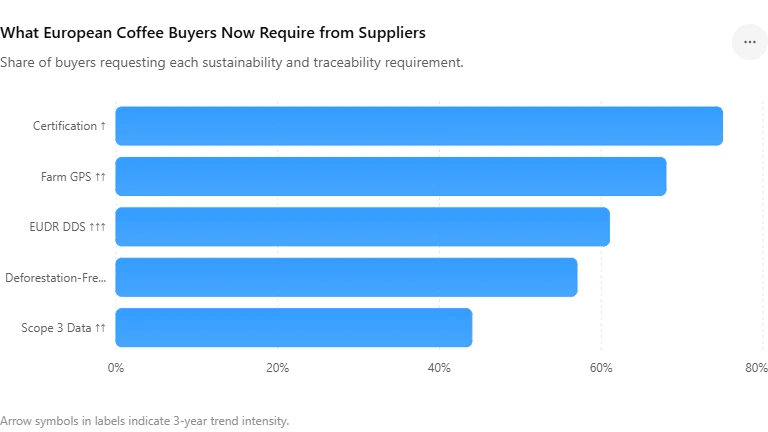
Roughly 75% of European coffee buyers now require at least one sustainability certification from their suppliers, with 4C accepted in nearly every procurement specification (Coffee Barometer, 2023). For exporters and roasters, the certificate isn’t a marketing badge it’s a market access ticket.
Responding to customer and consumer expectations
End consumers are reading the back of the bag. Brands that can’t show a credible sustainability story lose shelf space to ones that can. 4C is the floor that lets your coffee be considered in the first place.
Improving supply chain transparency
Going through certification forces you to map your suppliers, document your transactions, and standardize how data flows from farm to export. That visibility is useful far beyond 4C it underpins EUDR due diligence, Scope 3 carbon reporting, and recall readiness.
Supporting responsible sourcing commitments
Most large F&B brands have public commitments around deforestation, fair pay, and human rights. 4C-certified volume is the auditable evidence those commitments rely on.
Strengthening relationships with buyers
Repeat buyers reward suppliers who reduce their compliance friction. A clean 4C program with digital records means fewer follow-up emails, faster contract renewals, and access to longer-term offtake agreements.
Many exporters treat 4C as a procurement requirement to be cleared once a year. The exporters winning the largest European contracts are flipping that logic they’re using the data they already collect for 4C as the primary input for EUDR Due Diligence Statements, halving their compliance overhead.
Curious whether your current 4C documentation could double as EUDR evidence? Walk through it with the TraceX team book a 20-minute working session
Discover the key EUDR requirements for coffee, understand common compliance challenges, and learn the practical steps needed to build an audit-ready coffee supply chain.
Coffee passes through five to seven hands between the tree and the espresso machine, and the integrity of a 4C claim depends on every one of them keeping clean records. A single missing transaction breaks the chain of custody.
Farmers and producer groups: the data owners. They generate the primary records plot boundaries, inputs, harvest volumes, training attendance.
Cooperatives: the aggregators. They collect cherry or parchment from members, manage payments, and consolidate documentation.
Exporters and traders: the chain-of-custody operators. They blend certified volumes, manage mass balance, and issue the trade documents buyers see.
Roasters and brands: the claim owners. They make the consumer-facing sustainability statements that have to be defensible all the way back to the farm.
Certification bodies: the independent auditors. They sample, verify, and approve or suspend the certificate.
How 4C Coffee Supply Chains Operate
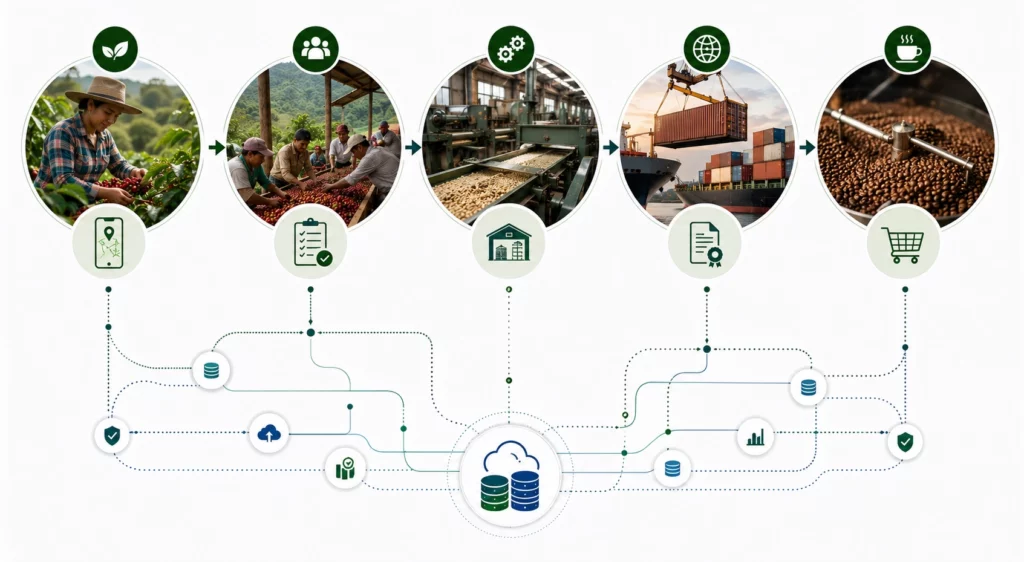
A 4C supply chain looks linear on a diagram, but in practice it’s a web of overlapping data flows. Each handover is a potential point of failure if records aren’t standardized. The five operational stages below map how certified volume actually moves and where documentation needs to live.
Farm-Level Production
Certified farmers manage their plots according to the 4C Code: soil cover, pesticide handling, record-keeping, fair labour. Data captured here geolocation, inputs, yields, training becomes the foundation of every claim made downstream. Without farm-level digital records, everything above it is a guess.
Collection and Aggregation
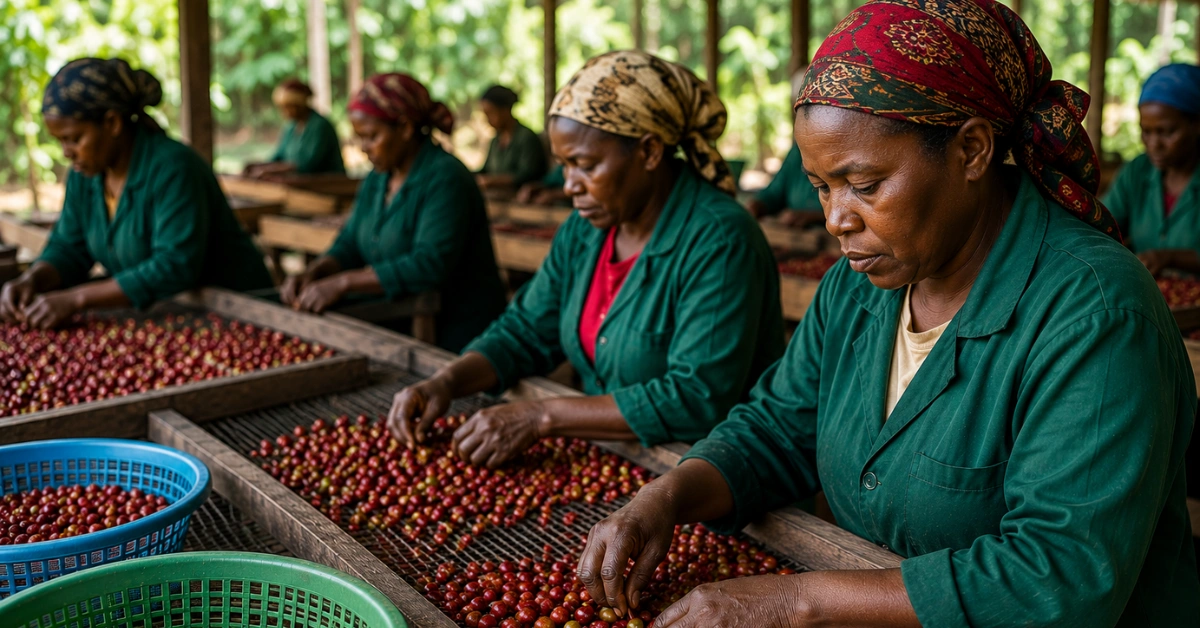
Cherry and parchment flow into cooperative collection points or buying stations. Each delivery has to be logged against a known certified farmer, with weight, quality grade, and payment recorded. This is where most paper-based chains start to leak.
Processing and Storage
Wet mills, dry mills, and warehouses process and consolidate lots. Certified and non-certified volumes must be physically segregated or managed under approved mass-balance rules. Batch identifiers travel with the coffee.
Export and Trading
Exporters handle FOB sales, generate ICO marks, and issue 4C transaction certificates against the volume sold. Buyers in destination markets reconcile these against their own purchase records.
Roasting and Final Consumption
Roasters draw from certified inventory, track sustainable volume in their roasting plans, and report consumer-facing claims. The cleaner the upstream data, the stronger the claim a roaster can defend on a retail shelf or in an investor report.
Benefits of 4C Coffee Supply Chains
Independent assessments of 4C-aligned units have shown measurable improvements in productivity and farmer income compared with non-certified peers (Committee on Sustainability Assessment, 2023). The benefits cluster across three areas.
Improved Environmental Performance
Soil conservation through cover crops, contour planting, and reduced tillage
Water management practices around wet milling and irrigation efficiency
Biodiversity protection by maintaining shade cover and buffer zones
Better Social Practices
Worker welfare including written contracts, fair wages, and safe handling of agrochemicals
Human rights protection with explicit prohibitions on child and forced labour
Community development through farmer training and producer-group capacity building
Enhanced Economic Resilience
Access to premium and specialty markets that require verified sourcing
Capacity building that lifts agronomic productivity and quality grades
Long-term supply relationships with buyers who reward consistent compliance
Challenges in Managing 4C Supply Chains
Certification looks clean on a website. On the ground it’s messy. About 84% of coffee farms globally are smaller than two hectares (World Coffee Research, 2022), which means a single exporter’s supply base can include thousands of independent producers, each with different literacy levels, languages, and connectivity. Five challenges show up over and over.
Smallholder Fragmentation
Coordinating data collection across thousands of small plots is a logistics problem before it’s a tech problem. Field agents need vernacular interfaces, offline capability, and clear escalation paths when farmers can’t be reached.
Data Collection Difficulties
Patchy connectivity, low digital literacy, and seasonal labour mean that paper forms are still common. Paper introduces transcription errors, duplicates, and gaps that surface only at audit time.
Maintaining Consistent Documentation
4C requires evidence of training, internal inspections, and corrective actions. When this lives in spreadsheets across multiple field officers, version control becomes a full-time job.
Traceability Across Multiple Actors
Each transaction between farmer, cooperative, mill, and exporter has to be linkable. A break anywhere in that chain a missing weighbridge slip, an unsigned receipt invalidates the certified claim for that volume.
Supplier Engagement and Training
4C is a continuous-improvement standard, not a one-time audit. Farmers need ongoing training, and exporters need a way to track who attended what, when, and what improved as a result.
The Role of Traceability in 4C Programs
Certification proves a program existed; traceability proves it actually worked. A 2024 IDH report on responsible sourcing found that buyers increasingly treat verifiable traceability as a precondition not a complement to certification claims
Why visibility matters beyond certification
Annual audits sample a fraction of farms and transactions. Traceability gives you continuous visibility into all of them, which is what regulators and buyers now want.
Digital records and chain of custody
Every farm registration, transaction, lot ID, and inspection logged in a single system creates an unbroken digital chain of custody. That same data set then supports EUDR Due Diligence Statements, food-safety recalls, and CSRD reporting.
Improving confidence across the supply chain
When farmers, cooperatives, exporters, and buyers all see the same data, disputes shrink. Payments are faster. Audits are smoother. Renewal conversations focus on growth, not blame.
Buyers increasingly require continuous traceability data alongside certification, not as a substitute for it. This is why coffee exporters with digital traceability infrastructure are winning longer-term contracts and faster contract renewals from European buyers.
Coffee supply chains are quietly becoming one of the most digitized agri sectors, driven by EUDR and buyer pressure. Five technology shifts are reshaping how 4C programs actually run.
Digital farmer onboarding
Mobile-first onboarding workflows capture farmer KYC, plot polygons, and certification status in a single flow replacing paper registrations that used to take weeks.
See How Farm Mapping Brings Transparency to Every Cup of Coffee
Traceability in coffee begins at the farm. By combining farm mapping with digital traceability, organizations can strengthen supplier visibility, improve sustainability reporting, and create greater confidence across the value chain—from growers to consumers.
Explore how a leading initiative leveraged TraceX to map farms and track coffee’s journey from bean to cup, building a more transparent and resilient supply chain.
Field agents collect transactions, training attendance, and inspection findings on smartphones or tablets, syncing when connectivity returns. Offline-first design is non-negotiable in coffee-growing regions.
Geospatial mapping
GPS polygons of each farm are now table stakes for EUDR-aligned coffee. The same polygons support 4C land-use compliance and biodiversity reporting.
Supply chain analytics
Dashboards that aggregate farm, cooperative, and lot-level data turn a documentation exercise into a sourcing intelligence tool flagging risk areas, productivity gaps, and pricing anomalies.
Sustainability reporting platforms
Purpose-built platforms generate audit-ready reports for 4C, Rainforest Alliance, EUDR, and CSRD from the same underlying farm dataset, eliminating duplicate data entry.
How 4C Compares to Other Common Coffee Standards
Standard
Focus
Adoption
Premium
Best for
4C
Baseline ESG
Very high
Low
Market access at scale
Rainforest Alliance
Environment + livelihoods
High
Medium
Branded coffees
Fairtrade
Producer price floor
Medium
High
Cooperative-led volume
Organic
Inputs & soil
Lower
High
Specialty channels
How Coffee Exporters Can Strengthen Their 4C Programs
The exporters running the cleanest 4C programs share four habits. None of them are about the certification itself they’re about the operating system underneath it.
Improve supplier communication: multilingual messaging at planned intervals, not just at harvest. Farmers who feel informed are easier to audit.
Standardize documentation processes: one template for transactions, one for training, one for inspections used everywhere, every time.
Build stronger traceability systems: end-to-end digital chain of custody from plot to FOB, with mass balance tracked at the lot level.
Invest in digital tools and data management: the marginal cost of going from paper to platform pays back inside one audit cycle for most mid-sized exporters.
How TraceX Supports Sustainable Coffee Supply Chains
TraceX’s Sustainable Sourcing Platform is the digital backbone behind 4C-aligned coffee programs. Built for emerging-market supply chains, the platform is offline-first, multilingual, and designed to digitize smallholder data without losing anyone in the process.
Supplier onboarding and engagement: mobile-first farmer registration with geotagged plots, KYC, and certification status captured in one flow.
Traceability across multiple tiers: end-to-end chain of custody from farm to export, with blockchain-backed transaction records.
Centralized data management: one source of truth for farms, transactions, training, inspections, and lots.
Audit-ready documentation: one-click export of audit packs for 4C, Rainforest Alliance, EUDR, and other frameworks.
Sustainability reporting support: the same farm dataset powers Scope 3 carbon, CSRD, and buyer-facing impact reports.
Ready to operationalize your 4C program?
TraceX helps coffee exporters and roasters digitize farmer onboarding, build multi-tier traceability, and generate audit-ready 4C and EUDR documentation from a single platform.
Three forces are converging on the coffee sector: harder regulation (EUDR, CSRD, ESPR), louder consumer expectations, and rapidly improving data infrastructure. The exporters that lead the next decade will be the ones who treat 4C not as a checkbox but as the first layer of a digital sourcing operating system.
Expect to see more buyers asking for raw farm-level data alongside certificates, more carbon-linked contracts that price-in Scope 3 emissions, and more programs where premiums flow back to producers based on verifiable improvement — not on participation alone.
The competitive line in coffee sourcing is moving from “are you certified?” to “can you show me the data behind your certificate within 24 hours?” Exporters who can answer yes are quietly capturing share from those still relying on annual PDFs.
Certification Is Only One Part of Supply Chain Excellence
4C certification provides a strong foundation for responsible coffee sourcing. But long-term success depends on how effectively companies manage supplier relationships, traceability, and operational transparency across the entire coffee value chain. The exporters and roasters winning right now are the ones treating certification as the floor not the ceiling and investing in the digital infrastructure that turns compliance work into a sourcing advantage.
Frequently Asked Questions (FAQ’s)
What is 4C certification in coffee?
4C is the Common Code for the Coffee Community a widely adopted baseline sustainability standard covering economic, social, and environmental practices on coffee farms. It’s managed by 4C Services and audited by independent third parties, and is the most common entry-level certification asked for by green-coffee buyers worldwide.
Who can participate in a 4C-certified supply chain?
Producers (individuals, groups, and cooperatives), processors, exporters, traders, and roasters can all be part of a 4C-certified chain. Producers are audited as 4C Units. Downstream actors handling certified volume must maintain chain-of-custody records and follow approved mass-balance or segregation rules.
What are the benefits of 4C certification?
Benefits include access to international buyers who require sustainability credentials, improved farm productivity through training, better worker conditions, and stronger long-term buyer relationships. According to the Coffee Barometer (2023), around 75% of European buyers ask for at least one certification — making 4C a near-default market access requirement.
How does traceability improve coffee supply chains?
Traceability creates continuous, verifiable records of every transaction, training session, and shipment replacing annual audit snapshots with always-on data. It strengthens 4C claims, supports EUDR Due Diligence, accelerates recalls, and gives buyers the proof they need to commit to longer-term offtake contracts.
Why is digitalization becoming important in coffee sourcing?
Regulations like EUDR and CSRD now require farm-level, geolocated data — something paper systems can’t deliver at scale. Digitalization lets exporters meet these obligations without doubling headcount, while also surfacing sourcing insights that improve quality, productivity, and producer relationships
Start using TraceX
Transparency, Trust, & Success for your Climate Journey.
We use cookies on our website to give you the most relevant experience by remembering your preferences and repeat visits. By clicking “Accept All”, you consent to the use of ALL the cookies. However, you may visit "Cookie Settings" to provide a controlled consent.
This website uses cookies to improve your experience while you navigate through the website. Out of these, the cookies that are categorized as necessary are stored on your browser as they are essential for the working of basic functionalities of the website. We also use third-party cookies that help us analyze and understand how you use this website. These cookies will be stored in your browser only with your consent. You also have the option to opt-out of these cookies. But opting out of some of these cookies may affect your browsing experience.
Necessary cookies are absolutely essential for the website to function properly. These cookies ensure basic functionalities and security features of the website, anonymously.
Cookie
Duration
Description
cookielawinfo-checkbox-analytics
11 months
This cookie is set by GDPR Cookie Consent plugin. The cookie is used to store the user consent for the cookies in the category "Analytics".
cookielawinfo-checkbox-functional
11 months
The cookie is set by GDPR cookie consent to record the user consent for the cookies in the category "Functional".
cookielawinfo-checkbox-necessary
11 months
This cookie is set by GDPR Cookie Consent plugin. The cookies is used to store the user consent for the cookies in the category "Necessary".
cookielawinfo-checkbox-others
11 months
This cookie is set by GDPR Cookie Consent plugin. The cookie is used to store the user consent for the cookies in the category "Other.
cookielawinfo-checkbox-performance
11 months
This cookie is set by GDPR Cookie Consent plugin. The cookie is used to store the user consent for the cookies in the category "Performance".
viewed_cookie_policy
11 months
The cookie is set by the GDPR Cookie Consent plugin and is used to store whether or not user has consented to the use of cookies. It does not store any personal data.
Functional cookies help to perform certain functionalities like sharing the content of the website on social media platforms, collect feedbacks, and other third-party features.
Performance cookies are used to understand and analyze the key performance indexes of the website which helps in delivering a better user experience for the visitors.
Analytical cookies are used to understand how visitors interact with the website. These cookies help provide information on metrics the number of visitors, bounce rate, traffic source, etc.
Advertisement cookies are used to provide visitors with relevant ads and marketing campaigns. These cookies track visitors across websites and collect information to provide customized ads.
Download the 2026 Traceability Scorecard and Benchmark Your Supply Chain Across 10 Critical Capabilities.
Download our eBook
Don’t Wait for an Audit to Find Your EUDR Gaps
The 2026 Simplification Package changes how HS codes, DDS pass-through and geolocation rules apply to you. Get the free guide and 20-point readiness checklist before enforcement catches you unprepared.