Africa Textile Value Chain: The Missing Middle Where the Value Leaks Out
Published
, 9 minute read
Share this article
Quick summary: The Africa textile value chain grows cotton and sews garments but loses the value in between — the missing middle. See why traceability, not just factories, is the fix.
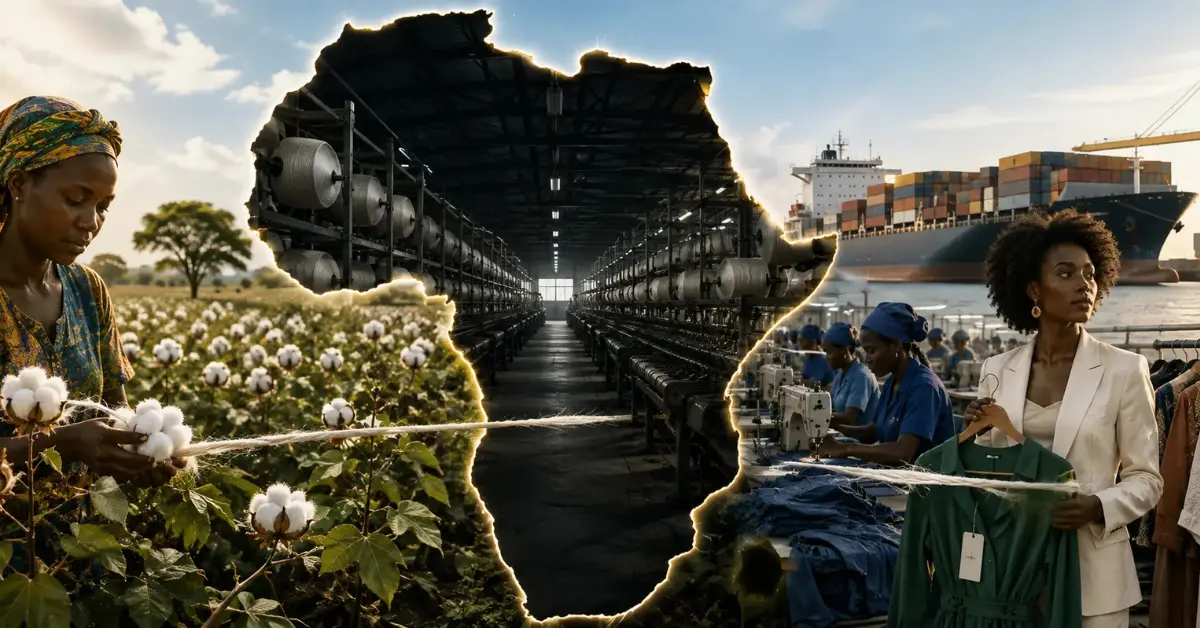
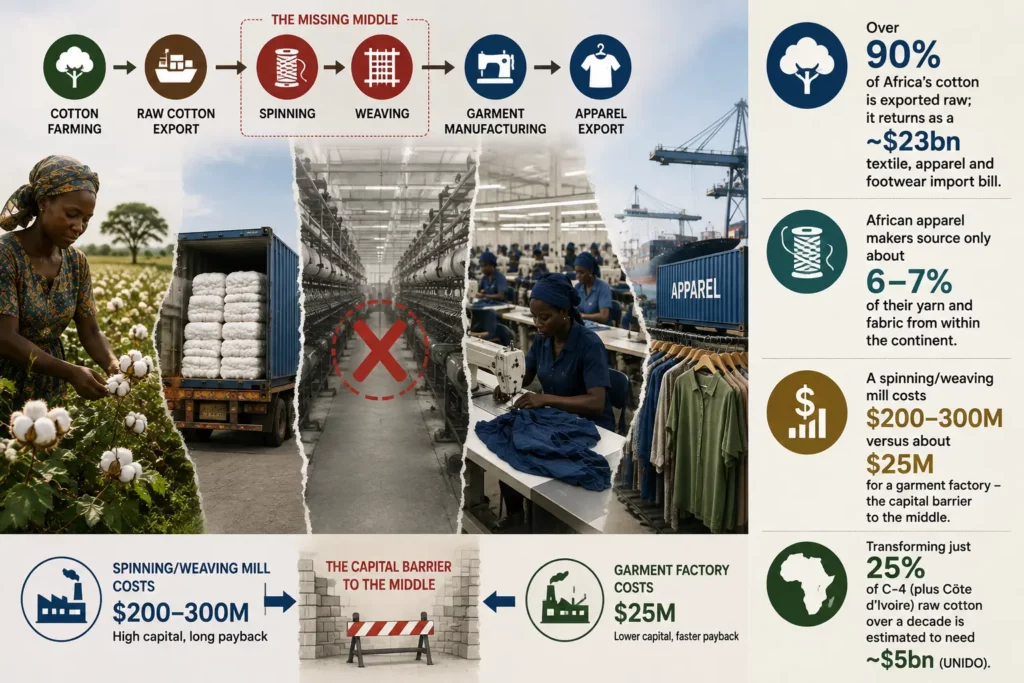
The Africa textile value chain runs from cotton farming and ginning through spinning, weaving, dyeing and finishing, into garment cut-make-trim and export. Africa is strong at both ends it is the world’s third-largest raw-cotton exporter and hosts growing apparel hubs under AGOA but weak in the middle, where most value is added. Over 90% of its cotton is exported raw and returns as finished clothing, driving a textile-and-apparel import bill of around $23 billion. The gap isn’t a lack of cotton or factories; it’s the missing middle of spinning and weaving, and the missing traceability that would let African fibre command a premium and pull that processing back onto the continent.
Key Takeaways
The ends are strong; the middle is missing. Africa grows the cotton and sews the garments, but spinning, weaving and dyeing where value is added mostly happen in Asia.
The value leaks between boll and garment. Over 90% of cotton leaves raw and returns as a ~$23bn import bill; a fibre with no traceable identity is worth only its weight.
Factories alone won’t close the gap. A spinning mill costs 8–12x a garment factory. The faster lever is traceability that lets African cotton earn a provenance premium now.
Regulation is the opening, not the threat. As brands must prove origin, labour and sustainability (DPP, due diligence), traceable African fibre becomes a competitive advantage.
Can you prove where your cotton came from boll to garment?
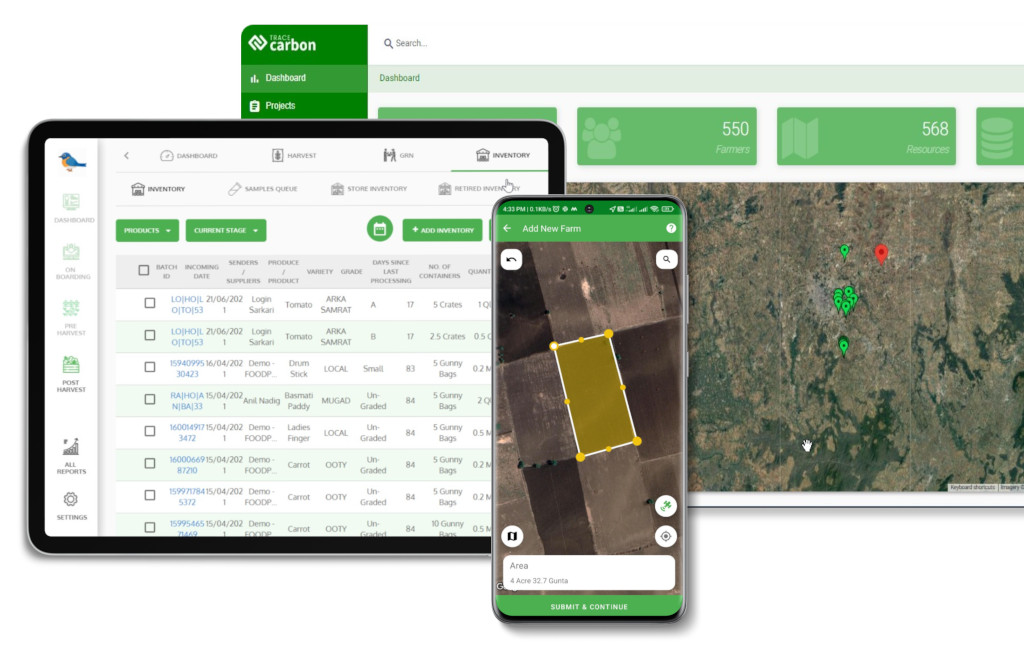
See how TraceX maps cotton plots and tracks chain-of-custody from ginning to garment for DPP-ready, farm-to-fashion transparency.
What the Africa Textile Value Chain Looks Like Today
The Africa textile value chain is the full journey from a cotton boll to a finished garment: farming, ginning, spinning into yarn, weaving or knitting into fabric, dyeing and finishing, then cut-make-trim (CMT) assembly and export. Africa is genuinely strong at the two ends of that chain. It is the world’s third-largest exporter of raw cotton lint, with the C-4 producers Benin, Burkina Faso, Mali and Chad among the most competitive growers anywhere. And under AGOA, apparel hubs in Kenya, Lesotho, Madagascar and Ethiopia assemble garments for export, accounting for the bulk of sub-Saharan apparel sold to the United States.
Between those two ends, though, the chain thins out. The continent has relatively few spinning mills and limited yarn and fabric production, so African apparel makers import the overwhelming majority of their yarn and fabric only a single-digit share is sourced from within Africa itself. The result is a value chain shaped like a barbell: strong at cotton, strong at final assembly, hollow in the middle. And the middle is exactly where the money is.
Understand the Textile Value Chain from Fiber to Finished Product
The Real Problem With the Africa Textile Value Chain: A Missing Middle
The usual diagnosis “Africa’s textile sector is underdeveloped and needs more factories” misses the point. Africa isn’t missing the ends; it’s missing the middle. Over 90% of the continent’s cotton is shipped out raw, only to return as finished clothing behind a textile-and-apparel import bill of roughly $23 billion. The value is added between the boll and the garment in spinning, weaving, dyeing and finishing and almost all of it is captured offshore.
AGOA quietly deepened this. Its third-country fabric rule let garment factories import Asian fabric and still qualify for duty-free access, so investors had every reason to build a $25-million cut-and-sew plant and none to build a $200–300-million spinning or weaving mill. The Africa textile value chain locked itself into CMT assembly, capturing only a sliver of each product’s value. It’s why the continent can be a cotton powerhouse and a net importer of cotton fabric at the same time.
Here is the reframe that matters. You cannot rebuild that middle on capacity alone the capital gap runs to billions. But the deeper reason African cotton travels as an anonymous, low-value commodity is that it carries no traceable identity, so it can only ever be sold by weight. As global brands are now required to prove origin, labour conditions and sustainability through the Digital Product Passport, corporate due diligence and forced-labour rules provenance itself becomes worth money. Traceability is the lever: a verified, traceable African fibre can command a premium and pull processing back onto the continent, because a buyer can finally prove its story. The Africa textile value chain’s next leap is as much about data as it is about machines.
Build End-to-End Traceability Across the Fashion Value Chain
These current dynamics show where value leaks and what recaptures it.
The cotton that leaves raw and comes back dressed
The C-4 nations grow world-class cotton, yet export the vast majority as raw lint to Asia and re-import it as finished garments. With only a single-digit share of yarn and fabric sourced intra-Africa, the continent pays a multi-billion-dollar import bill for products made from its own fibre. What recaptures it: traceable, verified-origin cotton that earns a premium and justifies local processing.
The AGOA assembly trap
Apparel hubs built under AGOA assemble garments from imported Asian fabric, capturing a thin cut-make-trim margin while the high-value spinning and weaving stay offshore. When the trade preference wobbles, the whole model is exposed because nothing durable was built in the middle. What recaptures it: value addition on the continent, supported by rules of origin and traceable regional sourcing.
The mitumba squeeze
In Kenya, second-hand clothing imports and cheap new Asian garments hollowed out the domestic industry cotton output fell sharply and formal textile employment collapsed because there was no integrated, competitive local chain to defend. The value chain was squeezed from both ends at once. What recaptures it: a joined-up, traceable domestic chain that can compete on verified quality and origin, not just price.
The provenance premium
Programmes that register smallholder cotton farmers, map their plots and track fibre from farm to garment are turning African cotton into a documented, sustainable-origin story exactly what Digital Product Passport and due-diligence rules now reward. AfCFTA adds the missing scale, projected to lift intra-African textile trade materially once its apparel provisions apply. What recaptures it: farm-to-fashion traceability that converts compliance into a marketable advantage.
Rebuilding the Africa Textile Value Chain: Traceability as the Lever
If provenance is now worth money, the fastest way to add value to the Africa textile value chain is to make it traceable. A platform built for this should do six things.
Digitally profile farmers and map cotton plots. Register growers and geo-map their fields so every bale starts with a verified origin.
Capture chain-of-custody from ginning to garment. Track fibre through ginning, spinning, weaving and CMT so identity survives every transformation.
Make output Digital Product Passport-ready. Structure origin, composition and processing data to meet ESPR/DPP and due-diligence requirements from brands and regulators.
Prove labour and sustainability performance. Document working conditions and environmental data so buyers can satisfy CSDDD and forced-labour obligations with evidence.
Turn verification into a premium. Use traceable, sustainable origin to command better prices — the commercial case that justifies investing in local processing.
Enable regional, AfCFTA-scale sourcing. Give manufacturers the visibility to source traceable cotton and fabric across borders, not just from Asia.
Africa Textile Value Chain: Where the Value Is Captured
Value-chain stage
Where it happens today
Value captured
Cotton farming
Africa (C-4, East & Southern)
Low — raw commodity price
Ginning
Africa
Low — minimal processing margin
Spinning, weaving, dyeing, finishing
Mostly Asia — the missing middle
High — most value is added here
Cut-make-trim assembly
Africa (AGOA hubs)
Thin — a fraction of product value
Branding & retail
Global North
Highest — margin and the customer
TraceX Sustainable Sourcing Solutions enables end-to-end visibility across the textile value chain, helping brands and manufacturers track every stage of a product’s journey from raw material sourcing to the finished garment. The platform digitizes supplier onboarding, captures material provenance, and records lifecycle events across spinning, weaving, dyeing, garment manufacturing, warehousing, and distribution. By integrating traceability, sustainability, and compliance data into a single platform, TraceX helps businesses verify fiber origins, monitor supplier performance, manage certifications, and maintain complete product records. With support for Digital Product Passports (DPP), batch-level traceability, QR code-enabled product identities, and audit-ready documentation, TraceX empowers textile companies to improve supply chain transparency, meet evolving EU regulations, strengthen ESG reporting, and build more sustainable, resilient, and consumer-trusted fashion value chains.
Turn the Africa textile value chain’s missing middle into your advantage.
TraceX profiles farmers, maps cotton plots, and tracks chain-of-custody from ginning to garment building DPP-ready, farm-to-fashion transparency that turns provenance into a premium.
Africa Textile Value Chain: Traceability Readiness Checklist
Before you can sell provenance, confirm you can prove it.
✓Cotton farmers are digitally profiled and their plots geo-mapped.
✓Chain-of-custody is captured from ginning through spinning, weaving and CMT.
✓Origin, composition and processing data are structured for Digital Product Passport.
✓Labour and sustainability performance are documented with evidence.
✓Traceable, verified origin is positioned to earn a price premium.
✓Regional, AfCFTA-scale sourcing is visible, not just Asian fabric imports.
✓Records support brand due-diligence and forced-labour requirements.
Frequently Asked Questions
Why does Africa export raw cotton and import finished clothes?
Because the middle of the value chain spinning, weaving, dyeing and finishing is largely missing. Trade rules like AGOA’s third-country fabric provision also made it cheaper to assemble garments from imported fabric than to build local mills.
What is the “missing middle” in the Africa textile value chain?
It’s the processing stages between raw cotton and garment assembly spinning yarn, weaving or knitting fabric, dyeing and finishing where most value is added. Africa has few of these facilities, so the value is captured offshore.
Does the EUDR apply to cotton and textiles?
No. Cotton is not one of the seven EUDR commodities. The relevant EU levers for textiles are the Digital Product Passport under ESPR, corporate sustainability due diligence, and the forced-labour regulation.
How does traceability add value to African cotton?
It turns anonymous bulk cotton into a documented, verifiable origin story exactly what Digital Product Passport and due-diligence rules reward so it can command a premium and justify local processing.
Can AfCFTA help build the value chain?
Yes. By lowering intra-African trade barriers, AfCFTA lets cotton grown in one country be spun, woven and stitched in another, and is projected to lift intra-African textile trade significantly as its apparel provisions take effect.
We use cookies on our website to give you the most relevant experience by remembering your preferences and repeat visits. By clicking “Accept All”, you consent to the use of ALL the cookies. However, you may visit "Cookie Settings" to provide a controlled consent.
This website uses cookies to improve your experience while you navigate through the website. Out of these, the cookies that are categorized as necessary are stored on your browser as they are essential for the working of basic functionalities of the website. We also use third-party cookies that help us analyze and understand how you use this website. These cookies will be stored in your browser only with your consent. You also have the option to opt-out of these cookies. But opting out of some of these cookies may affect your browsing experience.
Necessary cookies are absolutely essential for the website to function properly. These cookies ensure basic functionalities and security features of the website, anonymously.
Cookie
Duration
Description
cookielawinfo-checkbox-analytics
11 months
This cookie is set by GDPR Cookie Consent plugin. The cookie is used to store the user consent for the cookies in the category "Analytics".
cookielawinfo-checkbox-functional
11 months
The cookie is set by GDPR cookie consent to record the user consent for the cookies in the category "Functional".
cookielawinfo-checkbox-necessary
11 months
This cookie is set by GDPR Cookie Consent plugin. The cookies is used to store the user consent for the cookies in the category "Necessary".
cookielawinfo-checkbox-others
11 months
This cookie is set by GDPR Cookie Consent plugin. The cookie is used to store the user consent for the cookies in the category "Other.
cookielawinfo-checkbox-performance
11 months
This cookie is set by GDPR Cookie Consent plugin. The cookie is used to store the user consent for the cookies in the category "Performance".
viewed_cookie_policy
11 months
The cookie is set by the GDPR Cookie Consent plugin and is used to store whether or not user has consented to the use of cookies. It does not store any personal data.
Functional cookies help to perform certain functionalities like sharing the content of the website on social media platforms, collect feedbacks, and other third-party features.
Performance cookies are used to understand and analyze the key performance indexes of the website which helps in delivering a better user experience for the visitors.
Analytical cookies are used to understand how visitors interact with the website. These cookies help provide information on metrics the number of visitors, bounce rate, traffic source, etc.
Advertisement cookies are used to provide visitors with relevant ads and marketing campaigns. These cookies track visitors across websites and collect information to provide customized ads.
Download the 2026 Traceability Scorecard and Benchmark Your Supply Chain Across 10 Critical Capabilities.
Download our eBook
Don’t Wait for an Audit to Find Your EUDR Gaps
The 2026 Simplification Package changes how HS codes, DDS pass-through and geolocation rules apply to you. Get the free guide and 20-point readiness checklist before enforcement catches you unprepared.