EUDR Palm Oil Challenges in India: Ground Realities and How to Solve Them
Published
, 8 minute read
Share this article
Quick summary: EUDR palm oil challenges in India, from smallholder data gaps to refinery mixing, plus the real-world fixes that keep your EU market access open.
EUDR palm oil challenges in India stem from a single structural fact: India is one of the world’s largest palm oil importers and processors, not a primary producer so most of the plot-level evidence the EU Deforestation Regulation demands sits upstream, in supplier supply chains India does not control. To keep selling palm oil and derived products into the EU from 30 December 2026 (30 June 2027 for micro and small operators), Indian refiners, processors, and exporters must produce polygon geolocation to the plantation plot, proof of legality, proof of no deforestation after 31 December 2020, and a Due Diligence Statement (DDS) in the EU TRACES system for material they typically buy already blended. That gap between what the regulation wants and what the supply chain can currently prove is the real challenge.
KEY TAKEAWAYS
It’s an evidence gap, not an intent gap: Indian businesses lose EU access because their geolocation and supplier records are incomplet not because their oil is “bad.”
The origin sits upstream: India imports blended CPO from Indonesia and Malaysia, so plot-level data must be pulled back through suppliers and FFB agents.
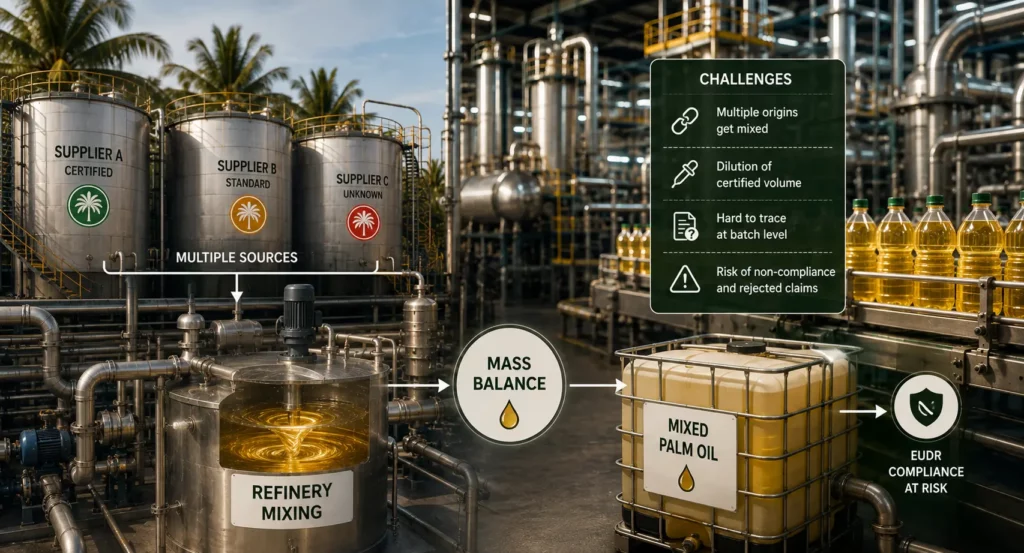
Refinery mixing breaks batches: mass-balance blending of compliant and non-compliant oil makes batch-level chain of custody the hard part.
Certificates don’t equal compliance: RSPO and ISCC support risk mitigation but do not replace geolocation or a DDS filing.
The deadline is firm: 30 December 2026 for large/medium operators; the Commission confirmed there will be no further delay.
December 2026 is approaching. Is your supply chain actually ready?
Move from spreadsheets and fragmented supplier data to a traceable, audit-ready EUDR workflow with TraceX.
Why the EUDR palm oil challenges in India are different
The EUDR palm oil challenges in India are different from those in Indonesia or Malaysia because India’s role in the value chain is different. India imports and processes palm oil at enormous scale on the order of 9 million tonnes a year mostly as crude palm oil that is refined and turned into edible oil, oleochemicals, soaps, and processed foods. Some of that finished output then heads to the EU.
Understanding the EUDR palm oil challenges in India therefore starts with one uncomfortable reality: the deforestation risk the EU cares about happened on a plantation that an Indian refiner never owned, often in another country, sold on by intermediaries who kept informal records. The regulation still holds the operator placing goods on the EU market accountable for proving that plot was deforestation-free after 31 December 2020.
The ground challenges: where India’s palm oil supply chains break
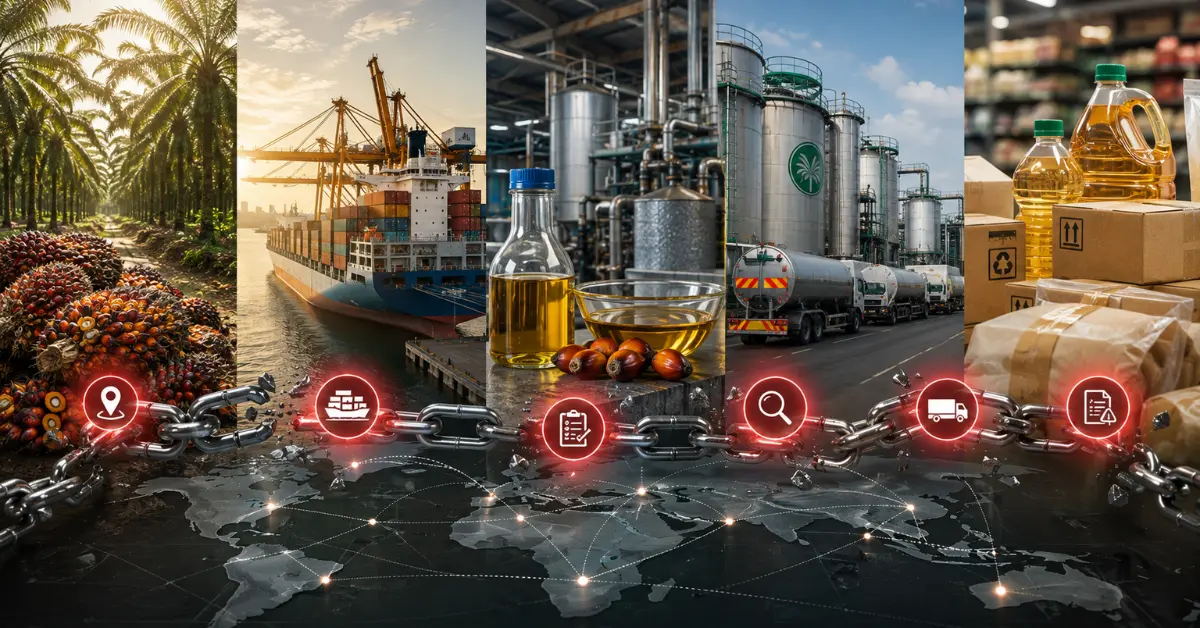
On the ground, the EUDR palm oil challenges in India cluster into six recurring failure points. Each is where a real shipment gets stuck, and each maps to a specific piece of missing evidence.
The list below is the practical anatomy of the EUDR palm oil challenges in India that surface most often in refiner and exporter supply chains.
No plot-level origin data — imported CPO arrives without polygon geolocation to the plantation, and suppliers cannot always provide GeoJSON coordinates for every source plot.
Smallholder and FFB-agent fragmentation — upstream, fresh fruit bunches are aggregated by agents from many small farms, so the link between farm plot and batch is broken before the oil is even shipped.
Refinery mass-balance mixing — compliant and non-compliant oil is blended in tanks and processing, making batch-level segregation and claim tracing genuinely hard.
Derived-product transformation — once palm oil becomes a soap, an oleochemical, or a food ingredient, layers of processing obscure the original plantation origin.
TRACES / DDS readiness — informal supplier records don’t exist in a format TRACES will accept, and the DDS reference-number chain has to be captured and passed correctly under the simplified downstream rules.
Certificate over-reliance — teams assume an RSPO or ISCC certificate is enough, then discover it doesn’t satisfy the geolocation and DDS requirement.
Taken together, this is why the EUDR palm oil challenges in India are as much a data problem as a deforestation problem.
Is your palm oil supply chain ready for EUDR?
Read the blog: EUDR Palm Oil: A Complete Guide to Traceability & Compliance
Real-world example: the Mumbai refiner
A Mumbai palm oil refiner sells refined oil to a European food company. Under EUDR it must prove the exact plantation source of every batch even though it buys from a Malaysian supplier who mixes compliant and non-compliant stock in the same consignment. The refiner has invoices and an RSPO certificate, but no polygon geolocation and no DDS-ready evidence trail. Result: the batch can’t be filed in TRACES, and the European buyer moves the order to a supplier who can produce plot-level data. Nothing was “illegal” the deal was lost on missing evidence.
Using RSPO certification and wondering how it fits into EUDR compliance?
Read the blog: RSPO and EUDR: How Certification Supports Palm Oil Compliance
Certifications help but they are not compliance
One of the most expensive EUDR palm oil challenges in India is mistaking a certificate for a compliance filing. RSPO and ISCC are valuable: they support risk mitigation, supplier engagement, and credibility. But a certificate label does not satisfy the regulation’s demand for dynamic, geospatially-verified data linked to each specific consignment. EUDR is a shift from certificate-based assurance to evidence-based traceability the certificate goes alongside the geolocation and DDS, never instead of them.
Wondering how certifications like FSC, RSPO and other sustainability standards fit into EUDR compliance?
Read the blog: EUDR and Certifications: How Sustainability Certifications Support Compliance
How to solve the EUDR palm oil challenges in India
Solving the EUDR palm oil challenges in India comes down to closing the evidence gap systematically, from the plot up. This is exactly what TraceX EUDR Solutions is built for]:
Map origin to the plot — onboard suppliers and validate polygon GeoJSON geolocation for every source plantation.
Digitise FFB-agent records — formalise the aggregation layer so farm-to-batch links survive.
Screen for deforestation risk — run each plot against the 31 December 2020 cut-off and risk-score suppliers.
Hold batch-level chain of custody — track claims through refining and mixing so a specific consignment can be traced back.
Automate DDS in TRACES — integrate with ERP and TRACES APIs to file audit-ready DDS and capture reference numbers, with a tamper-proof audit trail.
Done once, this turns the EUDR palm oil challenges in India into a repeatable workflow rather than a fire drill per shipment.
In India, EUDR is won or lost on data logistics, not sustainability sentiment. The refiners who keep their EU business are the ones who pushed geolocation and DDS-readiness upstream to their suppliers and FFB agents early, instead of hunting for evidence per consignment. The 30 December 2026 date is not a cliff to fear it’s a deadline to have the plumbing in place. Start with your highest-EU-revenue product lines and work back to the plot.
Book a TraceX demo and we’ll map one of your palm oil product lines from plot to DDS, and show exactly where your evidence gaps are before 30 December 2026
Buyer’s checklist: are you ready to close out the EUDR palm oil challenges in India?
Run your operation through these before 30 December 2026:
Can you produce polygon geolocation to the plantation plot for every EU-bound batch?
Are your FFB-agent and supplier records digitised in a TRACES-acceptable format?
Can you trace a specific refined consignment back through mixing to its source plots?
Can you screen each plot against the 31 December 2020 deforestation cut-off?
Can you file an audit-ready DDS and capture reference numbers automatically?
Frequently Asked Questions
What are the main EUDR palm oil challenges in India?
The biggest EUDR palm oil challenges in India are missing plot-level geolocation for imported oil, smallholder and FFB-agent fragmentation upstream, refinery mixing that breaks batch traceability, and getting supplier data into a TRACES-acceptable DDS format.
Does EUDR apply to India if we only import and re-export palm oil?
Yes. Any business placing regulated palm oil or derived products on the EU market, or exporting them from it, is in scope regardless of headquarters including Indian refiners and processors selling to EU buyers.
When do Indian palm oil businesses have to comply?
Large and medium operators must comply from 30 December 2026; micro and small operators from 30 June 2027. The Commission confirmed there will be no further postponement.
Does an RSPO or ISCC certificate make us EUDR-compliant?
No. These certifications support risk mitigation but do not replace polygon geolocation, legality proof, or a Due Diligence Statement filed in TRACES.
What geolocation data does EUDR require for palm oil?
Polygon (plot-level) geolocation for the plantations where the oil originated, plus evidence of no deforestation after 31 December 2020 and legal production.
Why is refinery mixing such a problem for compliance?
Mass-balance blending combines compliant and non-compliant oil, so proving that a specific consignment traces back only to deforestation-free plots requires batch-level chain of custody, not just supplier certificates.
How can a digital platform help with EUDR palm oil compliance in India?
Platforms from TraceX validate GeoJSON geolocation, digitise agent records, run deforestation risk screening, maintain batch-level custody, and automate DDS filing to TRACES with an audit trail .
Start using TraceX
Transparency, Trust, & Success for your Climate Journey.
We use cookies on our website to give you the most relevant experience by remembering your preferences and repeat visits. By clicking “Accept All”, you consent to the use of ALL the cookies. However, you may visit "Cookie Settings" to provide a controlled consent.
This website uses cookies to improve your experience while you navigate through the website. Out of these, the cookies that are categorized as necessary are stored on your browser as they are essential for the working of basic functionalities of the website. We also use third-party cookies that help us analyze and understand how you use this website. These cookies will be stored in your browser only with your consent. You also have the option to opt-out of these cookies. But opting out of some of these cookies may affect your browsing experience.
Necessary cookies are absolutely essential for the website to function properly. These cookies ensure basic functionalities and security features of the website, anonymously.
Cookie
Duration
Description
cookielawinfo-checkbox-analytics
11 months
This cookie is set by GDPR Cookie Consent plugin. The cookie is used to store the user consent for the cookies in the category "Analytics".
cookielawinfo-checkbox-functional
11 months
The cookie is set by GDPR cookie consent to record the user consent for the cookies in the category "Functional".
cookielawinfo-checkbox-necessary
11 months
This cookie is set by GDPR Cookie Consent plugin. The cookies is used to store the user consent for the cookies in the category "Necessary".
cookielawinfo-checkbox-others
11 months
This cookie is set by GDPR Cookie Consent plugin. The cookie is used to store the user consent for the cookies in the category "Other.
cookielawinfo-checkbox-performance
11 months
This cookie is set by GDPR Cookie Consent plugin. The cookie is used to store the user consent for the cookies in the category "Performance".
viewed_cookie_policy
11 months
The cookie is set by the GDPR Cookie Consent plugin and is used to store whether or not user has consented to the use of cookies. It does not store any personal data.
Functional cookies help to perform certain functionalities like sharing the content of the website on social media platforms, collect feedbacks, and other third-party features.
Performance cookies are used to understand and analyze the key performance indexes of the website which helps in delivering a better user experience for the visitors.
Analytical cookies are used to understand how visitors interact with the website. These cookies help provide information on metrics the number of visitors, bounce rate, traffic source, etc.
Advertisement cookies are used to provide visitors with relevant ads and marketing campaigns. These cookies track visitors across websites and collect information to provide customized ads.
Download the 2026 Traceability Scorecard and Benchmark Your Supply Chain Across 10 Critical Capabilities.
Download our eBook
Don’t Wait for an Audit to Find Your EUDR Gaps
The 2026 Simplification Package changes how HS codes, DDS pass-through and geolocation rules apply to you. Get the free guide and 20-point readiness checklist before enforcement catches you unprepared.