EUDR Timber Compliance: How Forestry, Sawmills & Timber Traders Keep EU Market Access
Published
, 9 minute read
Share this article
Quick summary: Unsure how to achieve EUDR compliance for timber? This blog post outlines key steps, from establishing a Due Diligence System to leveraging technology. Learn how TraceX can simplify compliance and ensure a sustainable future for your business.
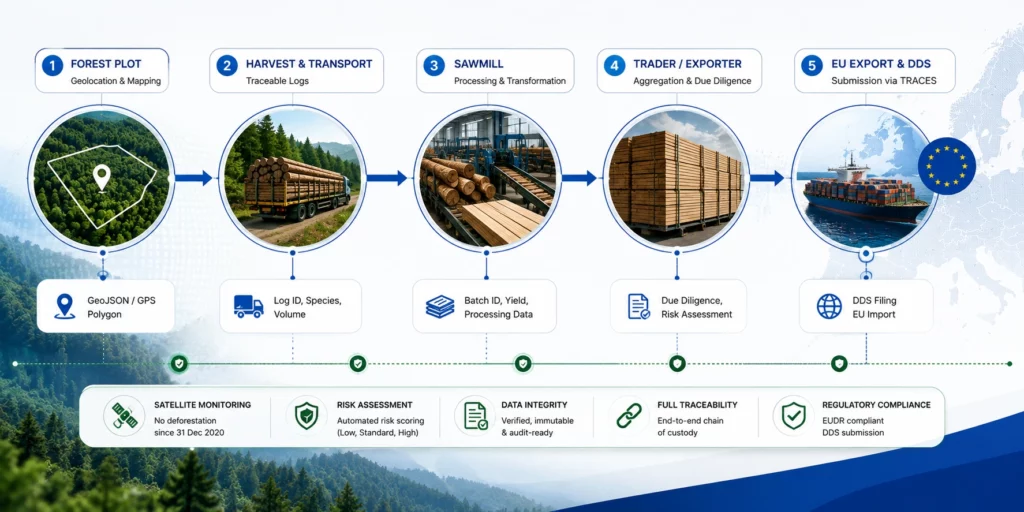
EUDR timber compliance means proving that every wood product placed on or exported from the EU market is deforestation-free (no clearance after 31 December 2020), legally harvested, and traceable to the exact plot of land it came from. For large and medium operators and, importantly, for micro and small operators in the timber sector the obligations apply from 30 December 2026. Compliance rests on three pillars: plot-level geolocation (a single point under 4 hectares, a GeoJSON polygon at or above 4 hectares), a Due Diligence Statement (DDS) filed in the EU Information System, and an unbroken chain of custody from forest to sawmill to export.
Key takeaways for timber operators
If you own forest, trade logs, run a sawmill, or process wood for the EU, here is what matters most right now:
Timber is one of seven EUDR commodities. Wood and wood-derived products sit squarely in scope alongside cattle, cocoa, coffee, oil palm, rubber and soya.
The timber sector loses the SME grace period. Micro and small timber operators must comply from 30 December 2026 the same date as large and medium operators not the June 2027 date that applies to other commodities.
Geolocation is the real bottleneck. Plots of 4 hectares or more need polygon boundaries in GeoJSON (WGS84 / EPSG:4326); a single formatting error can trigger a TRACES rejection.
Certification helps but does not substitute. FSC and PEFC strengthen your risk case, but they do not replace geolocation, the DDS, or plot-level evidence.
The EUTR is being repealed, with transitional rules for products produced before 29 June 2023 running to a long-stop of 31 December 2029.
December 2026 is approaching. Is your supply chain actually ready?
Move from spreadsheets and fragmented supplier data to a traceable, audit-ready EUDR workflow with TraceX.
EUDR timber compliance is a documentation and traceability obligation, not a certificate you buy once. Every consignment must be backed by evidence that stands up to a competent-authority check. In practice that means three things working together:
Deforestation-free proof — satellite-verifiable evidence that the harvest plot was not deforested or degraded after 31 December 2020.
Legality proof — harvest permits, licences, land-tenure and payment records showing the wood was cut in line with the laws of the country of production.
Traceability proof — geolocation of every source plot, tied through the chain of custody to the specific batch you are placing on the market.
For forestry businesses that already lived through the EU Timber Regulation, the legality logic will feel familiar. EUDR timber goes further: it adds mandatory geolocation, a formal DDS for each placement, and a hard deforestation cut-off date. Meeting the EUDR timber standard is less about new paperwork and more about connecting the records you already hold to the exact plot of land and keeping that link intact all the way to export.
EUTR vs EUDR: What Has Changed for Timber Businesses?The EUDR builds on the earlier EUTR framework but introduces significantly broader due diligence and traceability requirements. Understand the key differences, what has changed, and what timber businesses need to prepare for.
Timber traceability starts with the forest polygon
The single most operationally demanding part of EUDR timber compliance is geolocation. The rule is size-based:
Under 4 hectares: a single latitude/longitude point with at least six decimal places is acceptable.
4 hectares or more: a polygon tracing the perimeter of the harvest area, submitted as GeoJSON in the WGS84 (EPSG:4326) projection.
Most managed forest and concession blocks exceed the 4-hectare threshold, so polygons become the default for timber. That is where spreadsheets quietly fail: GeoJSON boundaries are complex, and a malformed polygon is one of the most common reasons a Due Diligence Statement is rejected in the EU Information System (TRACES). Getting timber traceability right at the point of capture in the forest is far cheaper than fixing rejected coordinates weeks before a shipment.
Can You Trace Your Timber Back to the Forest?EUDR compliance starts with knowing exactly where your timber comes from. Learn how end-to-end timber traceability connects forest plots, suppliers, processing, and products to build a transparent, audit-ready supply chain.
Chain of custody: from harvest to sawmill to export
A polygon at the stump is only useful if the link survives every transformation. Timber changes hands and form repeatedly felling, log yard, sawmill, kiln, secondary processing, trader, exporter and each hop is a chance to lose the connection between the wood and its plot of origin. Common failure points along the timber supply chain include:
Mixed-origin batches at the sawmill, where logs from many plots are pooled before milling.
Volume reconciliation gaps, where output timber can no longer be tied back to input harvest records.
Reference-number handoffs breaking as material moves between operators and traders.
The May 2026 simplification package eased part of this by removing the requirement to forward reference numbers down the entire chain, cutting bureaucratic load for downstream actors. But the core obligation is unchanged: the operator placing timber on the EU market must be able to show plot-level origin. A connected traceability system keeps that thread intact so mixed batches, milling yields and export lots all resolve back to a compliant DDS.
Is Your Timber Chain of Custody Ready for EUDR?From forest to final product, every movement matters. Learn how to build a transparent chain of custody, connect timber to its source, and maintain the evidence needed for EUDR due diligence.
We regularly meet forestry teams who assume an FSC or PEFC chain-of-custody certificate makes them EUDR-ready. It does not. Certification is strong evidence for the risk-assessment and risk-mitigation steps, and it will genuinely speed your diligence but it does not replace geolocation, it does not file your DDS, and it does not by itself prove your specific plot was deforestation-free after 31 December 2020. Treat certification as one input into EUDR timber diligence, then build the plot-to-product data layer underneath it.
EUDR timber deadlines and the EUTR transition
Timing is where timber differs most from other commodities. The headline dates:
Who
Obligation applies from
Large & medium operators / traders
30 December 2026
Micro & small operators — timber sector
30 December 2026 (no SME deferral)
Micro & small operators — non-timber
30 June 2027
Deforestation cut-off date
31 December 2020 (all commodities)
EUTR legacy stock long-stop
31 December 2029 (pre-29 June 2023 production)
The European Commission confirmed in its 4 May 2026 simplification package that there will be no third postponement. For timber businesses that had adopted a wait-and-see posture, the second half of 2026 is the implementation window not a planning window. The EU Timber Regulation is repealed as EUDR applies, with a transitional carve-out for products made before 29 June 2023 and placed on the market afterwards, running to 31 December 2029.
EUDR timber compliance: manual vs. a connected platform
The difference between a spreadsheet-based approach and a connected traceability platform shows up fastest at audit and at the TRACES submission screen.
Compliance task
Manual / spreadsheets
Connected platform (TraceX)
Geolocation capture
Coordinates keyed by hand; polygon errors common
Field-app polygon capture with validation
Deforestation screening
Manual satellite look-ups, plot by plot
Automated screening vs. post-2020 forest-loss data
Chain of custody
Breaks at mixed-origin sawmill batches
Plot-to-batch mass-balance tracking
DDS generation
Manual assembly; high rejection risk
Structured DDS output for the EU Information System
Legality documents
Scattered PDFs and email threads
Centralised, plot-linked document vault
Audit readiness
Reconstructed under deadline pressure
Query-ready evidence with 5-year retention
Buyer’s checklist: choosing an EUDR timber solution
If you are evaluating software to run EUDR timber compliance, pressure-test each option against these questions:
Can it capture and validate GeoJSON polygons in the field, including offline in remote forest sites?
Does it screen plots automatically against recognised post-2020 forest-loss datasets?
Can it hold the chain of custody through mixed-origin sawmill batches using mass balance?
Does it generate a DDS in the format the EU Information System (TRACES) expects?
Does it store legality documents linked to the specific plot, with at least five years of retention?
Will it ingest existing FSC/PEFC certificates as risk-mitigation evidence without double entry?
How TraceX supports EUDR timber compliance
TraceX EUDR Solutions is built to carry timber from the forest polygon to a filed DDS without the data breaking in between. For forest owners, timber traders, sawmills and wood processors, it aims to close the gaps that make manual EUDR timber compliance fragile:
Capture at source — polygon and point geolocation collected in the field, with validation before it enters your records.
Screen automatically — plots checked against post-2020 deforestation data so risk is flagged early, not at export.
Hold the chain — mass-balance tracking that keeps mixed sawmill batches tied to their source plots.
File with confidence — structured DDS output aligned to the EU Information System to reduce rejections.
The result timber teams are looking for is simple: keep EU market access, spend less time reconstructing evidence, and turn EUDR timber compliance from a scramble into a repeatable process.
See plot-to-DDS timber traceability on your own supply chain.
Yes. Wood is one of the seven regulated EUDR commodities, alongside cattle, cocoa, coffee, oil palm, rubber and soya. Timber and wood-derived products from logs and sawnwood to furniture and paper placed as a product fall in scope.
When does EUDR timber compliance start?
From 30 December 2026 for large and medium operators. Crucially, micro and small operators in the timber sector share that date; they do not get the 30 June 2027 deferral available to other commodities.
What geolocation does EUDR timber require?
A single coordinate (six decimal places) for plots under 4 hectares, and a GeoJSON polygon in WGS84 / EPSG:4326 for plots of 4 hectares or more. Most forest blocks need polygons.
Does FSC or PEFC certification make me EUDR compliant?
No. Certification supports your risk assessment and mitigation, but it does not replace geolocation, the Due Diligence Statement, or plot-level deforestation evidence.
What is a timber DDS?
A Due Diligence Statement the declaration filed in the EU Information System confirming you have collected the required information, assessed risk, and found no more than negligible risk that the timber is non-compliant.
What happened to the EU Timber Regulation (EUTR)?
The EUTR is repealed as the EUDR applies. A transitional rule keeps it relevant for products produced before 29 June 2023 and placed on the market afterwards, up to a long-stop of 31 December 2029.
What is the deforestation cut-off date for timber?
31 December 2020. Timber harvested from land deforested or degraded after that date is non-compliant, regardless of when it is placed on the EU market.
Start using TraceX
Transparency, Trust, & Success for your Climate Journey.
We use cookies on our website to give you the most relevant experience by remembering your preferences and repeat visits. By clicking “Accept All”, you consent to the use of ALL the cookies. However, you may visit "Cookie Settings" to provide a controlled consent.
This website uses cookies to improve your experience while you navigate through the website. Out of these, the cookies that are categorized as necessary are stored on your browser as they are essential for the working of basic functionalities of the website. We also use third-party cookies that help us analyze and understand how you use this website. These cookies will be stored in your browser only with your consent. You also have the option to opt-out of these cookies. But opting out of some of these cookies may affect your browsing experience.
Necessary cookies are absolutely essential for the website to function properly. These cookies ensure basic functionalities and security features of the website, anonymously.
Cookie
Duration
Description
cookielawinfo-checkbox-analytics
11 months
This cookie is set by GDPR Cookie Consent plugin. The cookie is used to store the user consent for the cookies in the category "Analytics".
cookielawinfo-checkbox-functional
11 months
The cookie is set by GDPR cookie consent to record the user consent for the cookies in the category "Functional".
cookielawinfo-checkbox-necessary
11 months
This cookie is set by GDPR Cookie Consent plugin. The cookies is used to store the user consent for the cookies in the category "Necessary".
cookielawinfo-checkbox-others
11 months
This cookie is set by GDPR Cookie Consent plugin. The cookie is used to store the user consent for the cookies in the category "Other.
cookielawinfo-checkbox-performance
11 months
This cookie is set by GDPR Cookie Consent plugin. The cookie is used to store the user consent for the cookies in the category "Performance".
viewed_cookie_policy
11 months
The cookie is set by the GDPR Cookie Consent plugin and is used to store whether or not user has consented to the use of cookies. It does not store any personal data.
Functional cookies help to perform certain functionalities like sharing the content of the website on social media platforms, collect feedbacks, and other third-party features.
Performance cookies are used to understand and analyze the key performance indexes of the website which helps in delivering a better user experience for the visitors.
Analytical cookies are used to understand how visitors interact with the website. These cookies help provide information on metrics the number of visitors, bounce rate, traffic source, etc.
Advertisement cookies are used to provide visitors with relevant ads and marketing campaigns. These cookies track visitors across websites and collect information to provide customized ads.
Download the 2026 Traceability Scorecard and Benchmark Your Supply Chain Across 10 Critical Capabilities.
Download our eBook
Don’t Wait for an Audit to Find Your EUDR Gaps
The 2026 Simplification Package changes how HS codes, DDS pass-through and geolocation rules apply to you. Get the free guide and 20-point readiness checklist before enforcement catches you unprepared.