Multi-Tier Supply Chain Transparency: Why Most Supplier Maps Break at the Silo
Published
, 7 minute read
Share this article
Quick summary: Multi-tier supply chain transparency that survives an audit: map suppliers to the plot, reconcile blended volumes and meet EUDR rules. See the checklist.
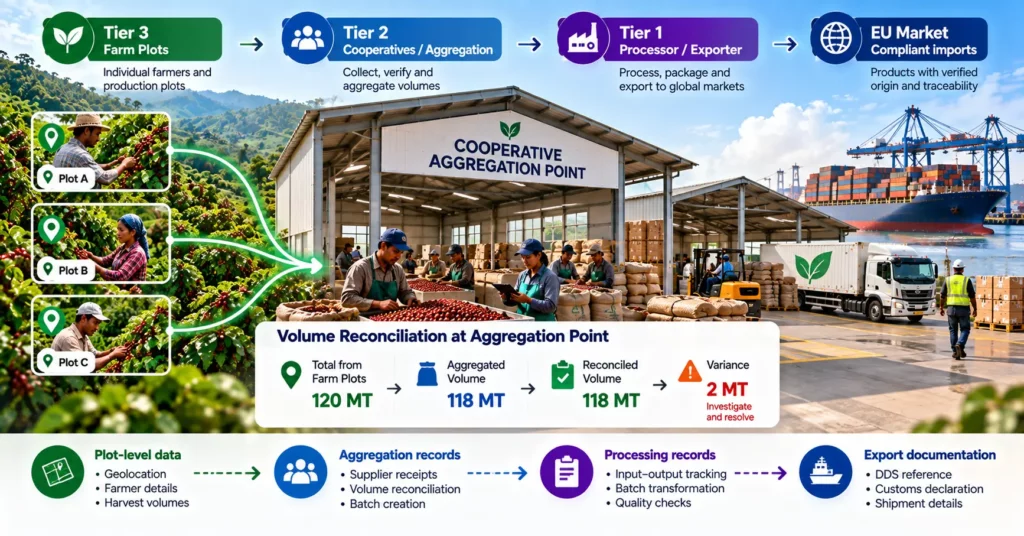
Multi-tier supply chain transparency is verified, auditable visibility into every layer of your supply network, from Tier-1 suppliers down to the farms, mines and plots where raw materials originate. It matters because EUDR and similar rules now demand proof at origin, not supplier declarations. Most programmes do not fail at the farm. They fail at aggregation points, where blended volumes lose their link to the plots they came from.
KEY TAKEAWAYS
Only 15% of CPOs reported visibility beyond Tier 1 in Deloitte’s 2021 Global CPO Survey.
EUDR applies from 30 December 2026 for large and medium operators and requires geolocation for every contributing plot.
The Commission FAQ rules out mass balance chains of custody that mix compliant and unknown-origin commodities.
Cooperatives, mills and collection centres are where traceability breaks, so volumes in must reconcile with volumes out.
A supplier map without volume reconciliation is not multi-tier supply chain transparency; it is a diagram.
See how TraceX can help.
To connect suppliers, sourcing locations, transactions, and multiple supply-chain tiers in one transparent, traceable workflow.
Multi-Tier Supply Chain Transparency: What Regulators Now Expect
Each tier has to produce a different kind of evidence, and regulators check the links between them.
Multi-tier supply chain transparency used to be a sustainability goal. EUDR turned it into a market access condition. From 30 December 2026, large and medium operators must show that each relevant commodity traces to a specific plot of land with no deforestation after 31 December 2020. For plots above 4 hectares, that means a polygon, not a single point.
Tier
Typical actors
Evidence regulators and buyers expect
Tier 1
Direct suppliers, exporters, manufacturers
Contracts, product declarations, certifications, DDS reference numbers where applicable
Tier 2
Processors, mills, cooperatives, aggregators
Batch records, volumes received and dispatched, segregation evidence
The starting point is weak for most companies. In Deloitte’s 2021 Global CPO Survey, only 15% of procurement leaders had visibility beyond their direct suppliers.
Multi-Tier Supply Chain Transparency Gaps That Fail Audits
Three gaps account for most failures, and the second is the one teams underestimate.
Multi-Tier Visibility That Stops at Direct Suppliers
Companies have contracts with Tier 1 and no contractual hold below it. Sub-suppliers hold the origin data, often on paper, and have little reason to share it without a clear request and a simple way to submit.
Multi-Tier Traceability Lost at Aggregation Points
This is where most multi-tier supply chain transparency programmes collapse. Cocoa, soy, palm and rubber pass through cooperatives and mills that pool output from hundreds of farms. Once lots are blended without records, perfect farm data becomes useless at export. The Commission FAQ is explicit: mass balance chains of custody that mix deforestation-free commodities with unknown-origin material do not meet EUDR, and one non-compliant plot in a mixed batch can taint the whole shipment.
Multi-Tier Data in Incompatible Formats
Suppliers submit coordinates as spreadsheets, photos or PDFs. The EU Information System accepts GeoJSON. Every manual conversion is a chance to break a polygon or swap a plot.
Mapping farms is the easy part of multi-tier supply chain transparency. Keeping those farms attached to the product after blending is the hard part.
Understand the key traceability requirements under EUDR, from supplier and product information to production locations, geolocation, DDS references, and supply-chain records needed to demonstrate compliance.
Multi-Tier Supply Chain Transparency Strategies That Hold Up
Four practices separate evidence that survives an audit from data that merely exists.
Multi-Tier Mapping That Starts With Risk
Do not map every tier at once. Start with the commodities and origins carrying the highest regulatory exposure, onboard Tier 1 onto a shared digital record, then use each Tier-1 supplier as the channel to its sub-suppliers.
Register farmers and sites with standard fields, capture polygons in the field, and validate format and overlaps at submission. Data fixed at entry never needs reconstructing later.
Multi-Tier Volumes Reconciled at Every Handover
Build allocation logic into each aggregation step. A cooperative’s dispatched volume should never exceed the plausible harvest of its mapped plots, and each blended lot should stay attributable to its source plots. Flag discrepancies before shipment approval, not after an authority asks.
Multi-Tier Evidence Verified Independently
Check plots against satellite forest-cover data for the post-2020 cut-off. Certifications such as FSC or Rainforest Alliance support risk mitigation, but they do not replace plot-level geolocation or the due diligence statement.
Understand how FSC, PEFC, and other certifications can support your EUDR due diligence process and why certification alone does not replace the EUDR requirements.
Stop measuring multi-tier supply chain transparency by how many suppliers you have mapped. Measure it by how many shipments you can reconcile from plot to port. A map with 5,000 farms and no volume controls fails the first audit question: which of those farms fed this container?
Omnibus I sharpens the point. Companies with 1,000 employees or fewer can decline CSRD data requests that go beyond voluntary standards, so ask suppliers for the origin and volume data regulation requires, not sprawling ESG questionnaires.
Multi-Tier Supply Chain Transparency Software vs Manual Tracking
Spreadsheets can list suppliers; they cannot keep origin attached to product through blending.
Capability
Spreadsheets and email
TraceX platform
Tier mapping
Tier 1 only, updated yearly
Digital mapping from Tier 1 to plot
Origin evidence
Supplier declarations
Polygon capture with satellite checks
Aggregation control
None, or manual tallies
Volume allocation and reconciliation per lot
Data format
Mixed files, manual conversion
GeoJSON-ready outputs
Risk alerts
Found at audit
Flags before shipment approval
ERP connection
Re-keyed by hand
Integration with existing ERP
Manual multi-tier supply chain transparency usually breaks at the first cooperative. Once one aggregator handles hundreds of plots, reconciliation by hand is no longer realistic. For EUDR due diligence statements, TraceX EUDR Solutions prepares the plot and volume data the EU operator files.
Book a multi-tier transparency demo and trace one of your shipments from port back to plot.
Multi-tier supply chain transparency is verified visibility into every layer of your supply network, from direct suppliers to the farms, mines or plots where materials originate, backed by records an auditor can check.
What is the difference between Tier 1, Tier 2 and Tier 3 suppliers?
Tier 1 suppliers sell to you directly. Tier 2 are their suppliers, such as processors and cooperatives. Tier 3 and beyond are raw material origins such as farms, plantations and mines.
Why does EUDR require visibility beyond Tier 1?
EUDR requires geolocation for every plot that produced a relevant commodity, with proof of no deforestation after 31 December 2020. For most agricultural products, those plots sit at Tier 3 or deeper.
Is mass balance accepted under EUDR?
No. The Commission FAQ states that mass balance chains of custody that mix deforestation-free commodities with unknown-origin or non-compliant material do not meet the Regulation.
Are certifications enough to prove origin?
No. FSC, RSPO and Rainforest Alliance support risk mitigation, but they do not replace plot geolocation, the due diligence statement or product-level evidence.
Who is responsible if supplier geolocation data is wrong?
The operator placing the product on the EU market remains responsible for the accuracy of geolocation data, even when a producer or supplier provided it.
Where should we start?
Start multi-tier supply chain transparency with the commodity and origin carrying the most exposure, map that chain to the plot, and add volume reconciliation at every aggregation point before expanding.
Start using TraceX
Transparency, Trust, & Success for your Climate Journey.
We use cookies on our website to give you the most relevant experience by remembering your preferences and repeat visits. By clicking “Accept All”, you consent to the use of ALL the cookies. However, you may visit "Cookie Settings" to provide a controlled consent.
This website uses cookies to improve your experience while you navigate through the website. Out of these, the cookies that are categorized as necessary are stored on your browser as they are essential for the working of basic functionalities of the website. We also use third-party cookies that help us analyze and understand how you use this website. These cookies will be stored in your browser only with your consent. You also have the option to opt-out of these cookies. But opting out of some of these cookies may affect your browsing experience.
Necessary cookies are absolutely essential for the website to function properly. These cookies ensure basic functionalities and security features of the website, anonymously.
Cookie
Duration
Description
cookielawinfo-checkbox-analytics
11 months
This cookie is set by GDPR Cookie Consent plugin. The cookie is used to store the user consent for the cookies in the category "Analytics".
cookielawinfo-checkbox-functional
11 months
The cookie is set by GDPR cookie consent to record the user consent for the cookies in the category "Functional".
cookielawinfo-checkbox-necessary
11 months
This cookie is set by GDPR Cookie Consent plugin. The cookies is used to store the user consent for the cookies in the category "Necessary".
cookielawinfo-checkbox-others
11 months
This cookie is set by GDPR Cookie Consent plugin. The cookie is used to store the user consent for the cookies in the category "Other.
cookielawinfo-checkbox-performance
11 months
This cookie is set by GDPR Cookie Consent plugin. The cookie is used to store the user consent for the cookies in the category "Performance".
viewed_cookie_policy
11 months
The cookie is set by the GDPR Cookie Consent plugin and is used to store whether or not user has consented to the use of cookies. It does not store any personal data.
Functional cookies help to perform certain functionalities like sharing the content of the website on social media platforms, collect feedbacks, and other third-party features.
Performance cookies are used to understand and analyze the key performance indexes of the website which helps in delivering a better user experience for the visitors.
Analytical cookies are used to understand how visitors interact with the website. These cookies help provide information on metrics the number of visitors, bounce rate, traffic source, etc.
Advertisement cookies are used to provide visitors with relevant ads and marketing campaigns. These cookies track visitors across websites and collect information to provide customized ads.
Download the 2026 Traceability Scorecard and Benchmark Your Supply Chain Across 10 Critical Capabilities.
Download our eBook
Don’t Wait for an Audit to Find Your EUDR Gaps
The 2026 Simplification Package changes how HS codes, DDS pass-through and geolocation rules apply to you. Get the free guide and 20-point readiness checklist before enforcement catches you unprepared.