Organic Farming for Sustainable Agriculture: The Practices that Build Resilient Farms
Published
, 7 minute read
Share this article
Quick summary: Organic farming for sustainable agriculture explained: core practices, benefits, certification, and how traceability proves every organic claim.
Organic farming for sustainable agriculture is a production system that grows food without synthetic pesticides or fertilizers, using soil-building practices crop rotation, cover cropping, composting, and biological pest control to keep land productive for the long term. It reduces chemical runoff, rebuilds soil carbon, protects biodiversity, and produces verifiable, residue-free food. Its commercial value now depends on proof: certification bodies, EU buyers, and consumers increasingly require traceable, farm-level records that show each organic claim is real.
Organic farming for sustainable agriculture is the practice of producing food in a way that keeps the land productive indefinitely without the synthetic pesticides and fertilizers that degrade soil, pollute water, and strip out biodiversity. Conventional systems have leaned hard on chemical inputs for decades, and the bill is now visible in eroded topsoil, dead zones downstream, and declining pollinator populations. For growers, brands, and compliance teams, the question is no longer whether organic matters, but how to run it profitably and prove it credibly.
In plain terms, organic farming for sustainable agriculture means that instead of buying a solution in a bag, the farmer builds it into the ecosystem feeding the soil, encouraging beneficial insects, and rotating crops so pests and disease never get a foothold. Done well, it delivers yields comparable to conventional farming while cutting input costs and environmental harm. Done without records, it delivers none of the market premium, because buyers cannot tell a genuinely organic crop from a claim.
Key takeaways
Organic farming for sustainable agriculture rests on five practices: soil, pest, weed, nutrient, and crop-rotation management each replacing a synthetic input with a biological one.
The measurable payoff is healthier soil, cleaner water, greater biodiversity, and premium, residue-free produce.
The hardest part is no longer growing organically it is proving it. Certification, EU market access, and consumer trust all hinge on farm-level records.
Digital farm management and traceability turn day-to-day organic practices into audit-ready evidence, shortening certification and unlocking price premiums.
Organic Farming Practices That Make Agriculture Sustainable
Sustainable organic systems are built from five interlocking practices. Each one swaps a synthetic shortcut for a biological process that pays off over time:
Soil management: Crop rotation, cover crops, and composting rebuild soil structure, lift nutrient content, hold moisture, and feed the microbes that make land fertile.
Pest and disease management: Rotation, intercropping, resistant varieties, physical barriers, and biological controls such as beneficial insects hold pests in check without synthetic sprays an integrated approach to non-pesticidal management.
Weed and nutrient management: Mulching, hand weeding, flame weeding, and proper spacing suppress weeds, while compost, manure, and green-manure cover crops keep plant nutrients balanced and replenished naturally.
Crop rotation and diversification: Alternating crops on the same plot breaks pest and disease cycles, spreads risk, and strengthens the whole system.
The Benefits of Organic Farming for Sustainable Agriculture
The reason organic farming for sustainable agriculture keeps gaining ground is that its benefits compound. Eliminating toxic chemicals minimizes soil erosion, protects water quality, and cuts pollution. Soil that is fed rather than forced holds more carbon and more water, making farms more resilient to drought and heavy rain alike. Crops grown in living soil often carry higher nutritional value, animal welfare improves, and the price premium on certified organic produce strengthens the regional economy.
There is a climate dimension too. Well-managed organic soils act as a carbon sink rather than a source building organic matter draws CO2 out of the atmosphere and locks it underground. This is where organic farming for sustainable agriculture stops being a cost center and starts becoming a measurable ESG and market advantage, provided the outcomes can be evidenced.
Organic systems can sequester up to [~2,000 lbs of carbon per acre per year — ≈ 7,000 lbs CO2] under composted-manure rotations, per Rodale’s Compost Utilization Trial.
Organic vs. Conventional Farming: How the Approaches Compare
The choice between organic and conventional farming is a trade-off between nature-centric resilience and short-term, input-driven yield. This side-by-side view shows where each approach lands on the factors buyers and auditors care about most:
Factor
Organic farming
Conventional farming
Inputs
Compost, manure, biological controls
Synthetic fertilizers and pesticides
Soil health
Built up over time
Depleted without amendment
Short-term yield
Comparable, sometimes lower
Often higher
Chemical residue
None to minimal
Possible in food and water
Market premium
Higher (if certified & proven)
Standard commodity pricing
Proof burden
High — records required
Lower
The last row is the one most growers underestimate. Organic carries a higher proof burden: the premium and the certification only materialize when practices are documented. That is a data problem before it is a farming problem.
Organic Certification and the Proof Problem in Sustainable Agriculture
An organic certification is what lets a farm charge an organic price and sell into demanding markets. Accredited bodies verify that inputs, pest control, animal welfare, and soil management meet defined standards and they require frequent inspections and thorough records to keep it. International frameworks from IFOAM and the Codex Alimentarius Commission harmonize these rules across borders so organic goods can trade globally, while Regenerative Organic Certification raises the bar further on soil, animal welfare, and social fairness.
Every one of those standards assumes one thing about organic farming for sustainable agriculture: that the farm can produce evidence on demand. Missing or paper-based records are the single most common reason organic claims fail an audit or stall at a border.
Overcoming the Challenges of Organic Farming for Sustainable Agriculture
Four hurdles come up repeatedly, and each has a practical route through it:
Transition period: Moving from conventional to organic takes time; training, mentorship, and financial incentives ease the shift.
Pest and disease pressure: Integrated Pest Management rotation, companion planting, biological controls manages threats without synthetic chemicals.
Access to organic inputs: Building local supply chains for compost, manure, and organic seed reduces cost and scarcity.
Marketing and traceability: Fair premiums and market access improve when the organic story is documented and verifiable end to end.
How Digital Traceability Proves Organic Farming for Sustainable Agriculture
This is where farm management software earns its place. The pain is real: organic practices generate value only when they can be proven, and manual records rarely survive an audit or satisfy an EU buyer. The capability that answers it is farm-level digital record-keeping every input, rotation, and treatment logged as it happens, tied to a specific plot and date.
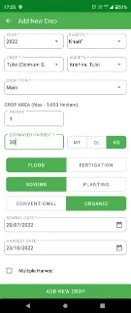
TraceX’s farm management platform records and monitors organic practices in real time, tracks approved inputs, and produces transparent, tamper-proof documentation that certification bodies can verify directly.
Prove your organic practices
See how TraceX turns everyday organic farming into audit-ready, certification-grade evidence.
The proof point: a foundation used TraceX to track organic crop production from seed sourcing to final harvest, giving consumers verified access to authentically organic products and backing every claim with transparent records.
Buyer’s Checklist: Evaluating Tools for Organic Farming for Sustainable Agriculture
If you are choosing a platform to support organic operations, confirm it can:
Log inputs, treatments, and rotations at the plot level, in real time
Map to your certification standard (organic, ROC, IFOAM, regional)
Produce audit-ready, tamper-proof records on demand
Capture geolocation and support EU market-access requirements
Give buyers and consumers a transparent farm-to-table record
Frequently Asked Questions
What are the main principles of organic farming for sustainable agriculture?
It works with nature rather than against it: no synthetic pesticides or fertilizers, plus soil health, biodiversity, crop rotation, and natural pest control to keep a balanced, resilient system.
How does organic farming contribute to sustainable agriculture?
By cutting chemical use it reduces soil and water pollution; practices like cover cropping and composting rebuild fertility, support biodiversity, and lower the carbon footprint of food production.
What are the benefits of choosing organic products over conventional ones?
Reduced exposure to synthetic residues, healthier soil and biodiversity, often higher nutritional value, and support for local economies through fair organic premiums — when the produce is genuinely certified and traceable.
How do farmers prove organic farming for sustainable agriculture to certifiers?
With farm-level records: inputs, treatments, rotations, and harvests logged against each plot and date, kept in an audit-ready, tamper-proof form that certification bodies can verify directly.
Start using TraceX
Transparency, Trust, & Success for your Climate Journey.
We use cookies on our website to give you the most relevant experience by remembering your preferences and repeat visits. By clicking “Accept All”, you consent to the use of ALL the cookies. However, you may visit "Cookie Settings" to provide a controlled consent.
This website uses cookies to improve your experience while you navigate through the website. Out of these, the cookies that are categorized as necessary are stored on your browser as they are essential for the working of basic functionalities of the website. We also use third-party cookies that help us analyze and understand how you use this website. These cookies will be stored in your browser only with your consent. You also have the option to opt-out of these cookies. But opting out of some of these cookies may affect your browsing experience.
Necessary cookies are absolutely essential for the website to function properly. These cookies ensure basic functionalities and security features of the website, anonymously.
Cookie
Duration
Description
cookielawinfo-checkbox-analytics
11 months
This cookie is set by GDPR Cookie Consent plugin. The cookie is used to store the user consent for the cookies in the category "Analytics".
cookielawinfo-checkbox-functional
11 months
The cookie is set by GDPR cookie consent to record the user consent for the cookies in the category "Functional".
cookielawinfo-checkbox-necessary
11 months
This cookie is set by GDPR Cookie Consent plugin. The cookies is used to store the user consent for the cookies in the category "Necessary".
cookielawinfo-checkbox-others
11 months
This cookie is set by GDPR Cookie Consent plugin. The cookie is used to store the user consent for the cookies in the category "Other.
cookielawinfo-checkbox-performance
11 months
This cookie is set by GDPR Cookie Consent plugin. The cookie is used to store the user consent for the cookies in the category "Performance".
viewed_cookie_policy
11 months
The cookie is set by the GDPR Cookie Consent plugin and is used to store whether or not user has consented to the use of cookies. It does not store any personal data.
Functional cookies help to perform certain functionalities like sharing the content of the website on social media platforms, collect feedbacks, and other third-party features.
Performance cookies are used to understand and analyze the key performance indexes of the website which helps in delivering a better user experience for the visitors.
Analytical cookies are used to understand how visitors interact with the website. These cookies help provide information on metrics the number of visitors, bounce rate, traffic source, etc.
Advertisement cookies are used to provide visitors with relevant ads and marketing campaigns. These cookies track visitors across websites and collect information to provide customized ads.
Download the 2026 Traceability Scorecard and Benchmark Your Supply Chain Across 10 Critical Capabilities.
Download our eBook
Don’t Wait for an Audit to Find Your EUDR Gaps
The 2026 Simplification Package changes how HS codes, DDS pass-through and geolocation rules apply to you. Get the free guide and 20-point readiness checklist before enforcement catches you unprepared.