PPWR Compliance for Tire Manufacturers in Netherlands: A 2026 Readiness Guide
Published
, 8 minute read
Share this article
Quick summary: PPWR compliance for tire manufacturers in Netherlands: map transport packaging, meet Verpact EPR and recyclability rules, and file Declarations of Conformity with confidence.
PPWR compliance for tire manufacturers in Netherlands is now a live obligation, not a future one. Since 12 August 2026, Regulation (EU) 2025/40 applies directly in the Netherlands, and every tyre you ship on a wrapped, strapped, palletised load carries packaging-level duties. In plain terms, PPWR is the EU rule that governs how all packaging is designed, documented, and recovered — and for a tyre plant that means your stretch film, pallets, strapping, tyre bags, and labels must be recyclable, minimised, and backed by a Declaration of Conformity, while your packaging volumes are declared to Verpact, the Dutch producer responsibility organisation.
Key takeaways
PPWR (Regulation (EU) 2025/40) has applied directly across the EU since 12 August 2026 the transition period is over.
For tyre makers, most exposure sits in transport packaging: stretch/pallet-wrap film, PP strapping, pallets, tyre bags, edge protectors, and labels.
In the Netherlands, EPR runs through Verpact (formerly Afvalfonds Verpakkingen), with ILT and NVWA enforcing under the Wet milieubeheer.
Recyclability performance grades bite from 1 January 2030: below-Grade-C packaging is banned, and only Grade A/B is allowed from 2038.
A 25 February 2026 delegated act exempts domestic and intra-group pallet-wrap and strapping from the 100% reuse duty — but the cross-border 40% transport-reuse target still lands in 2030.
PPWR compliance for tire manufacturers in Netherlands: what changed in August 2026
Achieving PPWR compliance for tire manufacturers in Netherlands now hinges on a shift most plants underestimate: PPWR replaced a directive with a regulation. The old Packaging and Packaging Waste Directive (94/62/EC) gave each member state room to interpret the rules; Regulation (EU) 2025/40 applies the same text directly in all 27 countries, so there is no Dutch transposition to hide behind. For a tyre manufacturer, that means the packaging around your product is now assessed against harmonised EU criteria at the same time as your Dutch EPR duties.
The pain is practical, and it is why PPWR compliance for tire manufacturers in Netherlands cannot be treated as a paperwork exercise. A tyre line is a heavy user of industrial packaging, yet those materials were rarely tracked as regulated items. Under PPWR, each packaging component the pallet, the wrap, the strap, the tyre bag is treated as a separate packaging item with its own recyclability, minimisation, and documentation requirements. Miss one and the whole shipment’s conformity story has a hole in it.
A regulation, not a directive uniform obligations, no national wiggle room.
Substances-of-concern and PFAS limits already apply to packaging placed on the market.
Declarations of Conformity and technical documentation must be on hand for inspection now.
Is your business ready for PPWR compliance?
Our guide to PPWR Compliance Requirements breaks down the key areas businesses need to prepare forfrom packaging design and recyclability to recycled content, labelling, EPR and packaging data management.
PPWR compliance for tire manufacturers in Netherlands starts with transport packaging
The fastest route to PPWR compliance for tire manufacturers in Netherlands is to map your transport packaging first, because that is where a tyre plant’s exposure concentrates. The European Commission’s guidance lists pallet-stabilising wrap and straps as classic transport packaging, and treats stretch film on a roll as packaging in its own right. So your bill of packaging materials not just the tyre becomes the compliance object.
Where the obligations land on a tyre load
Recyclability by design: from 1 January 2030 every film, strap, and pallet must meet a performance grade; below-Grade-C is banned from the market.
Recycled content: plastic packaging must hit recycled-content minimums that phase in from 2030, pushing converters toward mono-PE and away from carbon-black films.
Packaging minimisation: the empty-space and weight rules cap over-packaging on grouped and transport loads.
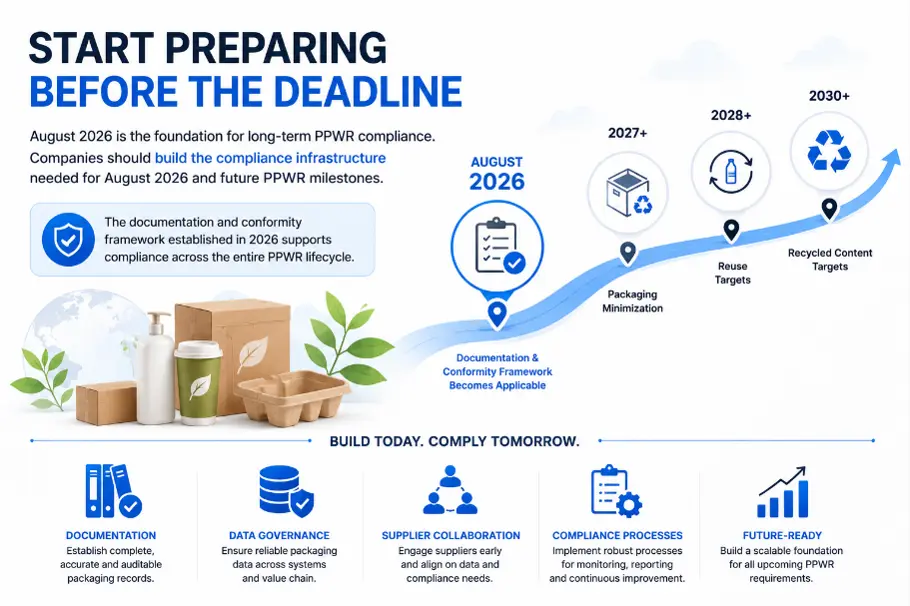
Reuse targets: the 25 February 2026 delegated act exempts domestic and intra-group pallet-wrap and strapping from the 100% reuse duty, but the cross-border 40% transport-reuse target under Article 29(1) still applies from 2030.
The upside: get the packaging specification right once, and PPWR compliance for tire manufacturers in Netherlands becomes a standard applied across every Dutch order, so you stop re-solving conformity shipment by shipment.
Is your transport packaging ready for PPWR requirements?
Our guide to Transport Packaging in PPWR explains what businesses need to consider when managing packaging used to protect, handle and transport products across the supply chainfrom packaging formats and material data to reuse, recyclability and compliance responsibilities.
PPWR compliance for tire manufacturers in Netherlands: Verpact, ILT and eco-modulated fees
On the enforcement side, PPWR compliance for tire manufacturers in Netherlands layers on top of an already mature Dutch system. Extended Producer Responsibility runs through Verpact (formerly Afvalfonds Verpakkingen), the collective scheme that finances collection and recycling. If you place more than 50,000 kg of packaging a year on the Dutch market you register, declare volumes, and pay a waste-management contribution; the Human Environment and Transport Inspectorate (ILT) and the NVWA enforce under the Wet milieubeheer.
The benefit of acting early is financial as well as legal. Verpact’s tariff structure is realigning to the PPWR recyclability grades, so eco-modulated fees will rise sharply for poorly recyclable packaging and fall for well-designed materials. A tyre maker that moves to mono-material, high-recyclate wrap now protects itself from both the 2030 market ban and years of escalating fees, which is where PPWR compliance for tire manufacturers in Netherlands pays for itself. Non-Dutch producers should also confirm whether they need an EPR representative, since self-registration alone may no longer be enough.
Register and declare with Verpact; keep the ~31 March declaration and ~31 July statutory report on schedule.
Expect eco-modulated fees indexed to recyclability grade design decisions now become cost decisions.
Foreign producers: check the mandatory EPR-representative requirement for non-established operators.
Do you know where your EPR registration obligations begin under PPWR?
Our guide to EPR Registration in PPWR explains what businesses need to understand about producer responsibility, registration, packaging data, reporting and EPR obligations across EU markets.
PPWR compliance for tire manufacturers in Netherlands with the TraceX platform
Operationalising PPWR compliance for tire manufacturers in Netherlands means turning scattered supplier specs into an audit-ready record you can produce on request. The TraceX PPWR platform is built to capture packaging-component data, recyclability evidence, and Declaration-of-Conformity artefacts against every SKU and shipment, so PPWR compliance for tire manufacturers in Netherlands becomes a live dataset rather than a folder of PDFs
Recyclability-grade and recycled-content tracking to flag below-Grade-C materials ahead of 2030
Verpact declaration support: volume roll-ups and evidence trails for the annual report
Declaration-of-Conformity and technical-documentation workflows kept inspection-ready for ILT
Certifications and supplier declarations help, but they don’t substitute for a plot-by-plot, component-by-component packaging record. For tyre makers, the win is treating packaging data like production data: one source of truth for every film, strap, and pallet, versioned and ready to prove. That is the difference between reacting to an ILT request and answering it in an afternoon.
See how the TraceX platform turns packaging data, recyclability evidence, and Verpact reporting into one inspection-ready record.
PPWR compliance for tire manufacturers in Netherlands: manual vs. platform
PPWR compliance for tire manufacturers in Netherlands looks very different depending on your tooling. Here is a short comparison of spreadsheets versus a dedicated platform.
Compliance task
Manual / spreadsheet approach
TraceX platform approach
Packaging component inventory
Scattered across supplier emails and PO files
Central register mapped to PPWR criteria
Recyclability grading
Re-checked per material, per shipment
Graded once, flagged automatically before 2030
Verpact declaration
Manual volume tallies, deadline risk
Automated roll-ups with evidence trail
Declaration of Conformity
PDF folders, hard to reproduce
Versioned, inspection-ready records
Fee optimisation
Reactive to eco-modulated increases
Design-stage grade visibility to cut fees
PPWR compliance for tire manufacturers in Netherlands: a buyer’s evaluation checklist
Use this to pressure-test any compliance tool or internal process before you commit.
Does it hold a component-level packaging register (film, strap, pallet, bag, label), not just a product list?
Can it store and reproduce recyclability grades and recycled-content data per material?
Does it flag below-Grade-C packaging ahead of the 1 January 2030 market ban?
Can it generate Verpact-ready volume declarations and keep the evidence trail?
Does it manage Declaration of Conformity and technical documentation for ILT inspection?
Does it surface eco-modulated fee exposure at the design stage?
Can it scale the same packaging spec across every Dutch and wider EU order?
Frequently Asked Questions
Is PPWR compliance for tire manufacturers in Netherlands mandatory yet?
Yes. Regulation (EU) 2025/40 has applied directly in the Netherlands since 12 August 2026, so packaging obligations, Declarations of Conformity, and technical documentation are already required.
Does PPWR apply to tyre transport packaging or only retail packaging?
It applies to all packaging, including transport packaging. For tyre makers that means pallet-wrap film, strapping, pallets, tyre bags, edge protectors, and labels are each in scope.
Who handles packaging EPR in the Netherlands?
Verpact (formerly Afvalfonds Verpakkingen) is the collective producer responsibility organisation. Producers above 50,000 kg per year register, declare, and pay a waste-management contribution.
What happens to poorly recyclable tyre packaging in 2030?
From 1 January 2030, packaging below recyclability Grade C is banned from the EU market, and from 2038 only Grade A and B are allowed so low-grade films and laminates need replacing now.
Are we still allowed to use single-use pallet wrap?
Yes for domestic and intra-group transport: the 25 February 2026 delegated act exempts pallet-wrap and strapping from the 100% reuse duty. The cross-border 40% transport-reuse target still applies from 2030.
Do non-Dutch tyre manufacturers have extra duties?
Often yes. Producers not established in the Netherlands may need an EPR representative and must confirm registration rather than assuming self-registration is enough.
How does the TraceX platform help?
It centralises packaging-component data, recyclability evidence, Verpact declaration support, and Declaration-of-Conformity workflows into one inspection-ready record.
Start using TraceX
Transparency, Trust, & Success for your Climate Journey.
We use cookies on our website to give you the most relevant experience by remembering your preferences and repeat visits. By clicking “Accept All”, you consent to the use of ALL the cookies. However, you may visit "Cookie Settings" to provide a controlled consent.
This website uses cookies to improve your experience while you navigate through the website. Out of these, the cookies that are categorized as necessary are stored on your browser as they are essential for the working of basic functionalities of the website. We also use third-party cookies that help us analyze and understand how you use this website. These cookies will be stored in your browser only with your consent. You also have the option to opt-out of these cookies. But opting out of some of these cookies may affect your browsing experience.
Necessary cookies are absolutely essential for the website to function properly. These cookies ensure basic functionalities and security features of the website, anonymously.
Cookie
Duration
Description
cookielawinfo-checkbox-analytics
11 months
This cookie is set by GDPR Cookie Consent plugin. The cookie is used to store the user consent for the cookies in the category "Analytics".
cookielawinfo-checkbox-functional
11 months
The cookie is set by GDPR cookie consent to record the user consent for the cookies in the category "Functional".
cookielawinfo-checkbox-necessary
11 months
This cookie is set by GDPR Cookie Consent plugin. The cookies is used to store the user consent for the cookies in the category "Necessary".
cookielawinfo-checkbox-others
11 months
This cookie is set by GDPR Cookie Consent plugin. The cookie is used to store the user consent for the cookies in the category "Other.
cookielawinfo-checkbox-performance
11 months
This cookie is set by GDPR Cookie Consent plugin. The cookie is used to store the user consent for the cookies in the category "Performance".
viewed_cookie_policy
11 months
The cookie is set by the GDPR Cookie Consent plugin and is used to store whether or not user has consented to the use of cookies. It does not store any personal data.
Functional cookies help to perform certain functionalities like sharing the content of the website on social media platforms, collect feedbacks, and other third-party features.
Performance cookies are used to understand and analyze the key performance indexes of the website which helps in delivering a better user experience for the visitors.
Analytical cookies are used to understand how visitors interact with the website. These cookies help provide information on metrics the number of visitors, bounce rate, traffic source, etc.
Advertisement cookies are used to provide visitors with relevant ads and marketing campaigns. These cookies track visitors across websites and collect information to provide customized ads.
Download the 2026 Traceability Scorecard and Benchmark Your Supply Chain Across 10 Critical Capabilities.
Download our eBook
Don’t Wait for an Audit to Find Your EUDR Gaps
The 2026 Simplification Package changes how HS codes, DDS pass-through and geolocation rules apply to you. Get the free guide and 20-point readiness checklist before enforcement catches you unprepared.