PPWR Compliance for Pharma Importers in Germany: The 2026 Readiness Guide
Published
, 10 minute read
Share this article
Quick summary: PPWR Compliance for Pharma Importers in Germany explained: primary vs secondary packaging exemptions, LUCID registration, DoC, and a 2026 readiness checklist.
PPWR Compliance for Pharma Importers in Germany means proving, from 12 August 2026, that the packaging around every medicinal product you place on the German market meets Regulation (EU) 2025/40 and, separately, registering as a producer in the LUCID packaging register run by the ZSVR. Pharma is not broadly exempt. Primary packaging in direct contact with the medicine earns narrow, conditional relief on recyclability and recycled content, but outer cartons, leaflets and transport packaging must comply in full, each backed by a Declaration of Conformity with no transition period.
Key takeaways
PPWR (Reg. (EU) 2025/40) entered into force 11 February 2025 and applies generally from 12 August 2026 directly, with no national transposition needed.
The importer that first places a packaged pharmaceutical on the German market is usually the responsible “producer” for EPR triggering LUCID registration with the ZSVR before first placement.
Exemptions are narrow: primary packaging (blisters, vials, ampoules, syringes) may be relieved from recyclability and recycled-content rules; secondary and transport packaging get no such relief.
LUCID registration and PPWR conformity are two separate workstreams you can be fully registered in LUCID and still non-compliant on the Declaration of Conformity side.
From 12 August 2026 every packaging unit needs technical documentation (Annex VII) and an EU Declaration of Conformity (Annex VIII).
What PPWR Compliance for Pharma Importers in Germany Actually Covers
PPWR regulates the packaging surrounding a medicine not the medicinal product itself.
It applies to primary, secondary and transport packaging, each treated differently.
It is directly applicable EU law from 12 August 2026, enforced nationally in Germany.
At its core, PPWR Compliance for Pharma Importers in Germany is about packaging, not medicine. The Packaging and Packaging Waste Regulation (EU) 2025/40 entered into force on 11 February 2025 and becomes generally applicable on 12 August 2026, replacing the old Packaging and Packaging Waste Directive with a single, directly applicable EU regime. Because it is a regulation rather than a directive, it applies the same way in every member state without waiting for national law to catch up.
The practical scope of PPWR Compliance for Pharma Importers in Germany follows the three packaging layers. Primary (immediate) packaging is the blister, vial, ampoule or pre-filled syringe touching the medicine. Secondary packaging is the outer carton, the patient information leaflet and any grouped packaging. Transport (tertiary) packaging is the shipper, pallet and cushioning that moves stock into Germany. Each layer carries different obligations and the layer most importers assume is “handled upstream” is usually the one that exposes them.
Do You Have the Right Packaging Data for PPWR Compliance?Explore the key packaging data types businesses need to track from materials and components to suppliers, weights, labelling and compliance evidence.
Why the Importer Is the Responsible Party Under German Packaging Law
Whoever first places packaged goods on the German market is the “producer” for EPR purposes.
That role triggers registration in LUCID, the national packaging register operated by the ZSVR.
There is no de minimis threshold quantity and company size do not exempt you.
Many teams assume the EU-based manufacturer or the marketing-authorisation holder absorbs every packaging duty which is where PPWR Compliance for Pharma Importers in Germany first surprises them. Under the German Packaging Act (VerpackG) now being adapted to the PPWR through the Packaging Law Implementation Act (VerpackDG) the party that first commercially places a packaged product on the German market is the obligated producer. For an importer bringing pharmaceuticals into Germany, that is frequently you.
So PPWR Compliance for Pharma Importers in Germany begins with correctly identifying your role, then registering in the LUCID packaging register with the Zentrale Stelle Verpackungsregister (ZSVR) before you place anything on the market. Registration is free and digital, but there is no small-volume exemption, and the penalties bite: administrative fines can reach €100,000 for a missing registration and €200,000 for missing system participation, alongside a distribution ban. Existing dual-system participation for producers already registered under both regimes continues through 31 December 2026 under the transitional rules.
Importing Products Into the EU? Understand Your PPWR Responsibilities.Learn what importers need to know about packaging obligations, producer responsibility, EPR, labelling and compliance documentation under PPWR.
The Exemptions Pharma Importers Most Often Get Wrong
Primary packaging may be relieved from recyclability and recycled-content rules on safety grounds.
Packaging minimisation relief for pharmaceuticals currently runs to 31 December 2034 (then reviewed).
Secondary and transport packaging get no exemption full assessment, minimisation and DoC apply.
The single biggest error in PPWR Compliance for Pharma Importers in Germany is treating “pharma is exempt” as a blanket truth. It is not. Where using recycled content or a more recyclable construction would compromise the safety, quality or efficacy of the medicine, primary packaging blisters, vials, ampoules, pre-filled syringes can be relieved from recyclability and recycled-content requirements. Packaging minimisation obligations for pharmaceuticals are likewise derogated, currently through 31 December 2034 pending review. These reliefs are narrow, conditional, and must be documented: you have to justify and evidence every exemption you claim.
Where the myth becomes expensive is secondary and transport packaging. Outer cartons, leaflet inserts, grouped packaging, shippers and pallets receive no safety exemption, so importers must treat PPWR Compliance for Pharma Importers in Germany as a full-scope programme for those layers recyclability assessment, minimisation and a Declaration of Conformity all apply from day one. The PFAS restriction, by contrast, targets food-contact packaging, so most pharmaceutical packaging sits outside it unless it also contacts food.
Is Your Packaging Portfolio Ready for PPWR’s Minimization Requirements?Learn how businesses can reduce unnecessary packaging, optimise packaging design and manage data needed to demonstrate compliance.
The Two Parallel Workstreams: EPR Registration and Declaration of Conformity
The distinction that trips up even well-prepared teams:
EPR registration (LUCID) covers collection, recovery and financing- the fee side.
PPWR conformity (technical file + DoC) covers substances, recyclability and documentation – the product side.
Being registered in LUCID says nothing about whether each packaging type has a valid DoC.
PPWR Compliance for Pharma Importers in Germany runs on two parallel workstreams that are easy to confuse. The first is extended producer responsibility: registering in LUCID, joining a dual system, and reporting volumes the machinery that finances collection and recycling. The second is conformity: assessing each packaging unit against the PPWR’s substance, recyclability and minimisation rules, compiling the technical documentation (Annex VII), and issuing an EU Declaration of Conformity (Annex VIII). A producer fully registered in LUCID can still be entirely non-compliant on the conformity side, because these are separate obligations under different articles.
Both sides of PPWR Compliance for Pharma Importers in Germany depend on the same thing: accurate, component-level packaging data for every SKU materials, weights, and where each unit is placed on the market. The documentation side gives no grace period; a valid Declaration of Conformity must exist from 12 August 2026. Importers who still hold packaging specs as scattered PDFs and spreadsheets are the ones most exposed, because they cannot evidence conformity or reconcile LUCID volumes on demand.
Is Your Business Ready for EPR Registration Under PPWR?Learn who needs to register, what packaging data you need, and how to prepare for EPR obligations across EU markets.
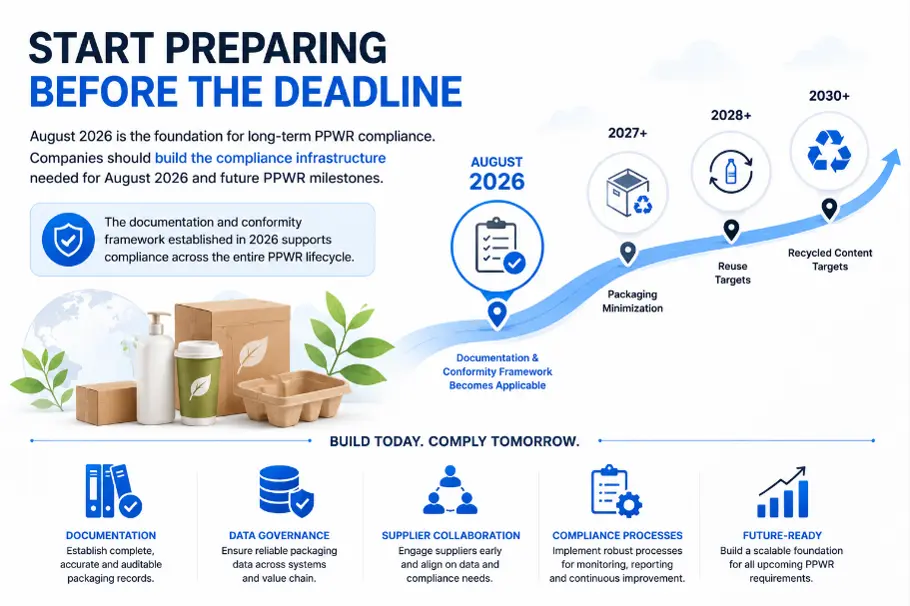
How Pharma Importers in Germany Can Get Ready Before 12 August 2026
A defensible starting sequence you can begin this quarter:
Inventory every packaging component per SKU and classify it as primary, secondary or transport.
Confirm your producer role, register in LUCID, and reconcile volumes with your dual system.
Build the technical file and Declaration of Conformity, documenting any exemption you claim.
Getting ahead of PPWR Compliance for Pharma Importers in Germany is less about legal interpretation and more about operational readiness: turning scattered packaging specifications into a structured, audit-ready data foundation you can query at article level. Once that foundation exists, registration, conformity and reporting stop being fire drills and become repeatable processes.
Most pharma importers do not fail PPWR on the law they fail on the data. When packaging specifications live in PDFs, ERP exports and email threads, you cannot prove conformity for a single SKU, let alone reconcile LUCID volumes when the ZSVR asks.
The TraceX PPWR platform is built to give importers one structured, component-level record per packaging unit the shared foundation that both the EPR and the Declaration-of-Conformity workstreams draw from.
See how the TraceX platform turns scattered packaging specs into audit-ready PPWR conformity and LUCID reporting for pharmaceutical imports
Manual Compliance vs a Traceability Platform: A Side-by-Side
Compliance task
Manual / spreadsheet approach
TraceX platform approach
Packaging inventory
SKU specs scattered across PDFs and spreadsheets; no single source of truth
Component-level record per SKU, classified by primary / secondary / transport
Producer-role & LUCID
Manual check of who places goods on the German market; registration tracked off-system
Role logic and registration status held against each market and entity
Declaration of Conformity
DoCs drafted per product by hand; version control by filename
DoC and Annex VII technical file generated from structured packaging data
Exemption evidence
Justifications stored ad hoc; hard to retrieve in an audit
Each claimed exemption linked to its evidence at the packaging-unit level
LUCID volume reconciliation
Manual matching of dual-system and LUCID figures; typo risk triggers ZSVR audits
Volumes reconciled against reported data so figures match 1:1
Audit readiness
Evidence assembled reactively when regulators ask
Article-level compliance status queryable on demand
Buyer Evaluation Checklist: Choosing a PPWR Compliance Solution
Use this to score any tool or service you evaluate for pharmaceutical packaging compliance in Germany:
Does it hold component-level packaging data per SKU, classified by packaging layer?
Can it generate an EU Declaration of Conformity (Annex VIII) and technical file (Annex VII) from that data?
Does it map the producer role and LUCID registration status per entity and market?
Can it store and retrieve the justification for every exemption you claim on primary packaging?
Does it help reconcile dual-system and LUCID volumes so the ZSVR reconciliation passes?
Does it flag substance, recyclability and minimisation gaps at the article level?
Will it scale to other EU markets and adjacent regimes (e.g. EPR, DPP) without re-keying data?
Frequently Asked Questions
Are pharmaceutical products exempt from PPWR in Germany?
No. There is no blanket exemption. Primary packaging in direct contact with the medicine may be relieved from recyclability and recycled-content rules where compliance would compromise safety, quality or efficacy, and packaging minimisation is derogated for pharmaceuticals (currently to 31 December 2034). Secondary and transport packaging must comply in full.
When does PPWR apply to pharma importers in Germany?
Regulation (EU) 2025/40 entered into force on 11 February 2025 and applies generally from 12 August 2026. The Declaration of Conformity obligation has no transition period, so a valid DoC must exist for each packaging unit from that date.
Do I still need to register in LUCID if I am covered by PPWR?
Yes. LUCID registration with the ZSVR is a separate extended-producer-responsibility obligation from PPWR conformity. Any company that first places packaged goods on the German market must register before first placement, regardless of volume or size.
Who is the responsible party the manufacturer or the importer?
It depends on who first places the packaged product on the German market. For imported pharmaceuticals, that is frequently the importer, which makes the importer the obligated producer for EPR and the party responsible for conformity.
What is the difference between Annex VII and Annex VIII under PPWR?
Annex VII sets out the technical documentation you must compile for each packaging unit; Annex VIII sets out the EU Declaration of Conformity. They are related but distinct the technical file supports the declaration.
Does the PFAS ban affect pharmaceutical packaging?
The PFAS restriction applies to food-contact packaging. Most pharmaceutical packaging falls outside it unless the packaging also contacts food, though voluntary testing may be prudent for forward-looking compliance.
What are the penalties for non-compliance in Germany?
Under German packaging law, a missing LUCID registration can attract fines up to €100,000 and missing system participation up to €200,000, plus a distribution ban. PPWR conformity failures carry their own national penalties under the implementing act.
Start using TraceX
Transparency, Trust, & Success for your Climate Journey.
We use cookies on our website to give you the most relevant experience by remembering your preferences and repeat visits. By clicking “Accept All”, you consent to the use of ALL the cookies. However, you may visit "Cookie Settings" to provide a controlled consent.
This website uses cookies to improve your experience while you navigate through the website. Out of these, the cookies that are categorized as necessary are stored on your browser as they are essential for the working of basic functionalities of the website. We also use third-party cookies that help us analyze and understand how you use this website. These cookies will be stored in your browser only with your consent. You also have the option to opt-out of these cookies. But opting out of some of these cookies may affect your browsing experience.
Necessary cookies are absolutely essential for the website to function properly. These cookies ensure basic functionalities and security features of the website, anonymously.
Cookie
Duration
Description
cookielawinfo-checkbox-analytics
11 months
This cookie is set by GDPR Cookie Consent plugin. The cookie is used to store the user consent for the cookies in the category "Analytics".
cookielawinfo-checkbox-functional
11 months
The cookie is set by GDPR cookie consent to record the user consent for the cookies in the category "Functional".
cookielawinfo-checkbox-necessary
11 months
This cookie is set by GDPR Cookie Consent plugin. The cookies is used to store the user consent for the cookies in the category "Necessary".
cookielawinfo-checkbox-others
11 months
This cookie is set by GDPR Cookie Consent plugin. The cookie is used to store the user consent for the cookies in the category "Other.
cookielawinfo-checkbox-performance
11 months
This cookie is set by GDPR Cookie Consent plugin. The cookie is used to store the user consent for the cookies in the category "Performance".
viewed_cookie_policy
11 months
The cookie is set by the GDPR Cookie Consent plugin and is used to store whether or not user has consented to the use of cookies. It does not store any personal data.
Functional cookies help to perform certain functionalities like sharing the content of the website on social media platforms, collect feedbacks, and other third-party features.
Performance cookies are used to understand and analyze the key performance indexes of the website which helps in delivering a better user experience for the visitors.
Analytical cookies are used to understand how visitors interact with the website. These cookies help provide information on metrics the number of visitors, bounce rate, traffic source, etc.
Advertisement cookies are used to provide visitors with relevant ads and marketing campaigns. These cookies track visitors across websites and collect information to provide customized ads.
Download the 2026 Traceability Scorecard and Benchmark Your Supply Chain Across 10 Critical Capabilities.
Download our eBook
Don’t Wait for an Audit to Find Your EUDR Gaps
The 2026 Simplification Package changes how HS codes, DDS pass-through and geolocation rules apply to you. Get the free guide and 20-point readiness checklist before enforcement catches you unprepared.