EUDR Transitional Period: What EU Importers and Non-EU Exporters Need to Know
Published
, 11 minute read
Share this article
Quick summary: EUDR transitional period explained: which stock placed before 30 Dec 2026 is exempt, the evidence you must keep, mixing rules and worked commodity examples.
EUDR transitional period is the window between the Regulation’s entry into force on 29 June 2023 and its entry into application 30 December 2026 for large and medium companies, and 30 June 2027 for micro and small operators. Relevant commodities and products placed on the EU market during this window are exempt from due diligence, but downstream operators and traders who later place derived products on the market must hold adequately conclusive and verifiable evidence that the input was placed on the EU market before the applicable application date.
Key takeaways
The EUDR transitional period runs from 29 June 2023 to the day before entry into application (FAQ 9.5).
Application dates: 30 December 2026 for large/medium operators and traders; 30 June 2027 for micro and small undertakings and natural persons.
No due diligence statement (DDS) is required for stock placed on the market during the EUDR transitional period; obligations shrink to holding evidence of the placing date.
Downstream operators and traders must prove the input was placed on the EU market before the application date the burden of proof sits with the operator.
Transition stock and compliant stock can be mixed if every batch is traceable to one bucket or the other and all Article 3 conditions are met.
Timber and timber products carry a special carve-out under Art. 37(2) treat them separately.
December 2026 is approaching. Is your supply chain actually ready?
Move from spreadsheets and fragmented supplier data to a traceable, audit-ready EUDR workflow with TraceX.
What the EUDR transitional period means for importers and exporters
EUDR transitional period is the single most misread part of the Regulation for teams sitting on inventory today. The confusion is expensive: a coffee importer, a tyre manufacturer or a chocolate maker with warehouses full of stock bought in 2024 or 2025 needs to know, batch by batch, which goods are grandfathered and which will need a full due diligence statement once enforcement begins. Guess wrong and you either file DDSs you never needed, or you place non-exempt product and expose the business to interim measures, seized shipments and fines of up to 4% of EU-wide turnover.
The good news is that the Commission’s own FAQ (Version 5, April 2026) is unusually concrete about how the EUDR transitional period works in practice. Section 9 walks through the exact scenarios most buyers face rubber into tyres, cocoa butter into chocolate, a trader onselling old stock and spells out the evidence that keeps that stock legally on the market. This guide turns those provisions into a decision you can actually operationalise.
EUDR transitional period timeline: entry into force to entry into application
In plain terms, the EUDR transitional period is a grandfathering window. The Regulation entered into force on 29 June 2023, but its substantive obligations only start to apply later. Anything lawfully placed on the EU market inside that window does not have to meet the deforestation-free, legality and DDS requirements of Article 3.
Two application dates close the window, depending on who first placed the goods:
30 December 2026 — for large and medium operators and traders (42 months after entry into force).
30 June 2027 — for micro and small undertakings and natural persons acting as operators (48 months after entry into force).
Because the deferred date exists, the EUDR transitional period effectively ends on a different day for different supply chains. If your input came from a micro or small operator, the relevant cut-off for that input is 30 June 2027, not 30 December 2026 a distinction that changes which of your goods are exempt.
EUDR transitional period scenarios: worked examples from the Commission FAQ
The clearest way to apply the EUDR transitional period is through the Commission’s own worked examples. In each, note the pattern: once a relevant input was placed on the market during the window, the downstream company’s job is not full due diligence it is proving the placing date.
Scenario 1 — Natural rubber into new tyres
Natural rubber (CN 4001) is placed on the EU market during the EUDR transitional period, so it was never geolocated. From 30 December 2026, a manufacturer turns that rubber into new tyres (CN 4011) and places them on the market. The downstream operator’s obligation is limited to gathering adequately conclusive and verifiable evidence that the rubber was placed on the EU market before entry into application. No DDS for the rubber is required. If, however, part of the rubber was placed from 30 December 2026 onward, that portion falls under the standard obligations.
Scenario 2 — Cocoa butter into chocolate
Cocoa butter (CN 1804) is placed on the market during the EUDR transitional period, then used to make chocolate (CN 1806) placed on the market by a downstream operator from 30 December 2026. Again, obligations are limited to evidence that the cocoa butter was placed before the application date. Any component made with cocoa placed from 30 December 2026 onward is subject to the full Regulation.
Scenario 3 — A trader onselling transition stock
An operator places a commodity or product during the EUDR transitional period; one or more traders then make it available on the market from 30 December 2026. The traders (and any subsequent downstream operators and traders) only need adequately conclusive and verifiable evidence that the goods were placed before entry into application.
Scenario 4 — Inputs from a micro or small operator (deferred date)
A downstream company places a product made from a commodity that a natural person, micro or small operator placed on the market before 30 June 2027. Here the EUDR transitional period reference date is the deferred 30 June 2027 cut-off, and the downstream company’s obligation is limited to evidencing that earlier placing.
Your HSN/HS code can determine whether a product falls within the scope of EUDR—but getting the classification wrong can create compliance gaps.
Read our guide on EUDR HSN/HS Codes to understand how product classification works, which codes are relevant, and how to determine whether your products require EUDR due diligence.
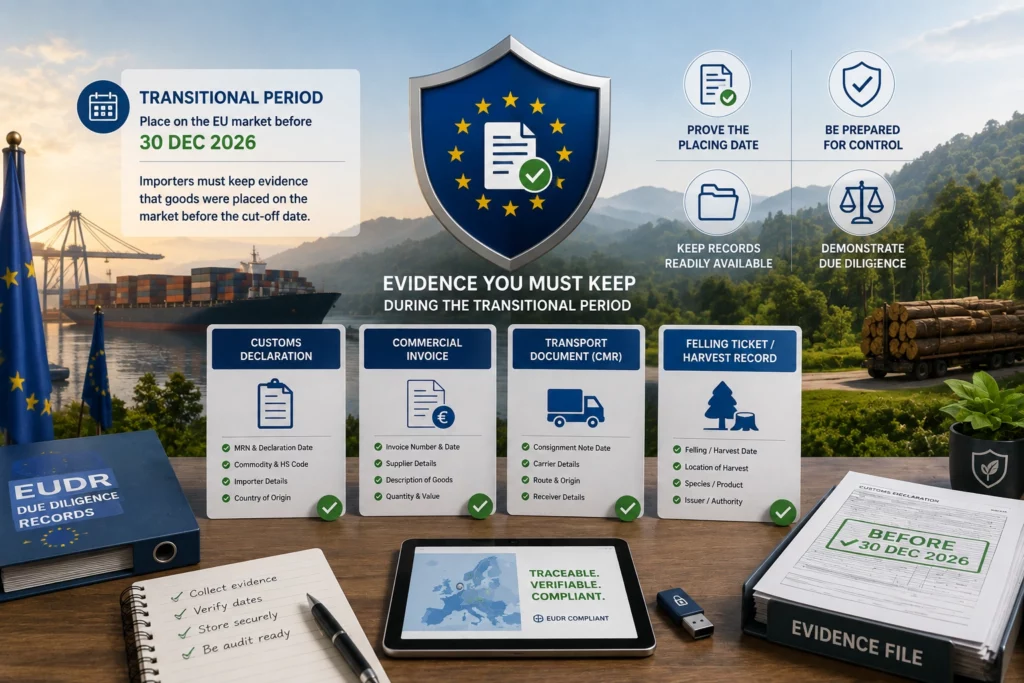
EUDR transitional period evidence: what proof you must keep
The whole benefit of the EUDR transitional period depends on documentation. The operator bears the burden of proof that goods were placed on the EU market before the application date, and no due diligence statement is filed for that stock. Competent Authorities can check transition claims at any time, so the evidence has to be linkable to the specific product.
For imported goods, the customs declaration is the accepted evidence of placing on the EU market. For EU-produced goods and for supporting the placing date generally, the FAQ accepts:
Felling tickets, ear tags and cattle passports, invoices, and other production- or selling-date records
Contracts between the parties and product order documents
Shipment documents: CMRs, bills of lading, delivery notes and air-waybills
For export or re-import of transition stock, a conventional DDS reference number the universal placeholder 99EU9999999999 can be entered on the customs declaration. Where a downstream operator exports, no reference number is needed at all; a dedicated TARIC certificate code is used instead.
EUDR transitional period and mixing: combining transition stock with compliant stock
A recurring buyer question about the EUDR transitional period is whether old and new stock can sit in the same silo, tank or pallet. The answer is yes provided every batch is proven to be either transition stock (with evidence of placing during the window) or fully compliant stock, and all Article 3(a)–(c) conditions are met for the compliant portion.
Inside the Information System, only the post-transition stock is declared. When you mix grandfathered commodities with newer stock, the DDS covers just the newly placed quantities that are actually subject to due diligence the transition portion stays off the system, backed by your evidence file.
Most teams treat the EUDR transitional period as a one-off amnesty and under-invest in record-keeping then scramble when a Competent Authority asks for proof two years later. The smarter play is to treat transition evidence as the first entry in the same data layer you will use for live DDS filings. TraceX tags each batch as transition-exempt or in-scope, stores the placing-date evidence against it, and carries that classification through mixing and processing steps so the exemption is defensible on demand rather than reconstructed under pressure.
EUDR transitional period vs standard obligations: a side-by-side
This table summarises how obligations differ between goods placed during the EUDR transitional period and goods placed after entry into application.
Requirement
Placed DURING the transitional period
Placed AFTER entry into application
Due diligence statement (DDS)
Not required
Required before placing / export
Geolocation & plot data
Not required
Required (polygons or points)
Core obligation
Prove the placing date only
Full information, risk assessment, mitigation
Downstream operator duty
Hold evidence input was placed pre-cut-off
Standard Art. 5 obligations
Customs reference (export/re-import)
99EU9999999999 or TARIC code (downstream export)
Real DDS reference number / declaration identifier
Burden of proof
On the operator claiming exemption
On the operator, via the DDS
EUDR transitional period done right: fewer stranded shipments, cleaner audits
Handled well, the EUDR transitional period protects working capital. Every batch you can legitimately classify as transition-exempt is a batch you don’t have to geolocate, risk-assess or block at the border while every batch you can’t evidence is a liability waiting for a check. The dividing line is your documentation, not your intentions.
How TraceX Cleara AI supports transition-period classification
TraceX EUDR Solutions is built for EUDR specifically and lets compliance teams flag transition stock, attach placing-date evidence customs declarations, invoices, CMRs, felling tickets at the batch level, and preserve that status through mixing and manufacturing.] [It then generates and files DDSs only for the in-scope quantities], which is exactly the split the Commission describes for mixed stock in the Information System. All product-capability statements here are bracketed for product-team sign-off before publication.
Walk through how TraceX classifies transition-exempt vs in-scope batches, attaches placing-date evidence, and files DDSs only for the stock that needs them.
EUDR transitional period compliance checklist for buyers
Use this checklist when evaluating whether your process or a vendor’s platform can defend a EUDR transitional period claim under audit:
Batch-level classification: Can every SKU or lot be tagged transition-exempt or in-scope, and re-checked against the correct cut-off date (30 Dec 2026 or 30 Jun 2027)?
Evidence capture: Does the system store customs declarations, invoices, contracts, CMRs, bills of lading and cattle documents against the specific batch?
Mixing integrity: When transition and compliant stock combine, does the tool keep each batch traceable and file a DDS for only the in-scope quantity?
Customs handling: Can it apply the conventional reference number 99EU9999999999 or the downstream-export TARIC code correctly?
Timber carve-out: Does it treat timber and timber products under Art. 37(2) separately from other commodities?
Audit readiness: Can you retrieve the full evidence trail for a Competent Authority check within a reasonable period?
Frequently Asked Questions (FAQ’s)
When does the EUDR transitional period start and end?
It starts on the entry into force date, 29 June 2023, and ends on the day before entry into application 30 December 2026 for large and medium companies, and 30 June 2027 for micro and small operators (FAQ 9.5, 8.1).
Do I need a DDS for stock placed during the EUDR transitional period?
No. Products placed on the EU market during the transitional period do not require a due diligence statement. Downstream operators and traders only need adequately conclusive and verifiable evidence that the input was placed before the application date (FAQ 9.1, 9.2).
What evidence proves a product was placed on the market before the cut-off?
For imports, the customs declaration. For EU goods, records such as felling tickets, cattle ear tags and passports, invoices, contracts, product order documents, CMRs, bills of lading, delivery notes and air-waybills anything linkable to the specific product (FAQ 9.2).
Can I mix transition-period stock with EUDR-compliant stock?
Yes, if each batch is proven to be either transition stock or fully compliant and all Article 3(a)–(c) conditions are met for the compliant portion. In the Information System, only the post-transition stock is declared in the DDS (FAQ 9.3, 9.4).
Who bears the burden of proof for a transition-period exemption?
The operator claiming the exemption. Competent Authorities can check transition claims, and the operator must provide evidence that the product is exempt (FAQ 9.6, 8.3).
How do I handle customs for exporting or re-importing transition stock?
Use the conventional DDS reference number 99EU9999999999 on the customs declaration. If a downstream operator is exporting, no reference number is required a dedicated TARIC certificate code is used instead (FAQ 9.2, 5.6.1).
Does the EUDR transitional period work the same for timber?
Not entirely. Timber and timber products are subject to a specific carve-out under Art. 37(2) EUDR, so the transition-period treatment for timber differs from other commodities and should be assessed separately (FAQ 9.1).
Start using TraceX
Transparency, Trust, & Success for your Climate Journey.
We use cookies on our website to give you the most relevant experience by remembering your preferences and repeat visits. By clicking “Accept All”, you consent to the use of ALL the cookies. However, you may visit "Cookie Settings" to provide a controlled consent.
This website uses cookies to improve your experience while you navigate through the website. Out of these, the cookies that are categorized as necessary are stored on your browser as they are essential for the working of basic functionalities of the website. We also use third-party cookies that help us analyze and understand how you use this website. These cookies will be stored in your browser only with your consent. You also have the option to opt-out of these cookies. But opting out of some of these cookies may affect your browsing experience.
Necessary cookies are absolutely essential for the website to function properly. These cookies ensure basic functionalities and security features of the website, anonymously.
Cookie
Duration
Description
cookielawinfo-checkbox-analytics
11 months
This cookie is set by GDPR Cookie Consent plugin. The cookie is used to store the user consent for the cookies in the category "Analytics".
cookielawinfo-checkbox-functional
11 months
The cookie is set by GDPR cookie consent to record the user consent for the cookies in the category "Functional".
cookielawinfo-checkbox-necessary
11 months
This cookie is set by GDPR Cookie Consent plugin. The cookies is used to store the user consent for the cookies in the category "Necessary".
cookielawinfo-checkbox-others
11 months
This cookie is set by GDPR Cookie Consent plugin. The cookie is used to store the user consent for the cookies in the category "Other.
cookielawinfo-checkbox-performance
11 months
This cookie is set by GDPR Cookie Consent plugin. The cookie is used to store the user consent for the cookies in the category "Performance".
viewed_cookie_policy
11 months
The cookie is set by the GDPR Cookie Consent plugin and is used to store whether or not user has consented to the use of cookies. It does not store any personal data.
Functional cookies help to perform certain functionalities like sharing the content of the website on social media platforms, collect feedbacks, and other third-party features.
Performance cookies are used to understand and analyze the key performance indexes of the website which helps in delivering a better user experience for the visitors.
Analytical cookies are used to understand how visitors interact with the website. These cookies help provide information on metrics the number of visitors, bounce rate, traffic source, etc.
Advertisement cookies are used to provide visitors with relevant ads and marketing campaigns. These cookies track visitors across websites and collect information to provide customized ads.
Download the 2026 Traceability Scorecard and Benchmark Your Supply Chain Across 10 Critical Capabilities.
Download our eBook
Don’t Wait for an Audit to Find Your EUDR Gaps
The 2026 Simplification Package changes how HS codes, DDS pass-through and geolocation rules apply to you. Get the free guide and 20-point readiness checklist before enforcement catches you unprepared.