EUDR Legality: What You Must Prove to Keep EU Market Access
Published
, 14 minute read
Share this article
Quick summary: EUDR legality means proving your goods were legally produced, not just deforestation-free. Learn the documents, the risks, and how to stay audit-ready.
EUDR legality is the requirement under the EU Deforestation Regulation to prove that a commodity was produced in compliance with all applicable laws of the country of production covering land-use rights, environmental protection, forest rules, third-party and human rights, labour law, FPIC, tax, anti-corruption, and trade rules in addition to being deforestation-free. Both the “deforestation-free” test and the “legally produced” test must be satisfied before a Due Diligence Statement (DDS) can be filed. Legally produced is defined in Article 2(40) of Regulation (EU) 2023/1115.
EUDR legality is the half of EU Deforestation Regulation compliance that most exporters and sourcing heads underestimate. Everyone fixates on deforestation-free claims and geolocation data but under the EUDR you must also prove that every commodity was legally produced at the point of origin. Miss that, and your Due Diligence Statement can be rejected, your shipment delayed, or your market access denied.
In plain terms: EUDR legality is documentary proof that the land was used lawfully, the harvest was authorised, workers were treated within the law, and environmental rules were followed all tied back to a specific, geo-located plot. This guide breaks down exactly what it requires, which documents you need, why proof breaks down in real supply chains, and how a digital traceability platform turns a last-minute scramble into an audit-ready system.
Key Takeaways
Legality is a separate, mandatory test alongside deforestation-free — you must prove both to file a valid DDS.
Proof must exist at the production stage, linked to a geo-tagged plot — not reconstructed when customs asks.
Five evidence pillars: land-use rights, harvest legality, labour law, environmental protection, and traceability proof.
The Commission’s 2026 guidance is risk-based: negligible-risk supply chains don’t require exhaustive collection of every land title.
Deadlines are firm — 30 December 2026 (large/medium) and 30 June 2027 (micro/small non-timber). No further delay is planned.
A digital platform with plot-level mapping, timestamped document capture, and legality risk scoring is the fastest route to defensible EUDR legality at scale.
EUDR Legality Explained — Why It Starts at the Source
EUDR legality starts where your supply chain is least visible: the farm, the plot, the smallholder’s field. It is no longer enough to say your supply is deforestation-free you have to prove your products were legally produced, and that proof must begin at the point of origin.
Under Article 2(40) of the EUDR,“legally produced” means the relevant commodity was produced in accordance with the applicable legislation of the country of production. The Commission defines that legislation broadly: land-use rights, environmental protection, forest-related rules, third parties’ rights, applicable labour rights, human rights protected under international law, the principle of free, prior and informed consent (FPIC), tax, anti-corruption, and trade and customs rules.
This is not paperwork for its own sake. The EU wants to keep commodities linked to illegal land grabs, forced labour, or unauthorised clearing off its market and that covers cattle, cocoa, coffee, palm oil, rubber, soy, and wood, plus their derived products. EUDR legality proof must be in place before goods are placed on the market, not patched together at the border.
If you source from multiple smallholders or third-party suppliers, you already know how fragmented documentation can be. Stitching together hundreds of land titles, harvest approvals, and supplier declarations by hand while a shipment waits is exactly the failure mode the regulation exposes. Ask yourself three questions to gauge your legality readiness:
Do I have land-use records for every plot I source from?
Can I link each legality document to a geo-tagged plot or a verified supplier ID?
Are my teams still relying on email, spreadsheets, and WhatsApp to collect proof?
If the honest answer is “kind of,” you are not alone but it means your legality process needs rebuilding before December 2026. One important nuance from the Commission’s 2026 guidance: the approach is risk-based and proportionate. Where an initial examination shows negligible risk, you are not expected to systematically gather individual land titles for every single plot but you must be able to show why the risk is negligible, and produce evidence when it is not.
Understanding where your sourcing risks exist is essential to building an effective due diligence program. Learn how to assess deforestation risks, validate sourcing locations, and strengthen compliance with EUDR.
EUDR Legality Documents — The Full Evidence Trail You Need
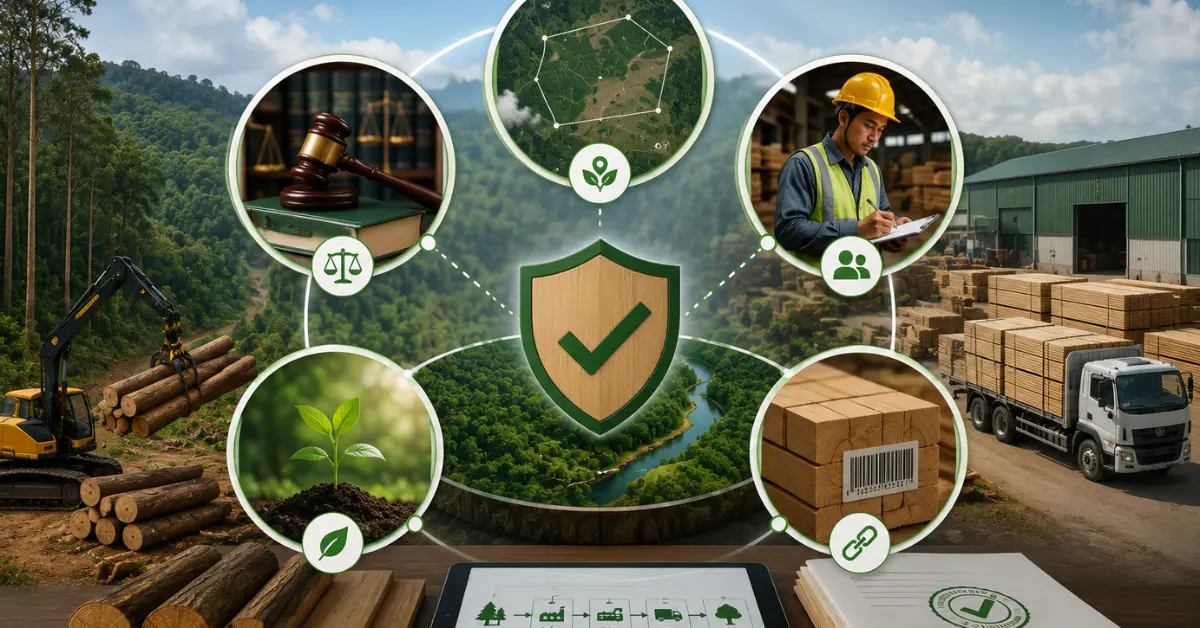
Legality documentation goes far beyond a land deed and an invoice. The EU expects a full evidence trail across land rights, harvest approvals, labour compliance, environmental safeguards, and traceability. Organise it by these five pillars and compliance becomes manageable even across hundreds of suppliers.
Legality pillar
Documents to collect
Why it matters
Land-use rights
Title deeds, lease agreements, government allotments, community/collective land recognitions
Shows the producer had a legal right to cultivate or harvest on that land
Harvest legality
Logging/felling permits, harvest receipts, transport authorisations, quota records
Verifies the raw material was not illegally extracted or over-harvested
Connects every document to a GPS location and supplier identity the backbone of your DDS
Trying to manage this with scattered spreadsheets, email threads, and scanned PDFs on local drives is a recipe for missed deadlines and failed audits. A defensible legality system instead relies on a centralised, digital evidence vault that supports:
Timestamped document uploads with version control
Role-based access for field agents and compliance teams
Auto-linking of documents to batches and geo-located plots
One-click, submission-ready exports (PDF/XML) for the DDS and the EU Information System
Do I need land titles for every farm?
Not always. Ideally you hold a land title for each plot, but the EUDR accepts alternatives long-term leases, community or collective land recognitions, or other government-accepted documents as long as each is linked to a specific plot by GPS. Under the Commission’s risk-based 2026 guidance, negligible-risk supply chains do not require exhaustive title collection for every plot; higher-risk plots do. Where documentation is missing, flag the plot as medium or high risk in your legality risk assessment.
EUDR Legality Challenges – Where Proof Breaks Down
Legality is one of the most overlooked yet mission-critical parts of compliance. For most companies the problem is not unwillingness it is an infrastructure gap, and it starts where visibility is lowest. Here is where proof most often collapses.
Fragmented supplier records with no formal KYC
Most supplier databases were never built for traceability. You may have a name and a phone number, but no verified ID, no mapped plot, and no reliable legality evidence a weak foundation for any legality claim.
See How Digital KYC Transformed Farmer Onboarding
Discover how integrated KYC validation helped streamline farmer onboarding, improve data accuracy, accelerate verification, and build a trusted foundation for supply chain traceability.
Land without clear titles, especially for smallholders
In parts of West Africa, Southeast Asia, and Latin America, smallholders operate on ancestral or community land with no formal titles or leases. Legitimate producers can still be flagged if you have no accepted alternative documentation on file.
Volume-to-quota mismatches that signal laundering
Even with valid permits, can you prove the volume you export matches what was legally allowed to be harvested? Mismatches are exactly where laundered commodities creep in — and where EU competent authorities raise red flags.
Documents that aren’t linked to a plot or batch
A permit is only meaningful if it is tied to a specific location, time, and product. Files stranded in shared drives, folders, or chat threads cannot survive an audit.
Manual systems prone to error, delay, and fraud
Spreadsheets, paper receipts, and handwritten declarations get lost or falsified. Under the EUDR that is not just inefficient; it is a legal liability.
Real-world scenario A rubber exporter sourced latex through a third-party aggregator. The shipment cleared local checks but when EU customs asked for land-legality proof tied to the original harvest plots, it could not be produced. The shipment was blocked at port, and the buyer flagged the supplier as non-compliant, threatening future contracts. The lesson: legality that cannot be traced to the plot is no legality at all.
EUDR Legality Automation – How TraceX Closes the Gap
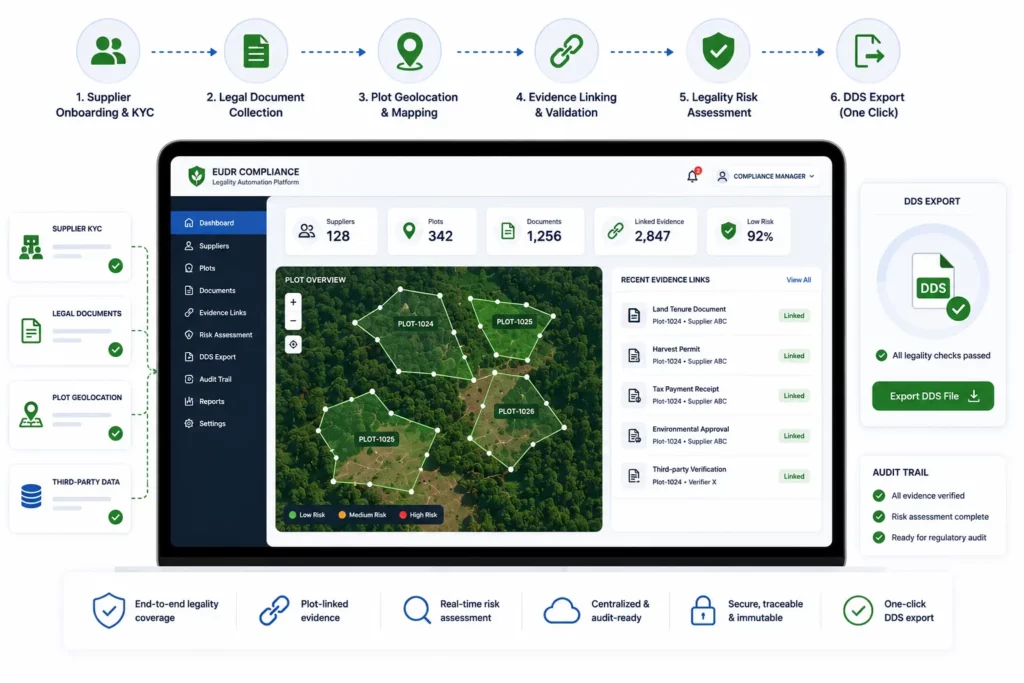
Proving legality is not just about collecting documents it is about making sure those documents are credible, verifiable, and connected to the right plot, batch, and supplier in real time. That is exactly where manual systems break down and where TraceX EUDR Solutions is designed to help. The pattern below follows pain, capability, and benefit.
Pain: missing land-use documentation
Capability: Upload land titles or leases at the farmer-onboarding stage, geo-tag them, and link them to the supplier’s digital profile. Benefit: When you need to show which plot a shipment came from, the legality evidence is already on file not chased across chat threads.
Pain: documents with no traceable link
Capability: Plot-level mapping and supplier-linked IDs tie every legality document a felling permit, a declaration from the origin plot to the exported container. Benefit: Each piece of legality proof becomes defensible because it carries location, time, and identity.
Pain: manual KYC and lost declarations
Capability: Digital onboarding workflows let farmers or field agents input, upload, or voice-record data all timestamped and stored automatically. Benefit: No more missing forms, and a verified supplier network from day one.
Pain: audit-prep and versioning chaos
Capability: Automated DDS generation, compliance dashboards, submission-ready PDF/XML exports for the EU Information System, and secure role-based storage with full version logs. Benefit: A week of data-gathering collapses into a few clicks, and you can prove who uploaded or changed each document, and when.
The shift is from “we think we have the right paperwork” to “we know, we can prove it, and we’re audit-ready anytime.” That is what turns legality from a scramble into a system.
EUDR Legality Risk Assessment – Scoring Suppliers and Plots
“We trust our suppliers” no longer satisfies the EUDR. You are expected to prove that every farmer, plot, and shipment comes from a legally compliant source across hundreds of smallholders, in geographies you may never visit, with paperwork in several languages. A digitally enabled EUDR legality risk assessment is your best defence and your biggest differentiator.
Supplier collaboration is the foundation of successful EUDR compliance. Learn how to collect supplier data, improve traceability, and streamline due diligence across your supply chain.
Start with satellite and region-level intelligence
Rather than relying on declarations alone, overlay satellite data with region-level indicators recent deforestation alerts, illegal-logging hotspots, proximity to protected zones. These signals give early warnings without boots on the ground. Sourcing cocoa from two cooperatives, one beside a newly logged reserve and one not? Now you know where to dig deeper before the shipment is even packed.
Assign a legality score to each plot or supplier
Score suppliers by legality risk instead of chasing red flags after the fact:
Low — fully verified documents and clean satellite data
Medium — missing declarations or proximity to risk zones
High — no land titles, flagged activity, or detected deforestation
Flag risky shipments before they ship
Risk scoring should feed directly into due-diligence workflows. About to ship ten containers of rubber? If the system flags two as linked to plots without confirmed land legality, you pause those batches, request documents, or reroute them before customs or your buyer is ever involved. You are preventing risk, not reacting to it.
The goal is not to eliminate all risk that is unrealistic. It is to spot risks early, take documented mitigation steps, and show regulators that you knew, you acted, and you documented it. That is what turns a potential shipment hold into a smooth customs clearance. Note that goods sourced exclusively from low-risk benchmarked countries qualify for a simplified regime under the 2026 guidance but the legality obligation itself does not disappear.
Most EUDR solutions rely ona single satellite image or one forest-loss dataset to determine whether a sourcing location is compliant. The challenge is that no single data source is perfect. Differences in satellite imagery, cloud cover, seasonal changes, or model limitations can lead to inconsistent results.
TraceX takes a different approach.
Our Advanced Consensus Engine analyzes each sourcing location using multiple independent remote sensing models and geospatial datasets instead of relying on just one source. By cross-validating evidence from an ensemble of specialized datasets, the platform delivers a more reliable and defensible assessment of deforestation risk.
Legal & Social Risk Assessment
EUDR compliance isn’t only about identifying deforestation. Companies must also assess broader legal and sourcing risks associated with their supply chains.
As an additional layer of analysis, TraceX evaluates sourcing locations against authoritative legal and social datasets, including:
National parks
Protected forests and nature reserves
Ramsar wetlands
UNESCO and internationally recognized protected areas
Indigenous territories
Community lands with recognized territorial rights
If a sourcing location overlaps with any of these areas, the platform automatically flags the potential legal risk.
Rather than changing the deforestation assessment itself, these findings are presented as additional due diligence indicators. For each overlap, TraceX provides:
The name of the protected or community area
The percentage of overlap
The specific legal or social designation
Recommendations for additional due diligence and verification
This gives operators the evidence needed to investigate potential risks and maintain the documentation required under EUDR.
Make EUDR legality a system, not a scramble.
See how TraceX links every legality document to a geo-tagged plot and generates audit-ready DDS exports.
Generates DDS-ready PDF/XML exports compatible with the EU Information System
Provides role-based access and full version/audit logs
Applies the risk-based, proportionate approach so negligible-risk chains aren’t over-documented
Scales across multiple commodities, regions, languages, and hundreds of suppliers
Frequently Asked Questions
What’s the difference between deforestation-free and legally produced under the EUDR?
Deforestation-free concerns land-use change after 31 December 2020. Legally produced (EUDR legality) covers land tenure, harvest permits, labour and human rights, environmental protection, and related laws at the point of origin. You must satisfy both tests to file a valid DDS.
Do I need land titles for every farm to prove EUDR legality?
Ideally yes, but accepted alternatives include long-term leases, community allotments, or other government-recognised documents each linked to a specific plot by GPS. Under the 2026 risk-based guidance, negligible-risk chains don’t require exhaustive title collection for every plot.
What laws count as ‘relevant legislation’ for EUDR legality?
Article 2(40) covers land-use rights, environmental protection, forest rules, third parties’ rights, labour rights, human rights under international law, FPIC, tax, anti-corruption, and trade and customs rules of the country of production.
When do the EUDR legality obligations apply?
From 30 December 2026 for large and medium operators (and micro/small operators in the timber sector), and from 30 June 2027 for other micro and small operators, per Regulation (EU) 2025/2650. The Commission has confirmed no further delay.
Can I get legality proof from my trader instead of collecting it myself?
Only if the trader has actually collected it and can tie it to the original production plot. As the operator, you remain responsible under the EUDR so verify, don’t assume.
How do I automate EUDR legality across hundreds of suppliers?
Use a traceability platform that supports geo-tagged document uploads, digital declarations, role-based access, plot-level risk scoring, and DDS-ready export formats such as TraceX end-to-end EUDR compliance suite.
Does certification (FSC, RSPO) replace EUDR legality proof?
No. Certification can support risk assessment and mitigation, and the Commission is building a certification-scheme repository, but it does not replace geolocation, plot-level evidence, or your DDS obligations.
Start using TraceX
Transparency, Trust, & Success for your Climate Journey.
We use cookies on our website to give you the most relevant experience by remembering your preferences and repeat visits. By clicking “Accept All”, you consent to the use of ALL the cookies. However, you may visit "Cookie Settings" to provide a controlled consent.
This website uses cookies to improve your experience while you navigate through the website. Out of these, the cookies that are categorized as necessary are stored on your browser as they are essential for the working of basic functionalities of the website. We also use third-party cookies that help us analyze and understand how you use this website. These cookies will be stored in your browser only with your consent. You also have the option to opt-out of these cookies. But opting out of some of these cookies may affect your browsing experience.
Necessary cookies are absolutely essential for the website to function properly. These cookies ensure basic functionalities and security features of the website, anonymously.
Cookie
Duration
Description
cookielawinfo-checkbox-analytics
11 months
This cookie is set by GDPR Cookie Consent plugin. The cookie is used to store the user consent for the cookies in the category "Analytics".
cookielawinfo-checkbox-functional
11 months
The cookie is set by GDPR cookie consent to record the user consent for the cookies in the category "Functional".
cookielawinfo-checkbox-necessary
11 months
This cookie is set by GDPR Cookie Consent plugin. The cookies is used to store the user consent for the cookies in the category "Necessary".
cookielawinfo-checkbox-others
11 months
This cookie is set by GDPR Cookie Consent plugin. The cookie is used to store the user consent for the cookies in the category "Other.
cookielawinfo-checkbox-performance
11 months
This cookie is set by GDPR Cookie Consent plugin. The cookie is used to store the user consent for the cookies in the category "Performance".
viewed_cookie_policy
11 months
The cookie is set by the GDPR Cookie Consent plugin and is used to store whether or not user has consented to the use of cookies. It does not store any personal data.
Functional cookies help to perform certain functionalities like sharing the content of the website on social media platforms, collect feedbacks, and other third-party features.
Performance cookies are used to understand and analyze the key performance indexes of the website which helps in delivering a better user experience for the visitors.
Analytical cookies are used to understand how visitors interact with the website. These cookies help provide information on metrics the number of visitors, bounce rate, traffic source, etc.
Advertisement cookies are used to provide visitors with relevant ads and marketing campaigns. These cookies track visitors across websites and collect information to provide customized ads.
Download the 2026 Traceability Scorecard and Benchmark Your Supply Chain Across 10 Critical Capabilities.
Download our eBook
Don’t Wait for an Audit to Find Your EUDR Gaps
The 2026 Simplification Package changes how HS codes, DDS pass-through and geolocation rules apply to you. Get the free guide and 20-point readiness checklist before enforcement catches you unprepared.