EUDR ERP Integration with Oracle: Turning Your ERP into a Deforestation-Compliance Engine
Published
, 9 minute read
Share this article
Quick summary: EUDR ERP Integration with Oracle connects Fusion Cloud ERP and E-Business Suite to DDS, geolocation, and the EU Information System so due diligence scales.
EUDR ERP Integration with Oracle connects your Oracle Fusion Cloud ERP, Oracle E-Business Suite (EBS), or Oracle SCM Cloud environment to an EU Deforestation Regulation compliance layer, so the supplier, commodity, purchase-order, and HSN/CN data already sitting in Oracle can be enriched with plot-level geolocation and risk data, converted into a Due Diligence Statement (DDS), submitted to the EU Information System, and written back to Oracle as a DDS reference number that travels with every downstream transaction. Done well, it removes the parallel spreadsheet stack most compliance teams are running today.
Key takeaways
EUDR applies from 30 December 2026 for large and medium operators and EUTR-covered micro/small operators; 30 June 2027 for most other micro/small operators. Cut-off date for deforestation-free proof is 31 December 2020.
Under Regulation (EU) 2025/2650, only the first operator placing goods on the EU market files a full DDS; downstream operators retain and reference its DDS reference number, so that number must live in your Oracle records.
Oracle holds the transactional truth (POs, suppliers, items, CN codes) but not geolocation, risk scoring, or the DDS itself, which is why an integration layer is needed rather than a bolt-on report.
The 13 July 2026 Delegated Act reshapes Annex I (adds soluble coffee and palm oil derivatives, removes cattle leather and retreaded tyres); new items apply from 30 December 2027, so product-scope mapping in Oracle must stay dynamic.
December 2026 is approaching. Is your supply chain actually ready?
Move from spreadsheets and fragmented supplier data to a traceable, audit-ready EUDR workflow with TraceX.
For any operator placing coffee, cocoa, soy, palm oil, rubber, cattle, or wood products on the EU market, EUDR ERP Integration with Oracle is the difference between a compliance process that scales and one that buckles under manual work. The Regulation (EU) 2023/1115, as amended by (EU) 2025/2650, requires a filed Due Diligence Statement, backed by plot-level geolocation, for relevant products before they are placed on or exported from the EU market. [verify at EUR-Lex] The data needed to build that statement, such as which supplier shipped which commodity under which purchase order and CN code, is precisely the data Oracle records every day.
Without EUDR ERP Integration with Oracle, teams re-key supplier, commodity, and volume data out of Oracle into standalone compliance tools, then re-key DDS reference numbers back in by hand. That parallel process is slow, error-prone, and impossible to audit at volume. With the first-operator DDS rule, a missing or mistyped reference number can stall a downstream shipment, because downstream operators are entitled to rely on the upstream DDS reference but only if they actually hold it in their system of record.
Learn how EUDR ERP integration can connect your existing enterprise data with supplier information, geolocation, risk assessment, compliance evidence and DDS workflows
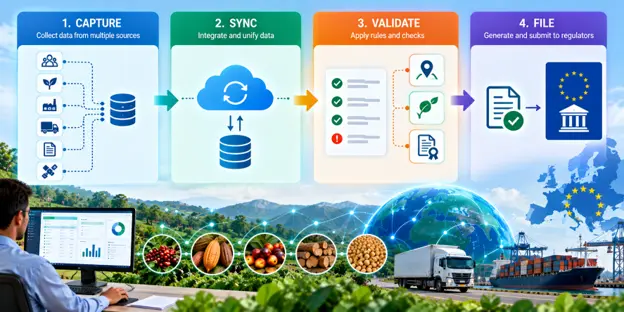
A well-designed EUDR ERP Integration with Oracle typically moves through four layers rather than a single connector. Understanding these layers helps buyers pressure-test any EUDR ERP Integration with Oracle proposal during a demo.
The four-layer integration pattern
Source layer (Oracle): supplier master, item/product master, purchase orders, receipts, and CN/HSN classifications are read from Oracle Fusion Cloud ERP, Oracle E-Business Suite, or Oracle SCM/Procurement Cloud.
Enrichment layer (compliance platform): the platform attaches plot-level geolocation polygons, legality documents, and deforestation risk scores that Oracle does not natively store.
Submission layer (EU Information System): a validated DDS is generated and lodged, using the updated API specifications published under Implementing Regulation (EU) 2026/1565. [verify at EUR-Lex]
Write-back layer (Oracle): the returned DDS reference number is written back to the relevant Oracle records so it flows to downstream orders, invoices, and export documents automatically.
Learn how EUDR APIs can connect your ERP and supply-chain systems with supplier data, geolocation, traceability, risk workflows, and DDS submission reducing manual data transfer and creating a more connected compliance process.
In practice, a robust EUDR ERP Integration with Oracle uses Oracle Integration Cloud (OIC) or the ERP Cloud REST APIs to move this data, rather than flat-file exports. The final write-back layer is the part most teams underestimate: without it, the DDS reference number that downstream operators must reference never makes it back into the transactional flow, and the integration solves only half the problem.
Learn how EUDR interoperability can help connect systems, standardize compliance data, reduce manual data transfers, and create a continuous flow from supplier and source data to traceability, risk assessment and DDS submission.
What a Mature EUDR ERP Integration with Oracle Delivers
A mature EUDR ERP Integration with Oracle removes manual re-keying, gives auditors a single lineage from purchase order to filed DDS, and keeps commodity classification current. Because scope is defined by CN codes in Annex I, and because those codes shift, a strong EUDR ERP Integration with Oracle should let you re-map affected Oracle item lines when the list changes rather than rebuilding a spreadsheet.
This matters right now. The 13 July 2026 Delegated Act amending Annex I adds soluble coffee (CN 2101 11 00) and a range of palm oil derivatives while removing cattle leather and retreaded tyres, with newly added products becoming subject to the Regulation from 30 December 2027. A future-proof EUDR ERP Integration with Oracle treats the Annex I list as configuration, so a scope change becomes a mapping update, not a project.
Eliminated re-keying between Oracle and standalone compliance tools, reducing DDS submission errors.
End-to-end lineage from Oracle PO and supplier record to the filed DDS and its reference number.
Downstream orders and export docs inherit the DDS reference automatically, protecting shipment continuity.
Dynamic Annex I scope mapping that adapts to Delegated Act changes without a rebuild.
What Good EUDR ERP Integration with Oracle Looks Like in Practice
The strongest EUDR ERP Integration with Oracle projects treat Oracle as the system of record and the compliance platform as the system of engagement. Teams that ran EUDR ERP Integration with Oracle as a data-mapping exercise first, agreeing exactly which Oracle fields carry supplier identity, commodity, CN code, and origin, moved far faster than teams that started with tooling. One recurring lesson: certifications such as FSC, RSPO, Rainforest Alliance, or Fairtrade support risk mitigation but do not replace EUDR geolocation, plot-level evidence, or a filed DDS, so they should sit alongside the DDS record in Oracle, never in place of it.
TraceX EUDR Solutions is built for exactly this handoff: it reads supplier, commodity, and purchase-order data from your Oracle environment, layers on plot-level geolocation and automated deforestation risk assessment, generates and files the DDS to the EU Information System, and writes the DDS reference number back into Oracle so downstream transactions carry it automatically. The result is one deforestation-compliance engine rather than an ERP and a disconnected spreadsheet.
See how TraceX EUDR Solutions reads your Oracle data, files the DDS, and writes the reference number back, in one workflow.
Use these questions when scoping a vendor or an internal build:
Does it read from our specific Oracle stack (Fusion Cloud ERP, E-Business Suite, or SCM Cloud) via OIC or REST APIs, not just flat files?
Does it write the DDS reference number back into Oracle, or only pull data out?
Does it capture plot-level geolocation and automate risk assessment, not just store certificates?
Does it submit to the EU Information System using the current API specifications? [verify at EUR-Lex]
Can Annex I scope be reconfigured when the product list changes, without a rebuild?
Does it preserve a single audit lineage from purchase order to filed DDS?
Frequently Asked Questions
Does EUDR ERP Integration with Oracle replace the EU Information System?
No. The EU Information System remains where the Due Diligence Statement is filed. The integration prepares, validates, and submits the DDS from your Oracle data, then returns the DDS reference number to Oracle. It complements the EU system rather than replacing it. [verify at EUR-Lex]
Which Oracle products can it connect to?
A capable integration should support Oracle Fusion Cloud ERP and Oracle E-Business Suite, and ideally Oracle SCM and Procurement Cloud, typically through Oracle Integration Cloud or ERP Cloud REST APIs. Confirm your exact version and modules during scoping.
When do we need this in place?
EUDR applies from 30 December 2026 for large and medium operators and EUTR-covered micro/small operators, and 30 June 2027 for most other micro/small operators. Because sourcing and system lead times are long, most teams need integration running well before those dates.
Who actually files the DDS in our supply chain?
Under Regulation (EU) 2025/2650, the first operator placing the goods on the EU market files the full DDS. Downstream operators reference its DDS reference number instead of filing again, which is why storing that number correctly in Oracle matters.
Do our certifications cover the requirement?
No. FSC, RSPO, Rainforest Alliance, and Fairtrade support risk mitigation but do not replace EUDR geolocation, plot-level evidence, or a filed DDS. They can be stored alongside the DDS record, not in place of it.
What about the July 2026 Annex I changes?
The 13 July 2026 Delegated Act adds products such as soluble coffee and palm oil derivatives and removes others such as cattle leather; newly added items apply from 30 December 2027. It is adopted but in the scrutiny period, so treat scope mapping as dynamic and re-verify the final text.
Is geolocation stored in Oracle itself?
Usually not. Oracle holds transactional and master data, while plot-level geolocation polygons and risk scores sit in the compliance layer and are linked to the corresponding Oracle records, keeping the ERP clean and the compliance data auditable.
Start using TraceX
Transparency, Trust, & Success for your Climate Journey.
We use cookies on our website to give you the most relevant experience by remembering your preferences and repeat visits. By clicking “Accept All”, you consent to the use of ALL the cookies. However, you may visit "Cookie Settings" to provide a controlled consent.
This website uses cookies to improve your experience while you navigate through the website. Out of these, the cookies that are categorized as necessary are stored on your browser as they are essential for the working of basic functionalities of the website. We also use third-party cookies that help us analyze and understand how you use this website. These cookies will be stored in your browser only with your consent. You also have the option to opt-out of these cookies. But opting out of some of these cookies may affect your browsing experience.
Necessary cookies are absolutely essential for the website to function properly. These cookies ensure basic functionalities and security features of the website, anonymously.
Cookie
Duration
Description
cookielawinfo-checkbox-analytics
11 months
This cookie is set by GDPR Cookie Consent plugin. The cookie is used to store the user consent for the cookies in the category "Analytics".
cookielawinfo-checkbox-functional
11 months
The cookie is set by GDPR cookie consent to record the user consent for the cookies in the category "Functional".
cookielawinfo-checkbox-necessary
11 months
This cookie is set by GDPR Cookie Consent plugin. The cookies is used to store the user consent for the cookies in the category "Necessary".
cookielawinfo-checkbox-others
11 months
This cookie is set by GDPR Cookie Consent plugin. The cookie is used to store the user consent for the cookies in the category "Other.
cookielawinfo-checkbox-performance
11 months
This cookie is set by GDPR Cookie Consent plugin. The cookie is used to store the user consent for the cookies in the category "Performance".
viewed_cookie_policy
11 months
The cookie is set by the GDPR Cookie Consent plugin and is used to store whether or not user has consented to the use of cookies. It does not store any personal data.
Functional cookies help to perform certain functionalities like sharing the content of the website on social media platforms, collect feedbacks, and other third-party features.
Performance cookies are used to understand and analyze the key performance indexes of the website which helps in delivering a better user experience for the visitors.
Analytical cookies are used to understand how visitors interact with the website. These cookies help provide information on metrics the number of visitors, bounce rate, traffic source, etc.
Advertisement cookies are used to provide visitors with relevant ads and marketing campaigns. These cookies track visitors across websites and collect information to provide customized ads.
Download the 2026 Traceability Scorecard and Benchmark Your Supply Chain Across 10 Critical Capabilities.
Download our eBook
Don’t Wait for an Audit to Find Your EUDR Gaps
The 2026 Simplification Package changes how HS codes, DDS pass-through and geolocation rules apply to you. Get the free guide and 20-point readiness checklist before enforcement catches you unprepared.