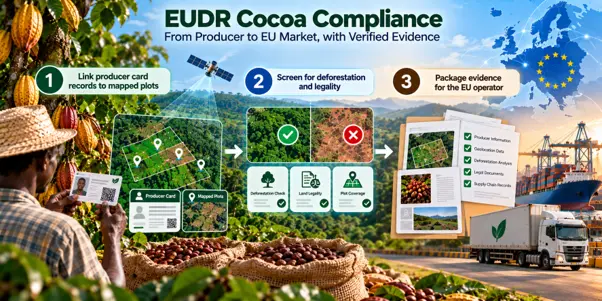
EUDR Cocoa Compliance in Brazil: What You Must Prove
Published
, 6 minute read
Share this article
Quick summary: EUDR cocoa compliance in Brazil starts 30 December 2026. See the plot geolocation, DDS and risk steps exporters and importers need to ship to the EU.
EUDR cocoa compliance in Brazil means proving that every lot of cocoa placed on the EU market comes from identified plots, was not grown on land deforested after 31 December 2020, and was produced legally, then backing that proof with a due diligence statement (DDS). The rules apply to large and medium operators from 30 December 2026 and to micro and small non-timber operators from 30 June 2027. Brazil is a standard-risk country, so full due diligence applies.
Key Takeaways
Brazil is standard risk: full due diligence, and at least 3% of operators checked.
Farms of 5 to 10 hectares are common, so many plots need polygons.
The CAR registry is a useful starting layer, but it is self-declared and not proof.
Bahia and Pará carry different evidence risks and need separate handling.
Certifications support risk mitigation but never replace a filed DDS.
December 2026 is approaching. Is your supply chain actually ready?
Move from spreadsheets and fragmented supplier data to a traceable, audit-ready EUDR workflow with TraceX.
EUDR Cocoa Compliance in Brazil: What the Regulation Requires
EUDR cocoa compliance in Brazil rests on three proofs: deforestation-free land, legal production and plot-level geolocation.
Cocoa is one of seven regulated commodities, alongside cattle, coffee, oil palm, rubber, soya and wood. Derivatives such as chocolate are also in scope. Regulation (EU) 2025/2650, published on 23 December 2025, set the current application dates, and in May 2026 the Commission confirmed it would not reopen the text. For teams planning EUDR cocoa compliance in Brazil, 30 December 2026 is the working deadline.
Deforestation-free: no clearing after the 31 December 2020 cut-off.
Legal: production that follows Brazilian land, environmental and labor rules.
Declared: a DDS filed in the EU information system before goods enter the market.
Discover how cocoa businesses can manage farm-level geolocation, deforestation risk assessment, supplier traceability, due diligence, and risk mitigation to meet EUDR requirements and build transparent, compliant cocoa supply chains. Read the Full Blog →
Brazilian Cocoa Under EUDR: Standard Risk Means Full Due Diligence
EUDR cocoa compliance in Brazil starts at standard risk, so no simplified due diligence applies.
Under the Commission’s country benchmarking, Brazil sits in the standard-risk tier. For EUDR cocoa compliance in Brazil, that means a full risk assessment and, where risk is not negligible, documented mitigation. Competent authorities must check at least 3% of operators sourcing from standard-risk countries, against 1% for low-risk origins. A 2026 benchmarking review means the tier should be reconfirmed.
One point catches Brazilian exporters off guard. The EU importer is usually the operator who files the DDS, but it cannot file without your data. In EUDR cocoa compliance in Brazil, exporters that supply clean polygons, legality documents and risk notes keep orders. Certifications such as Rainforest Alliance or Fairtrade can support risk mitigation, but they never replace plot geolocation or a filed DDS.
Standard risk: full due diligence and 3% operator checks.
The importer files the DDS, and the exporter supplies the evidence.
Certification supports the file, and never replaces it.
EUDR Geolocation for Brazil Cocoa: Plots, Polygons and the CAR
EUDR cocoa compliance in Brazil needs a polygon above 4 hectares and a point at or below, both to six decimals.
Brazil has a head start in the Rural Environmental Registry (Cadastro Ambiental Rural, or CAR), which already holds boundaries for many farms. But CAR is self-declared. Treat it as a starting layer for EUDR cocoa compliance in Brazil, then cross-check every polygon for overlaps, protected areas and clearing after 2020 before it enters a DDS.
Plot size changes the workload. Cocoa farms in Brazil commonly run 5 to 10 hectares, so many plots will cross the 4 hectare line and need a full polygon. Separate fields count as separate plots.
Use CAR as a starting layer, not as proof.
Capture polygons above 4 hectares and points at or below.
Run overlap and post-2020 clearing checks on every plot.
EUDR Cocoa Compliance in Brazil by Region: Bahia and Pará
Bahia and Pará produce about 95% of Brazilian cocoa, and each needs different evidence.
Bahia supplies about 59% of national output and Pará about 36%. Strong EUDR cocoa compliance in Brazil treats them as two separate risk profiles.
Bahia Cocoa Compliance: Cabruca and Atlantic Forest Edges
Bahia has just over 400,000 hectares of cocoa and about 41,000 farmers. Much of it is cabruca, cocoa grown under native Atlantic Forest canopy. Cabruca supports forest cover, but canopy can make satellite checks harder to read, so precise polygons and land-use history matter most.
Pará Cocoa Compliance: Amazon Biome Scrutiny
Pará sits in the Amazon biome, where buyers and auditors look hardest for deforestation links. Expect closer review of land tenure, land use after 2020 and neighboring clearing, plus more field verification.
Bahia: cabruca polygons and canopy history.
Pará: tenure, post-2020 land use and field checks.
EUDR Cocoa Compliance in Brazil: Manual Tracking vs a Platform
Spreadsheets break at plot scale, so EUDR cocoa compliance in Brazil is far easier with one evidence trail.
Capability
Spreadsheets and manual files
Traceability platform
Geolocation capture
Mixed formats and decimal errors
Point and polygon rules enforced by plot size
Deforestation check
Ad hoc map review
Repeatable satellite check against the 2020 cut-off
CAR reconciliation
Manual overlap checks
Overlap flags raised automatically
Legality evidence
Files scattered across email and folders
Stored per plot and per lot
DDS preparation
Hand-built for each shipment
Generated from verified records
Audit readiness
Rebuilt on request
One exportable evidence trail
Brazilian cocoa is not a mapping problem, it is a reconciliation problem. Polygons already exist in CAR, in cooperative files and in buyer surveys, and they rarely agree. TraceX EUDR Solutions is built for EUDR DDS and geolocation workflows, checking plot polygons against satellite data and preparing DDS records for TRACES submission CAR import and Portuguese-language field tools for Brazil are critical components that enable seamless data ingestion and localized field validation, ensuring that all overlapping boundaries are fully reconciled before the final compliance dossier is submitted.
We use cookies on our website to give you the most relevant experience by remembering your preferences and repeat visits. By clicking “Accept All”, you consent to the use of ALL the cookies. However, you may visit "Cookie Settings" to provide a controlled consent.
This website uses cookies to improve your experience while you navigate through the website. Out of these, the cookies that are categorized as necessary are stored on your browser as they are essential for the working of basic functionalities of the website. We also use third-party cookies that help us analyze and understand how you use this website. These cookies will be stored in your browser only with your consent. You also have the option to opt-out of these cookies. But opting out of some of these cookies may affect your browsing experience.
Necessary cookies are absolutely essential for the website to function properly. These cookies ensure basic functionalities and security features of the website, anonymously.
Cookie
Duration
Description
cookielawinfo-checkbox-analytics
11 months
This cookie is set by GDPR Cookie Consent plugin. The cookie is used to store the user consent for the cookies in the category "Analytics".
cookielawinfo-checkbox-functional
11 months
The cookie is set by GDPR cookie consent to record the user consent for the cookies in the category "Functional".
cookielawinfo-checkbox-necessary
11 months
This cookie is set by GDPR Cookie Consent plugin. The cookies is used to store the user consent for the cookies in the category "Necessary".
cookielawinfo-checkbox-others
11 months
This cookie is set by GDPR Cookie Consent plugin. The cookie is used to store the user consent for the cookies in the category "Other.
cookielawinfo-checkbox-performance
11 months
This cookie is set by GDPR Cookie Consent plugin. The cookie is used to store the user consent for the cookies in the category "Performance".
viewed_cookie_policy
11 months
The cookie is set by the GDPR Cookie Consent plugin and is used to store whether or not user has consented to the use of cookies. It does not store any personal data.
Functional cookies help to perform certain functionalities like sharing the content of the website on social media platforms, collect feedbacks, and other third-party features.
Performance cookies are used to understand and analyze the key performance indexes of the website which helps in delivering a better user experience for the visitors.
Analytical cookies are used to understand how visitors interact with the website. These cookies help provide information on metrics the number of visitors, bounce rate, traffic source, etc.
Advertisement cookies are used to provide visitors with relevant ads and marketing campaigns. These cookies track visitors across websites and collect information to provide customized ads.
Download the 2026 Traceability Scorecard and Benchmark Your Supply Chain Across 10 Critical Capabilities.
Download our eBook
Don’t Wait for an Audit to Find Your EUDR Gaps
The 2026 Simplification Package changes how HS codes, DDS pass-through and geolocation rules apply to you. Get the free guide and 20-point readiness checklist before enforcement catches you unprepared.