EPR Requirements in Germany: Registration, Reporting and Compliance Guide
Published
, 10 minute read
Share this article
Quick summary: EPR requirements in Germany explained: LUCID registration, dual-system reporting, VerpackDG deadlines and fines, plus a step-by-step compliance path.
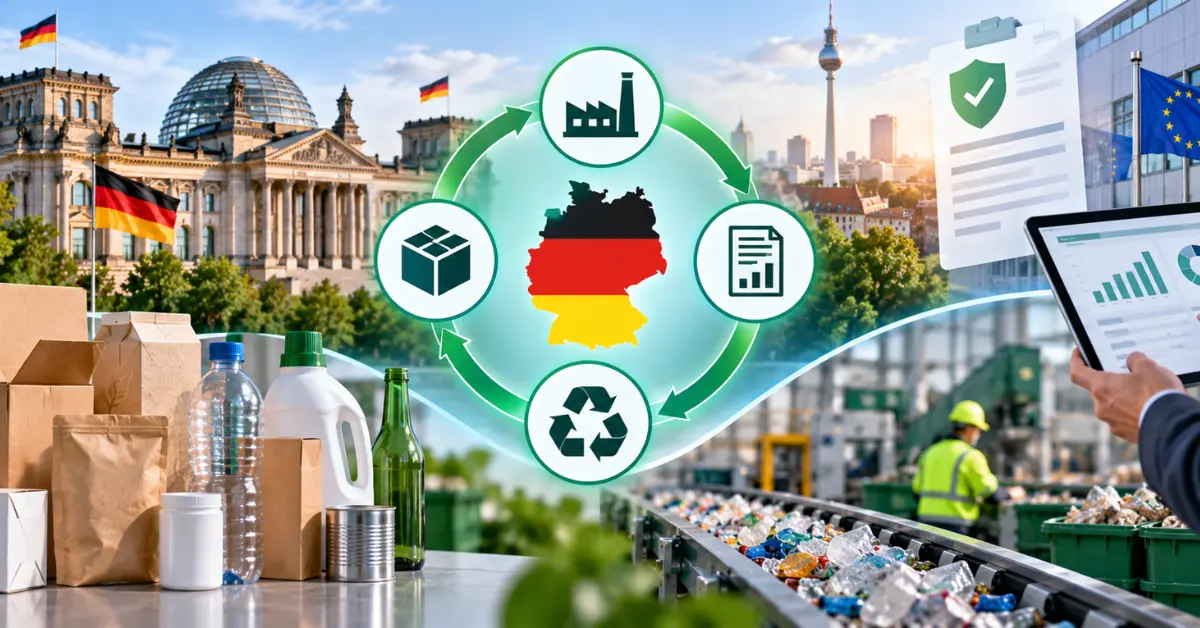
EPR requirements in Germany mean any company that first places packaged goods on the German market must register in the LUCID packaging register, license that packaging with a dual system, and report the same volumes to both the dual system and the ZSVR. Since 12 August 2026 these duties sit under the VerpackDG (the national act implementing the EU PPWR), which replaced the older VerpackG. Missing registration or reporting can trigger sales bans and fines up to 200,000 euros.
Key takeaways
Three core duties: register in LUCID, participate in a dual system, and report volumes to the ZSVR and your dual system.
The legal basis changed: VerpackDG replaced VerpackG on 12 August 2026, aligned to the EU PPWR.
Who is obligated is decided by the PPWR ‘producer’ role, not by who physically makes the packaging.
Non-compliance carries sales bans, fines up to 200,000 euros, profit forfeiture, and competitor cease-and-desist action.
Foreign sellers without a German branch now generally need a German authorised representative recorded in LUCID.
EPR requirements in Germany explained
What obligated companies must do, and where the law now sits.
Register, license, and report packaging placed on the German market.
The governing act is now the VerpackDG, aligned to the EU PPWR.
EPR requirements in Germany apply the moment your business first places packaged goods on the German market, whether you sell direct, through a marketplace, or ship in from abroad. Extended producer responsibility (EPR) is the principle that the company putting packaging into circulation, not the taxpayer, funds its later collection, sorting, and recycling. In plain terms, if your product reaches a German customer in any wrapper, box, or filler, you carry duties for that material.
The framework behind EPR requirements in Germany changed on 12 August 2026. On that date the Packaging Law Implementation Act (VerpackDG) took effect and the older Packaging Act (VerpackG) expired, so companies now operate under national enforcement rules that sit alongside the directly applicable EU Packaging and Packaging Waste Regulation (PPWR). The established German structures carry forward: the dual systems still finance recycling, the LUCID register remains the central database, and the ZSVR (Central Agency Packaging Register) stays the supervisory and registration authority.
EPR registration is only the starting point. Stay ahead by managing your packaging data, EPR obligations, supplier information and compliance evidence in one connected workflow.
EPR requirements in Germany: who counts as a producer
The obligated party is defined by role, and the label matters.
‘Producer’ (EPR duties) is not the same as ‘manufacturer’ (design and conformity duties).
Importers, brand owners, and online sellers are often the producer in Germany.
A common error when reading EPR requirements in Germany is to assume the producer is whoever physically makes the packaging. Under the PPWR the ‘producer’ (Article 3(15)) is the party that first makes packaging available on a national market, which is frequently the brand owner, importer, or e-commerce seller, not the packaging supplier. That is separate from the PPWR ‘manufacturer’ (Article 3(13)), who handles packaging design and the EU Declaration of Conformity. Keep the two roles distinct, because EPR volume reporting and the Declaration of Conformity are different instruments with different owners.
Getting this mapping right is the first practical step in meeting EPR requirements in Germany. If you import finished, packaged goods, you are usually the producer for that packaging. If you fill and pack products yourself before selling into Germany, the same conclusion applies. Marketplace sellers should note that platforms must now check for a valid registration, so an unmapped role quickly turns into blocked listings.
Working with a Producer Responsibility Organization (PRO) is only one part of your packaging compliance journey. You still need accurate packaging data, supplier evidence, EPR records and reporting workflows.
EPR registration requirements in Germany (LUCID)
Register before your first sale, and register the right way.
Registration in LUCID is free but mandatory before placing packaging on the market.
Foreign producers without a German branch generally appoint an authorised representative.
Registration sits at the front of EPR requirements in Germany. You must enter your company and packaging details in the LUCID register operated by the ZSVR before you place packaging on the market for the first time. Registration itself costs nothing, but it is not optional and it is publicly visible, which means competitors can check your status and act on gaps. Without a valid LUCID number, distribution is legally banned and marketplaces will suspend listings.
A newer layer of EPR requirements in Germany concerns foreign sellers. Since 12 August 2026, qualifying producers established outside Germany and without a German branch generally must appoint a German authorised representative. The appointment has to be recorded in LUCID and confirmed by the ZSVR before it takes legal effect, only one active representative is allowed, and the mandate needs a written agreement in German. Existing LUCID registrations stay valid, but changes required by the new law should be filed within the transition window.
EPR reporting requirements in Germany (dual system and data)
License your packaging, then report matching volumes to both sides.
Sign a dual-system (system participation) contract for packaging that qualifies.
Report identical volumes to your dual system and to the ZSVR.
Reporting is where EPR requirements in Germany become an ongoing operational task rather than a one-off. For packaging subject to system participation, you license it by signing a contract with an approved dual system such as Der Grune Punkt, Interseroh+, or Zentek. That system then finances the collection and recycling of your packaging once it becomes waste.
The reporting duty within EPR requirements in Germany is specific: you report the same packaging volumes, broken down by material, to both your dual system and the ZSVR, and the two figures must match. The PPWR also introduces eco-modulated EPR fees, so fees increasingly reflect how recyclable a given packaging design is, which rewards cleaner materials and penalises hard-to-recycle formats [verify against final fee schedules]. Single-use beverage packaging subject to deposit (Pfand) follows its own return system, yet the LUCID registration duty still applies to it.
Understanding PPWR compliance requirements is only the first step. The real challenge is collecting the right packaging data, managing supplier evidence, tracking compliance obligations and maintaining an audit-ready record.
EPR compliance requirements in Germany: deadlines and penalties
Know the transition dates and what non-compliance costs.
Newly obligated companies faced a September 2026 registration deadline; existing profiles update by November 2026.
Fines reach 200,000 euros, plus sales bans and profit forfeiture.
Compliance under EPR requirements in Germany runs on a concrete calendar. VerpackDG entered into force on 12 August 2026. Newly obligated companies were expected to complete registration with the ZSVR by 12 September 2026, and existing registered entities were asked to update their profiles by 12 November 2026. Existing system participation contracts continue until 31 December 2026, and the annual packaging data report is due by 15 May of the following year. Full enforcement of administrative fines lands in February 2027
The penalties attached to EPR requirements in Germany are real and enforced. Depending on the breach, fines can reach 200,000 euros, with the highest amounts reserved for placing system-participation packaging on the market without proper participation or selling despite a distribution ban. Breaches of registration and reporting duties can draw fines up to 100,000 euros. Add profit forfeiture, automatic sales bans without a valid LUCID number, and civil cease-and-desist action from competitors who can read the public register, and the cost of getting this wrong climbs fast.
For multi-market sellers, EPR requirements in Germany are one node in a wider EU picture. The PPWR requires separate registration in the national register of each target market, so a German LUCID entry does not cover France, Spain, or Italy. Treating Germany as a disconnected task, rather than part of a coordinated EU registration and reporting programme, is where teams tend to lose control of volumes and deadlines.
Most teams do not fail EPR requirements in Germany because the rules are unknowable; they fail because packaging data lives in spreadsheets across procurement, suppliers, and logistics, and the numbers never reconcile at reporting time. The TraceX PPWR platform centralises packaging specifications, material weights, and volumes in one structured record so the figures sent to your dual system and the ZSVR come from a single source . When roles, materials, and volumes are captured once and reused, registration, licensing, and annual reporting stop being a scramble and become a repeatable workflow.
See how the TraceX PPWR platform centralises packaging data for LUCID registration and ZSVR reporting.
Producer vs manufacturer decided ad hoc, easy to mis-assign
Role captured against each SKU and packaging component
LUCID data
Details re-keyed each cycle from scattered files
Registration data held once and reused
Volume reporting
Dual-system and ZSVR figures reconciled by hand, often mismatch
Matched volumes generated from one dataset
Deadlines
Tracked in personal calendars, easy to miss
Reporting cycles flagged centrally
Multi-market
Each EU country handled as a separate project
Country registers managed from one packaging record
Audit trail
Evidence rebuilt reactively during disputes
Supplier evidence and history retained
Buyer evaluation checklist
Use this to pressure-test any EPR compliance approach before you commit:
▢ Does it map the producer role per SKU, not just per company?
▢ Can it hold LUCID registration data and reuse it each cycle?
▢ Does it produce matching dual-system and ZSVR volume figures from one dataset?
▢ Does it separate EPR volume reporting from the PPWR Declaration of Conformity?
▢ Can it flag German transition and annual reporting deadlines?
▢ Does it scale to registers in other EU markets without duplicate data entry?
▢ Does it retain supplier evidence for audit and competitor challenges?
Frequently Asked Questions
What are the EPR requirements in Germany in simple terms?
Register your packaging in the LUCID register, license it with an approved dual system, and report matching volumes to both the dual system and the ZSVR. These duties apply before you place packaged goods on the German market.
Is VerpackG still the law for packaging EPR in Germany?
No. VerpackG expired at the end of 11 August 2026 and was replaced by the VerpackDG on 12 August 2026, which implements the EU PPWR at national level. LUCID, the dual systems, and the ZSVR continue under the new act.
Who is the ‘producer’ responsible for EPR in Germany?
The producer is the party that first places packaging on the German market, often the brand owner, importer, or online seller. This is a different role from the PPWR ‘manufacturer’, who handles packaging design and the Declaration of Conformity.
Do foreign companies need to register for EPR in Germany?
Yes, if you place packaged goods on the German market. Producers without a German branch generally also need a German authorised representative, recorded in LUCID and confirmed by the ZSVR before it takes effect.
What are the penalties for non-compliance?
Fines can reach 200,000 euros, alongside automatic sales bans without a valid LUCID number, profit forfeiture, and cease-and-desist action from competitors who can view the public register.
What is the difference between registration and system participation?
Registration means entering your details in LUCID. System participation means signing a licensing contract with a dual system for packaging that qualifies. Most obligated companies must do both, then report volumes.
When is the annual packaging data report due?
The annual volume report is generally due by 15 May of the following year, reported identically to your dual system and the ZSVR. Confirm your exact obligations against current ZSVR guidance.
Start using TraceX
Transparency, Trust, & Success for your Climate Journey.
We use cookies on our website to give you the most relevant experience by remembering your preferences and repeat visits. By clicking “Accept All”, you consent to the use of ALL the cookies. However, you may visit "Cookie Settings" to provide a controlled consent.
This website uses cookies to improve your experience while you navigate through the website. Out of these, the cookies that are categorized as necessary are stored on your browser as they are essential for the working of basic functionalities of the website. We also use third-party cookies that help us analyze and understand how you use this website. These cookies will be stored in your browser only with your consent. You also have the option to opt-out of these cookies. But opting out of some of these cookies may affect your browsing experience.
Necessary cookies are absolutely essential for the website to function properly. These cookies ensure basic functionalities and security features of the website, anonymously.
Cookie
Duration
Description
cookielawinfo-checkbox-analytics
11 months
This cookie is set by GDPR Cookie Consent plugin. The cookie is used to store the user consent for the cookies in the category "Analytics".
cookielawinfo-checkbox-functional
11 months
The cookie is set by GDPR cookie consent to record the user consent for the cookies in the category "Functional".
cookielawinfo-checkbox-necessary
11 months
This cookie is set by GDPR Cookie Consent plugin. The cookies is used to store the user consent for the cookies in the category "Necessary".
cookielawinfo-checkbox-others
11 months
This cookie is set by GDPR Cookie Consent plugin. The cookie is used to store the user consent for the cookies in the category "Other.
cookielawinfo-checkbox-performance
11 months
This cookie is set by GDPR Cookie Consent plugin. The cookie is used to store the user consent for the cookies in the category "Performance".
viewed_cookie_policy
11 months
The cookie is set by the GDPR Cookie Consent plugin and is used to store whether or not user has consented to the use of cookies. It does not store any personal data.
Functional cookies help to perform certain functionalities like sharing the content of the website on social media platforms, collect feedbacks, and other third-party features.
Performance cookies are used to understand and analyze the key performance indexes of the website which helps in delivering a better user experience for the visitors.
Analytical cookies are used to understand how visitors interact with the website. These cookies help provide information on metrics the number of visitors, bounce rate, traffic source, etc.
Advertisement cookies are used to provide visitors with relevant ads and marketing campaigns. These cookies track visitors across websites and collect information to provide customized ads.
Download the 2026 Traceability Scorecard and Benchmark Your Supply Chain Across 10 Critical Capabilities.
Download our eBook
Don’t Wait for an Audit to Find Your EUDR Gaps
The 2026 Simplification Package changes how HS codes, DDS pass-through and geolocation rules apply to you. Get the free guide and 20-point readiness checklist before enforcement catches you unprepared.