Goals of Farm Management: Why Digitization Is How You Actually Hit Them
Published
, 9 minute read
Share this article
Quick summary: Goals of farm management—productivity, sustainability, profit and compliance—are hard to hit manually. See how farm digitization delivers each one.
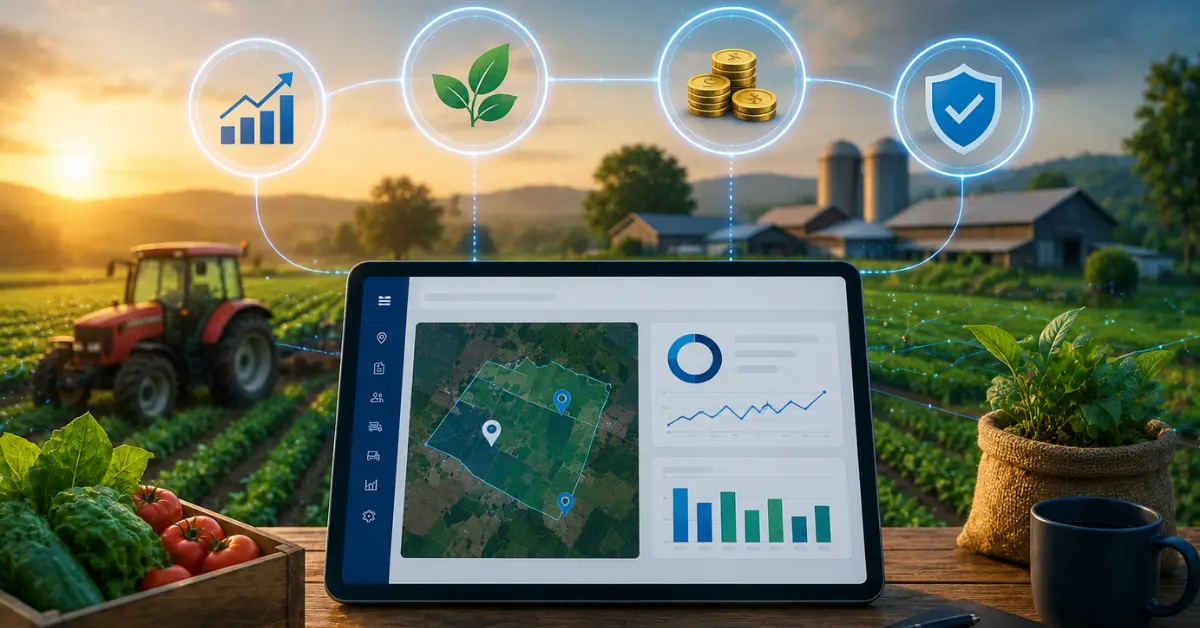
The goals of farm management are the outcomes a farming operation is run to achieve: maximising productivity, ensuring long-term sustainability, protecting profitability, and maintaining traceability for compliance and market access. In modern agriculture these goals are increasingly met through farm digitization replacing spreadsheets and paper with a farm management platform that captures farmer, plot and crop data at source, turns it into real-time insight, and produces audit-ready records buyers and regulators can trust.
Key takeaways
Four goals, one system. There are four buyer-relevant goals of farm management: productivity, sustainability, profitability, and traceability/compliance.
Manual falls short. Spreadsheets and paper records can describe these goals but rarely deliver them at scale, across many farmers and plots.
Digitization is the lever. Farm digitization connects field data to decisions, so each goal becomes measurable and repeatable.
Proof, not promises. A digital farm management platform turns these goals into evidence dashboards, records and compliance-ready exports.
See how digital tools can help you streamline farmer onboarding, farm records, field activities, procurement, traceability and sustainability tracking and turn farm-level data into actionable insights.
The goals of farm management are the high-level outcomes a farm is run to achieve, and getting them right is the difference between a resilient business and one that lurches from season to season. In plain terms, farm management is the practice of planning, organising and controlling farm operations so that resources land, labour, water, inputs and capital produce the best possible result. The goals of farm management give that work direction; the day-to-day tasks are how you get there.
It helps to separate two things. The goals describe the destination (what “good” looks like), while the objectives break that destination into specific, measurable steps. If you want the operational breakdown, see our guide to the objectives of farm management; for how far the discipline reaches across the operation, see the scope of farm management. This page focuses on the goals themselves and, for a buyer, on the practical question of how you actually reach them once your operation is too big to run from memory and a stack of notebooks.
For the full picture, this article sits under our farm management guide
The Four Core Goals of Farm Management
Older framings talk about “two goals” (yield and sustainability). For a business evaluating technology, that is too narrow. The buyer-relevant goals of farm management are four, and each maps to a decision you are already trying to make:
1. Productivity — get more from the same land
The first goal is maximising output per acre without simply spending more. That means the right crop choices, disciplined crop rotation, and precision agriculture so water, fertiliser and labour go exactly where they are needed. Productivity is one of the farm management goals that responds fastest to better data because most waste comes from acting on guesswork rather than field-level facts.
2. Sustainability — keep the land productive for the long run
The second goal is protecting soil, water and biodiversity so the farm stays viable season after season. Sustainable farm management covers soil-health practices, water conservation and lowering the carbon footprint. Among these goals this is the one buyers increasingly must prove, not just pursue because customers and financiers now ask for evidence.
3. Profitability — control cost and protect margin
Higher yield means little if input costs, wastage and rework eat the gain. Profitability as a goal of farm management is about visibility into where money is spent and lost inputs distributed, labour deployed, produce rejected so decisions improve margin, not just volume.
4. Traceability & compliance — earn market access
The newest of the goals of farm management is provable origin. Buyers, retailers and regulations increasingly require farm-level records who grew it, where, and how. Farm-level sustainability data and traceability are now a condition of doing business in many export and ESG-reporting supply chains, not a nice-to-have.
Most operations don’t fail to hit the goals of farm management because they lack ambitionthey fail because the data to act on lives in scattered spreadsheets, WhatsApp messages and field notebooks. You cannot manage what you cannot see. Digitization isn’t a fifth goal; it is the operating layer that makes the other four achievable and, crucially, provable.
Read our guide on the Objectives of Farm Management to understand the key goals businesses should focus on and how digital farm management systems can help turn those objectives into measurable outcomes.
Why Manual Methods Miss the Goals of Farm Management
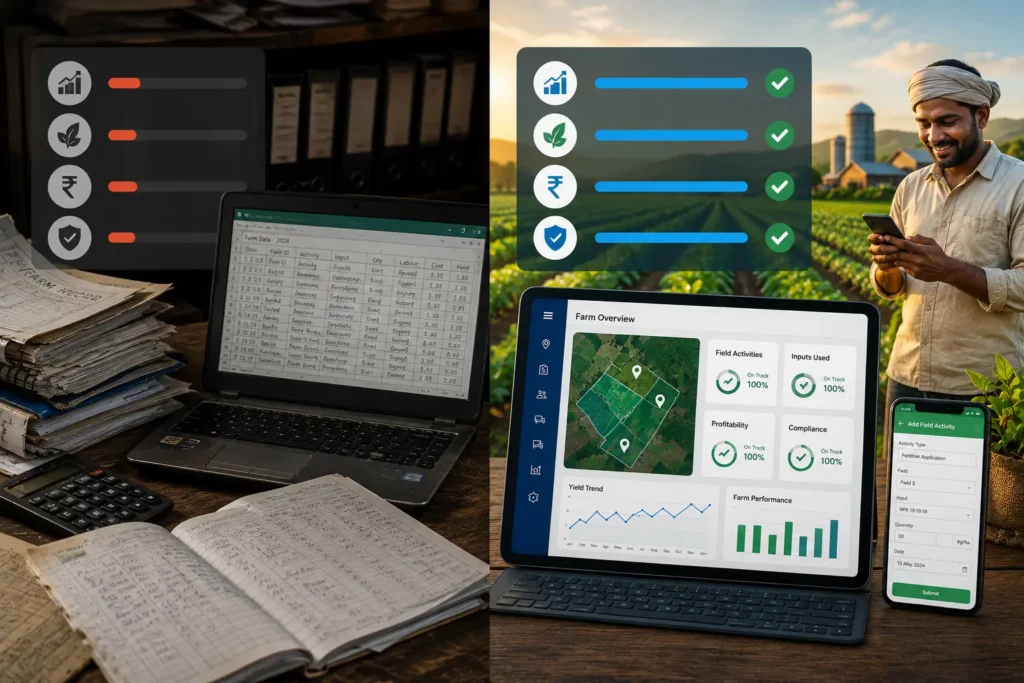
Here is the buyer’s real problem. Spreadsheets and paper can record intentions, but they break down exactly where the goals of farm management need them most:
Blind spots. Data is captured late and often re-keyed, so decisions are made on stale or wrong numbers.
No aggregation. Field notes don’t roll up. With hundreds of farmers and plots, no one has a live view of the whole operation.
Unprovable claims. Sustainability and traceability claims can’t be verified, so they fail buyer and regulator scrutiny.
Audit pain. Every audit becomes a manual scramble, pulling records together after the fact instead of on demand.
In other words, manual methods can describe these goals but rarely deliver them consistently once an operation reaches real scale. That gap between goals on paper and results in the field is what farm digitization is built to close.
How Farm Digitization Delivers Each Goal of Farm Management
This is where digital farm management changes the equation. A farm management platform connects what happens in the field to the decisions in the office, so the goals of farm management stop being aspirations and become measurable, repeatable outcomes.
The TraceX Farm Management Platform is designed to help agribusinesses, producer organisations and foundations run field operations against every one of these goals:
Productivity: a mobile, offline-first app captures farmer, plot and crop data at source, even in low-bandwidth areas, so productivity decisions run on real field data, not guesswork.
Sustainability: GPS and satellite plot mapping, input tracking and dashboards make soil, water and carbon practices visible and reportable.
Profitability: a single farmer ledger links identity, plots, inputs, deliveries and payments, exposing where cost and wastage occur.
Traceability: plot-level, blockchain-backed records and audit-ready exports turn origin claims into evidence buyers and regulators accept.
The pattern is consistent: each of these goals is served by capturing data once, at the point of work, then reusing it everywhere operations, reporting and compliance. That is the core benefit of farm digitization, and it is why buyers evaluating the goals of farm management increasingly start with the platform question, not the practice question.
Track every farmer, plot and crop in one platform and turn your farm management goals into records you can show a buyer or auditor.
Read our guide on Farm Management for Traceability to understand how digital farm management can connect farm-level data, sourcing, field activities and downstream traceability creating greater visibility from farm to finished product.
Choosing a Platform to Meet Your Goals of Farm Management
If you’re evaluating tools, judge each one against your farm management goals directly. Use this checklist on any demo:
☐Field-first capture: Does it capture farmer and plot data offline, at source, with minimal friction for field teams?
☐Aggregation: Do individual records roll up into a live, whole-operation view across all farmers and plots?
☐Sustainability evidence: Can it map plots (GPS/polygon) and track the inputs behind your sustainability claims?
☐Profitability visibility: Does a farmer ledger connect inputs, deliveries and payments so you can see margin, not just volume?
☐Compliance-ready: Can it produce audit-ready, plot-level traceability exports on demand for buyers and regulators?
☐Scale & fit: Will it scale to your full sourcing network, not just a pilot, and integrate with your existing systems?
Score each platform against all six. The right choice is the one that turns your farm management goals into outputs you can show a customer, an auditor or a lender not just describe in a meeting.
Frequently Asked Questions
What are the main goals of farm management?
The main goals of farm management are maximising productivity, ensuring long-term sustainability, protecting profitability, and maintaining traceability for compliance and market access. Older sources list two (yield and sustainability); for a business evaluating technology, the four-goal view is more useful.
How do goals and objectives of farm management differ?
Goals describe the destination what success looks like while objectives are the specific, measurable steps to get there. See our objectives of farm management for the actionable breakdown.
Why is farm digitization important for these goals?
Because the goals of farm management depend on data you can act on and prove. Digitization captures field data once, at source, and reuses it for operations, reporting and compliance so goals become measurable outcomes instead of intentions.
Can a small operation pursue the same goals of farm management?
Yes. The goals are the same at any size; what changes is the tooling. Smaller operations often start with mobile data capture and plot mapping, then add reporting and traceability as buyer requirements grow.
How does a farm management platform support sustainability goals?
By mapping plots and tracking inputs, water and practices, a platform makes sustainable farm management measurable and reportable turning claims into evidence for buyers and ESG reporting.
Do buyers really require farm-level traceability now?
Increasingly, yes. Many export, retail and ESG-reporting supply chains now treat plot-level origin data as a condition of doing business, which is why traceability has become one of the core goals of farm management.
What’s the fastest first step toward these goals?
Digitize data capture in the field. Once farmer and plot data is flowing into one system, every other goal productivity, profitability, sustainability, compliance gets easier. A demo of the farm management platform is the quickest way to see it applied to your crops and geographies.
Start using TraceX
Transparency, Trust, & Success for your Climate Journey.
We use cookies on our website to give you the most relevant experience by remembering your preferences and repeat visits. By clicking “Accept All”, you consent to the use of ALL the cookies. However, you may visit "Cookie Settings" to provide a controlled consent.
This website uses cookies to improve your experience while you navigate through the website. Out of these, the cookies that are categorized as necessary are stored on your browser as they are essential for the working of basic functionalities of the website. We also use third-party cookies that help us analyze and understand how you use this website. These cookies will be stored in your browser only with your consent. You also have the option to opt-out of these cookies. But opting out of some of these cookies may affect your browsing experience.
Necessary cookies are absolutely essential for the website to function properly. These cookies ensure basic functionalities and security features of the website, anonymously.
Cookie
Duration
Description
cookielawinfo-checkbox-analytics
11 months
This cookie is set by GDPR Cookie Consent plugin. The cookie is used to store the user consent for the cookies in the category "Analytics".
cookielawinfo-checkbox-functional
11 months
The cookie is set by GDPR cookie consent to record the user consent for the cookies in the category "Functional".
cookielawinfo-checkbox-necessary
11 months
This cookie is set by GDPR Cookie Consent plugin. The cookies is used to store the user consent for the cookies in the category "Necessary".
cookielawinfo-checkbox-others
11 months
This cookie is set by GDPR Cookie Consent plugin. The cookie is used to store the user consent for the cookies in the category "Other.
cookielawinfo-checkbox-performance
11 months
This cookie is set by GDPR Cookie Consent plugin. The cookie is used to store the user consent for the cookies in the category "Performance".
viewed_cookie_policy
11 months
The cookie is set by the GDPR Cookie Consent plugin and is used to store whether or not user has consented to the use of cookies. It does not store any personal data.
Functional cookies help to perform certain functionalities like sharing the content of the website on social media platforms, collect feedbacks, and other third-party features.
Performance cookies are used to understand and analyze the key performance indexes of the website which helps in delivering a better user experience for the visitors.
Analytical cookies are used to understand how visitors interact with the website. These cookies help provide information on metrics the number of visitors, bounce rate, traffic source, etc.
Advertisement cookies are used to provide visitors with relevant ads and marketing campaigns. These cookies track visitors across websites and collect information to provide customized ads.
Download the 2026 Traceability Scorecard and Benchmark Your Supply Chain Across 10 Critical Capabilities.
Download our eBook
Don’t Wait for an Audit to Find Your EUDR Gaps
The 2026 Simplification Package changes how HS codes, DDS pass-through and geolocation rules apply to you. Get the free guide and 20-point readiness checklist before enforcement catches you unprepared.