EUDR Rubber Compliance in Indonesia: What Exporters Must Prove
Published
, 7 minute read
Share this article
Quick summary: EUDR Rubber Compliance in Indonesia starts 30 Dec 2026. See what exporters must prove, how to map smallholder plots and build buyer-ready due diligence data.
EUDR Rubber Compliance in Indonesia means proving that every lot of natural rubber shipped to the EU was grown on land not deforested after 31 December 2020, was produced legally under Indonesian law, and can be traced to plot-level GPS coordinates. Obligations apply from 30 December 2026 for large and medium operators and traders, and from 30 June 2027 for micro and small operators.
Key Takeaways
Indonesia is benchmarked as standard risk, so EU buyers must run full due diligence on Indonesian rubber.
Every supplying plot needs geolocation: a GPS point for plots up to 4 hectares, a polygon above that.
Smallholders supply most of Indonesia’s rubber, so the collector and dealer layers are where traceability breaks.
Certifications support risk mitigation but never replace the Due Diligence Statement or plot-level evidence.
Exporters who hand buyers complete, verified data packs will keep EU market access.
EUDR Rubber Compliance in Indonesia is now a commercial requirement, not a future concern. Indonesia is the world’s second-largest natural rubber producer after Thailand, and the EU is a key market for its Standard Indonesian Rubber (SIR), latex and tyre-grade material.
In plain language, EUDR compliance for rubber means your EU buyer can show, with evidence, that your rubber did not come from land cleared after 2020 and was produced legally. On 4 May 2026 the European Commission published its simplification review and confirmed there will be no further delay, so the 30 December 2026 date holds.
December 2026 is approaching. Is your supply chain actually ready?
Move from spreadsheets and fragmented supplier data to a traceable, audit-ready EUDR workflow with TraceX.
EUDR Rubber Compliance in Indonesia: Deadlines, Scope and Responsibility
For EUDR Rubber Compliance in Indonesia, the dates are confirmed, the product list is refined, and the filing duty sits with the EU operator while the data burden sits with you.
Application dates by company size
Rubber products still in scope after the July 2026 Delegated Act
Who files the Due Diligence Statement
EUDR Rubber Compliance Dates for Indonesian Supply Chains
30 December 2026 for large and medium operators, traders and downstream operators of all sizes; 30 June 2027 for micro and small operators outside the timber sector. Regulation (EU) 2025/2650 set these dates in December 2025, and the Commission did not reopen them in its 2026 review.
EUDR Rubber Products Still in Scope
Natural rubber in primary forms (HS 4001), including latex, ribbed smoked sheets and technically specified grades such as SIR, remains fully in scope, as do new pneumatic tyres. A Delegated Act adopted on 13 July 2026 removes retreaded tyres, certain articles of vulcanised rubber, and conveyor and transmission belts. Synthetic rubber was never covered.
EUDR Rubber Due Diligence Statement: Who Files It
The operator that first places rubber on the EU market, or exports it, files the Due Diligence Statement (DDS) in the EU Information System. Indonesian exporters usually do not file, but buyers cannot file without your geolocation, legality and supplier data. No data, no DDS, no shipment.
Learn how Indonesian rubber exporters can meet EUDR requirements, validate geolocation data, and build a defensible compliance workflow. Read the Guide →
EUDR Rubber Compliance in Indonesia: Why Smallholder Supply Is the Hard Part
Most EUDR Rubber Compliance in Indonesia failures start upstream, where rubber passes through tappers, collectors and dealers before reaching a factory.
Smallholders dominate production
Blending at factory level hides origin
Land and legality records are often informal
Industry estimates put the smallholder share of Indonesian rubber output above 80%, spread across Sumatra, Kalimantan and other provinces. Latex and cup lump usually move from tappers to village collectors and regional dealers before a crumb rubber factory blends them into SIR bales. By then, one shipment may contain material from thousands of plots.
Understand the key EUDR requirements for smallholder supply chains and how to build a compliant, traceable sourcing process. Read the Guide →
Three gaps show up again and again:
Plot data: Many smallholders have no mapped plot boundary, and coverage of plantation registration (STDB) remains limited.
Mixing: The EUDR does not accept mass balance. A blended lot must list every plot that contributed to it.
Legality: Land tenure, labour and forestry documents are frequently missing or informal.
EUDR Rubber Compliance Requirements for Indonesian Exporters
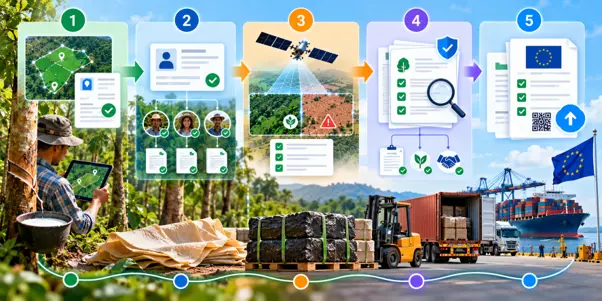
EUDR Rubber Compliance in Indonesia rests on four pillars of evidence that you must supply to your buyer.
Deforestation-free: No deforestation or forest degradation after 31 December 2020, verified against satellite imagery.
Legal production: Compliance with Indonesian law on land use, environment, labour, human rights, tax and anti-corruption, including free, prior and informed consent where it applies.
Geolocation: Coordinates for every plot, to six decimal places: a point for plots up to 4 hectares, a polygon for larger plots.
Records: Supporting evidence retained for five years.
Because Indonesia is classified as standard risk, buyers cannot use the simplified due diligence open to low-risk origins. Expect requests for risk assessments and proof of mitigation for any plot near forest areas. EU operators face fines of at least 4% of their EU annual turnover, confiscation and market exclusion, which is why buyers are tightening supplier requirements now.
Certifications such as FSC or Rainforest Alliance strengthen risk mitigation, but they do not replace the DDS, plot-level geolocation or verifiable deforestation and legality evidence.
Understand what certifications can—and cannot—prove under EUDR, and what additional due diligence your supply chain may need. Read the Guide →
EUDR Rubber Compliance in Indonesia: Manual Process vs Platform
Spreadsheets fail at smallholder scale; a platform keeps EUDR Rubber Compliance in Indonesia data, risk checks and buyer packs in one auditable record.
Where manual workflows break down
What a traceability platform changes for exporters
Compliance task
Manual approach
Platform approach
Plot geolocation
GPS points noted on paper or phones, re-keyed into spreadsheets
Offline mobile capture with polygon checks at source
Deforestation check
Ad hoc satellite review, plot by plot
Automated screening against the 2020 cutoff
Collector and dealer flows
Delivery notes, often lost at blending
Lot-level links from plot to bale
Legality documents
Scattered across emails and folders
Central store with expiry alerts
Buyer DDS data
Manual exports with format errors
Information System-ready data packs
Five-year records
Paper files that are hard to audit
Timestamped audit trail
How TraceX supports EUDR Rubber Compliance in Indonesia
TraceX EUDR Solutions captures plot polygons offline through multilingual field apps built for smallholder settings, screens each plot against satellite deforestation data referenced to 31 December 2020, uses agentic AI to extract land and legality records from supplier documents, and generates Information System-ready DDS data for EU buyers. The result: one record from tapper to bale that your buyer can file against.
Ready to close your EUDR rubber data gaps?
See plot mapping, deforestation screening and DDS data packs on your own Indonesian supply chain.
EUDR Rubber Compliance Checklist for Indonesian Exporters
Use this checklist to rate your EUDR Rubber Compliance in Indonesia readiness, or to evaluate any traceability platform before you buy.
Every supplying plot mapped as a point or polygon, with six-decimal coordinates
Collector and dealer flows recorded down to each delivery
Satellite deforestation check completed against the 31 December 2020 cutoff
Land tenure and legality documents collected and current
Segregated lots, or a full plot list for every blended lot
Data exports that match the EU Information System format
Five-year retention with a tamper-evident audit trail
Field tools that work offline and in Bahasa Indonesia
Frequently Asked Questions
Is Indonesian rubber classified as high risk under the EUDR?
No. The Commission’s May 2025 benchmarking classifies Indonesia as standard risk, so EU operators must run full due diligence rather than the simplified version for low-risk countries.
Do Indonesian exporters submit the Due Diligence Statement?
Usually not. The EU operator files the DDS, but it depends entirely on the geolocation and legality data you provide.
Does synthetic rubber fall under the EUDR?
No. Only natural rubber and listed products made from it are covered.
Can smallholder rubber still be sold to the EU?
Yes. EUDR Rubber Compliance in Indonesia is achievable for smallholder supply when every plot is mapped, checked against the 2020 cutoff and backed by legality evidence.
Is an FSC or Rainforest Alliance certificate enough?
No. Certification supports risk mitigation, but EU buyers still need plot-level geolocation, deforestation and legality proof, and a filed DDS.
What happens to non-compliant rubber shipments?
They can be held at the EU border, and the EU operator faces fines, confiscation and possible market exclusion.
Start using TraceX
Transparency, Trust, & Success for your Climate Journey.
We use cookies on our website to give you the most relevant experience by remembering your preferences and repeat visits. By clicking “Accept All”, you consent to the use of ALL the cookies. However, you may visit "Cookie Settings" to provide a controlled consent.
This website uses cookies to improve your experience while you navigate through the website. Out of these, the cookies that are categorized as necessary are stored on your browser as they are essential for the working of basic functionalities of the website. We also use third-party cookies that help us analyze and understand how you use this website. These cookies will be stored in your browser only with your consent. You also have the option to opt-out of these cookies. But opting out of some of these cookies may affect your browsing experience.
Necessary cookies are absolutely essential for the website to function properly. These cookies ensure basic functionalities and security features of the website, anonymously.
Cookie
Duration
Description
cookielawinfo-checkbox-analytics
11 months
This cookie is set by GDPR Cookie Consent plugin. The cookie is used to store the user consent for the cookies in the category "Analytics".
cookielawinfo-checkbox-functional
11 months
The cookie is set by GDPR cookie consent to record the user consent for the cookies in the category "Functional".
cookielawinfo-checkbox-necessary
11 months
This cookie is set by GDPR Cookie Consent plugin. The cookies is used to store the user consent for the cookies in the category "Necessary".
cookielawinfo-checkbox-others
11 months
This cookie is set by GDPR Cookie Consent plugin. The cookie is used to store the user consent for the cookies in the category "Other.
cookielawinfo-checkbox-performance
11 months
This cookie is set by GDPR Cookie Consent plugin. The cookie is used to store the user consent for the cookies in the category "Performance".
viewed_cookie_policy
11 months
The cookie is set by the GDPR Cookie Consent plugin and is used to store whether or not user has consented to the use of cookies. It does not store any personal data.
Functional cookies help to perform certain functionalities like sharing the content of the website on social media platforms, collect feedbacks, and other third-party features.
Performance cookies are used to understand and analyze the key performance indexes of the website which helps in delivering a better user experience for the visitors.
Analytical cookies are used to understand how visitors interact with the website. These cookies help provide information on metrics the number of visitors, bounce rate, traffic source, etc.
Advertisement cookies are used to provide visitors with relevant ads and marketing campaigns. These cookies track visitors across websites and collect information to provide customized ads.
Download the 2026 Traceability Scorecard and Benchmark Your Supply Chain Across 10 Critical Capabilities.
Download our eBook
Don’t Wait for an Audit to Find Your EUDR Gaps
The 2026 Simplification Package changes how HS codes, DDS pass-through and geolocation rules apply to you. Get the free guide and 20-point readiness checklist before enforcement catches you unprepared.