EUDR Cocoa Compliance in Nigeria: What Exporters Must Prove
Published
, 7 minute read
Share this article
Quick summary: EUDR cocoa compliance in Nigeria explained: plot mapping, legality proof and DDS-ready lot records exporters need before the 30 December 2026 deadline.
EUDR cocoa compliance in Nigeria means proving that every cocoa lot shipped to the EU comes from geolocated plots with no deforestation after 31 December 2020, was produced legally under Nigerian law, and is covered by a due diligence statement (DDS) before it enters the EU market.
Key takeaways
The rules apply from 30 December 2026 for large and medium EU operators, and 30 June 2027 for micro and small operators.
Nigeria is classed as standard risk, so full risk assessment and mitigation apply to every lot.
The EU operator files the DDS, but EUDR cocoa compliance in Nigeria depends on the exporter supplying plot-level evidence.
The biggest gap is the first mile, where smallholder cocoa is bulked before its origin is recorded.
December 2026 is approaching. Is your supply chain actually ready?
Move from spreadsheets and fragmented supplier data to a traceable, audit-ready EUDR workflow with TraceX.
EUDR cocoa compliance in Nigeria is now a condition of EU market access for every exporter shipping beans, butter, paste or powder. In plain terms, each cocoa lot must come from a mapped plot not deforested since 31 December 2020, be produced under Nigerian law, and be traceable through every hand it passed on the way to the port.
The EU operator that first places the cocoa on the market files the due diligence statement, but it can only do so if the Nigerian exporter supplies a complete, verifiable evidence package. Exporters who cannot supply one will lose buyers to those who can.
EUDR Cocoa Compliance in Nigeria: What the Regulation Requires
Cocoa must be deforestation-free, legal and backed by a DDS, with large and medium EU operators bound from 30 December 2026.
Deforestation-free: no forest loss on the plot after 31 December 2020
Legal: produced under the relevant laws of Nigeria
Documented: covered by a DDS in the EU Information System
Regulation (EU) 2023/1115 covers cocoa beans and derived products under HS headings 1801 to 1806, from beans and shells to paste, butter, powder and chocolate. Each shipment needs geolocation for every contributing plot: a GPS point for plots of four hectares or less, and a full polygon for larger plots.
Following Regulation (EU) 2025/2650, the rules apply from 30 December 2026 for large and medium operators and traders, and from 30 June 2027 for micro and small operators. The Commission’s May 2026 simplification review confirmed that timeline, so EUDR cocoa compliance in Nigeria is a 2026 project, not a 2027 one.
Exporting cocoa from Nigeria to the EU? Discover how Nigerian cocoa exporters can navigate EUDR requirements, verify farm-level geolocation, assess deforestation risks, and prepare Due Diligence Statements (DDS).
Nigeria EUDR Risk Classification: Why Standard Risk Means Full Due Diligence
Nigeria is standard risk, so operators must run the full assessment and mitigation process for Nigerian cocoa.
Classed as standard risk under Implementing Regulation (EU) 2025/1093
Full risk assessment and mitigation apply, not simplified due diligence
Authorities check 3% of operators sourcing from standard-risk countries
Low-risk origins qualify for simplified due diligence; Nigeria does not. Operators must complete the full Article 10 risk assessment and Article 11 mitigation steps. A first benchmark review is scheduled for 2026, so monitor the list, but do not plan EUDR cocoa compliance in Nigeria around a reclassification.
Is your sourcing country classified as low, standard, or high risk under the EUDR? Discover how country risk classification affects due diligence, compliance requirements, and deforestation risk assessments.
EUDR Cocoa Compliance Challenges in Nigeria’s First-Mile Supply Chain
The hardest part is the first mile, where smallholder cocoa is bought, bulked and mixed before anyone records where it came from.
Around 300,000 smallholders farming small, often unregistered plots
Customary land tenure that complicates legality evidence
Aggregation through buying agents and middlemen, where lots get mixed
Nigeria has around 300,000 cocoa farmers, mostly smallholders across Ondo, Cross River, Ekiti, Osun, Ogun and Edo states. Industry estimates reported in 2026 suggest more than half of output may struggle to meet EU requirements, because so much cocoa moves through indirect channels with weak farm-level verification. That is why EUDR cocoa compliance in Nigeria starts at the farm gate, not the port.
Land tenure adds a second layer. Many farmers hold land under customary arrangements rather than formal certificates of occupancy, so legality is often harder to document than geolocation.
Leading exporters show the gap can close. Sunbeth Global reports mapping 124,000 hectares across southern Nigeria, and large exporters report spending $40 to $80 per tonne on mapping and traceability since 2023. Nigeria has also set up a National Task Force on EUDR Compliance, and Ondo State has its own committee.
Mapped is not the same as compliant: a GPS point only counts once it is linked to the specific lot that plot produced.
How to Achieve EUDR Cocoa Compliance in Nigeria: A 6-Step Workflow
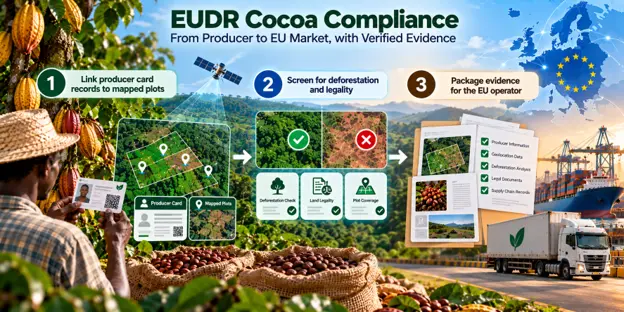
Map plots, screen them against satellite data, collect legality evidence, segregate verified lots, assess risk and pass the file to the EU operator.
Map every supplying plot. Capture a GPS point or polygon for each farm and link it to a unique farmer ID.
Screen plots against deforestation data. Check forest cover after 31 December 2020 and flag overlaps with forest reserves.
Collect legality evidence. Gather land use rights, labour and tax records required under relevant Nigerian legislation.
Segregate verified lots. Keep verified cocoa physically and digitally separate from unverified purchases.
Assess and mitigate risk. Record residual risks such as mixing or disputed tenure, and the steps taken to address them.
Hand over a DDS-ready file. Share plot data and lot records with the EU operator and retain records for five years.
Certifications such as Rainforest Alliance and Fairtrade support risk mitigation, but they do not replace plot-level geolocation, legality evidence or the DDS. Treat certification data as one input to EUDR cocoa compliance in Nigeria, not as proof on its own.
For EUDR cocoa compliance in Nigeria, the gap is rarely farm maps. It is the link between those maps and the lots that ship. TraceX EUDR Solutions connects farmer onboarding, polygon validation against JRC and Hansen datasets, and lot-level segregation so a DDS can be assembled from live supply chain records.
See how TraceX turns Nigerian farm maps into DDS-ready lot records.
Manual vs Platform EUDR Cocoa Compliance in Nigeria
Manual tracking can work for a pilot cooperative, but rarely survives exporter-scale volume and an authority check.
Task
Manual (spreadsheets and paper)
TraceX
Plot mapping
GPS points in spreadsheets, often unlinked to farmers
Plots tied to farmer IDs at onboarding
Deforestation screening
One-off desk checks
Automated screening against satellite datasets
Legality evidence
Paper files held by field teams
Documents stored against each farmer record
Lot segregation
Relies on warehouse discipline
Lot records linked back to source plots
DDS preparation
Compiled by hand for each shipment
DDS-ready data packages per shipment
Audit response
Days to rebuild the evidence trail
Records retrievable on request
EUDR Cocoa Compliance in Nigeria: Buyer Evaluation Checklist
Before choosing a tool to support EUDR cocoa compliance in Nigeria, confirm it can answer yes to each point:
Does it validate points and polygons against post-2020 deforestation data?
Can it link each plot to specific lots through aggregation and processing?
Does it work offline for field agents in low-connectivity areas?
Does it store legality evidence against each farmer ID?
Can it export data in the format the EU Information System requires?
Frequently Asked Questions
What is EUDR cocoa compliance in Nigeria?
EUDR cocoa compliance in Nigeria is the process of proving that cocoa exported to the EU is deforestation-free since 31 December 2020, legally produced, and traceable to geolocated plots, so the EU operator can file a DDS.
Who is legally responsible, the Nigerian exporter or the EU importer?
The EU operator files the DDS. Nigerian exporters are not directly bound, but buyers will require their plot and lot evidence.
When does the EUDR apply to Nigerian cocoa?
From 30 December 2026 for large and medium operators and traders, and from 30 June 2027 for micro and small operators.
Is Nigeria high risk under the EUDR?
No. Nigeria is standard risk, which requires full due diligence.
Do smallholder plots need polygons?
Only plots larger than four hectares. Smaller plots can use a single GPS point.
Is Rainforest Alliance certification enough for the EUDR?
No. Certification supports risk mitigation but does not replace geolocation, legality evidence or the DDS.
How long must EUDR records be kept?
Operators must keep due diligence records and DDS information for five years.
Start using TraceX
Transparency, Trust, & Success for your Climate Journey.
We use cookies on our website to give you the most relevant experience by remembering your preferences and repeat visits. By clicking “Accept All”, you consent to the use of ALL the cookies. However, you may visit "Cookie Settings" to provide a controlled consent.
This website uses cookies to improve your experience while you navigate through the website. Out of these, the cookies that are categorized as necessary are stored on your browser as they are essential for the working of basic functionalities of the website. We also use third-party cookies that help us analyze and understand how you use this website. These cookies will be stored in your browser only with your consent. You also have the option to opt-out of these cookies. But opting out of some of these cookies may affect your browsing experience.
Necessary cookies are absolutely essential for the website to function properly. These cookies ensure basic functionalities and security features of the website, anonymously.
Cookie
Duration
Description
cookielawinfo-checkbox-analytics
11 months
This cookie is set by GDPR Cookie Consent plugin. The cookie is used to store the user consent for the cookies in the category "Analytics".
cookielawinfo-checkbox-functional
11 months
The cookie is set by GDPR cookie consent to record the user consent for the cookies in the category "Functional".
cookielawinfo-checkbox-necessary
11 months
This cookie is set by GDPR Cookie Consent plugin. The cookies is used to store the user consent for the cookies in the category "Necessary".
cookielawinfo-checkbox-others
11 months
This cookie is set by GDPR Cookie Consent plugin. The cookie is used to store the user consent for the cookies in the category "Other.
cookielawinfo-checkbox-performance
11 months
This cookie is set by GDPR Cookie Consent plugin. The cookie is used to store the user consent for the cookies in the category "Performance".
viewed_cookie_policy
11 months
The cookie is set by the GDPR Cookie Consent plugin and is used to store whether or not user has consented to the use of cookies. It does not store any personal data.
Functional cookies help to perform certain functionalities like sharing the content of the website on social media platforms, collect feedbacks, and other third-party features.
Performance cookies are used to understand and analyze the key performance indexes of the website which helps in delivering a better user experience for the visitors.
Analytical cookies are used to understand how visitors interact with the website. These cookies help provide information on metrics the number of visitors, bounce rate, traffic source, etc.
Advertisement cookies are used to provide visitors with relevant ads and marketing campaigns. These cookies track visitors across websites and collect information to provide customized ads.
Download the 2026 Traceability Scorecard and Benchmark Your Supply Chain Across 10 Critical Capabilities.
Download our eBook
Don’t Wait for an Audit to Find Your EUDR Gaps
The 2026 Simplification Package changes how HS codes, DDS pass-through and geolocation rules apply to you. Get the free guide and 20-point readiness checklist before enforcement catches you unprepared.