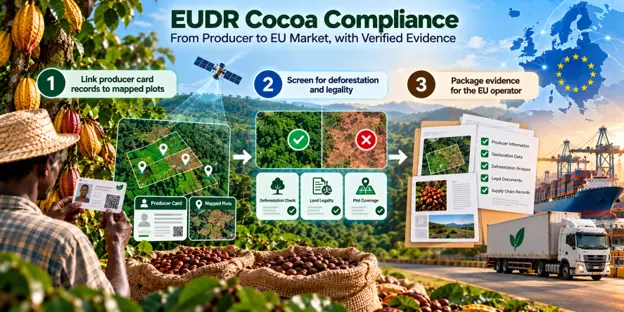
EUDR Cocoa Compliance in Ghana: What Low-Risk Status Does and Does Not Change
Published
, 8 minute read
Share this article
Quick summary: EUDR cocoa compliance in Ghana explained: what low-risk status changes, plot geolocation rules and the DDS steps EU importers need before 30 December 2026.
EUDR cocoa compliance in Ghana means that every EU operator placing Ghanaian cocoa beans, butter, powder or chocolate on the EU market must prove the cocoa is deforestation-free after 31 December 2020, legally produced under Ghanaian law, and traceable to geolocated farm plots, then file a due diligence statement (DDS). Ghana’s low-risk benchmarking simplifies the risk assessment. It does not simplify the data.
In plain terms, it is the evidence file that lets a shipment of Ghanaian cocoa pass an EU competent authority check without delay, seizure or a fine.
KEY TAKEAWAYS
Application starts 30 December 2026 for large and medium operators and 30 June 2027 for micro and small operators.
Ghana is currently classified low risk, so formal risk assessment and mitigation are waived unless red flags appear.
Plot geolocation, legality evidence and a DDS are still mandatory for every shipment.
Mixing Ghanaian cocoa with standard-risk Côte d’Ivoire cocoa triggers full due diligence for that lot.
COCOBOD’s GCTS helps, but the EU operator keeps legal responsibility for the evidence.
December 2026 is approaching. Is your supply chain actually ready?
Move from spreadsheets and fragmented supplier data to a traceable, audit-ready EUDR workflow with TraceX.
EUDR Cocoa Compliance in Ghana: What the Regulation Requires
EUDR cocoa compliance in Ghana rests on three proofs per shipment (deforestation-free, legal, traceable) plus a filed DDS.
Regulation (EU) 2023/1115, as amended by Regulation (EU) 2025/2650, lists cocoa as one of seven relevant commodities. Annex I covers cocoa beans (CN 1801), shells and husks (1802), paste (1803), butter (1804), powder (1805) and chocolate (1806). For EUDR cocoa compliance in Ghana, the operator is usually the EU importer or processor that first places the product on the EU market, not the Ghanaian exporter. That operator carries the filing duty.
Deforestation-free: no deforestation on the production plot after 31 December 2020.
Legally produced: compliant with Ghanaian rules on land use rights, environment, labour, tax and anti-corruption.
Traceable: geolocation for every plot, with a single point accepted for plots of 4 hectares or less and a polygon required above 4 hectares.
Filed: a DDS submitted in the EU Information System before the product is placed on the market or exported.
Penalties include fines of at least 4% of total annual EU turnover, confiscation of goods and revenues, and temporary exclusion from public procurement.
Understand the key EUDR requirements for Ghanaian cocoa exporters, including farmer traceability, plot-level geolocation, deforestation checks, due diligence, risk assessment, and DDS preparation.
EUDR Cocoa Compliance in Ghana Under Low-Risk Benchmarking
Low-risk status removes the mandatory risk assessment and mitigation steps but keeps information collection, geolocation and the DDS in place.
Commission Implementing Regulation (EU) 2025/1093 classified Ghana as low risk, while neighbouring Côte d’Ivoire sits in the standard tier. Under Article 13, operators sourcing from a low-risk country can apply simplified due diligence. They still gather the full Article 9 information set and file a DDS, but they do not need to run a formal risk assessment or mitigation step. Competent authorities are expected to check around 1% of operators for low-risk origins, against 3% for standard risk.
The simplification falls away the moment an operator obtains information pointing to non-compliance or circumvention. That condition matters for EUDR cocoa compliance in Ghana because informal cross-border cocoa flows with Côte d’Ivoire are well documented, and a bag from a standard-risk origin that enters a Ghanaian lot pulls the whole lot back into full due diligence.
“Low risk changes the depth of the analysis. It does not change the data you must hold.”
The tier is also not permanent. The Commission committed to a first review in 2026 using updated FAO forest data, and a reclassification could reach operators with little lead time.
Understand how EUDR country risk classification influences due diligence, risk assessment, and compliance requirements—and what businesses should consider when sourcing from different countries.
EUDR Cocoa Compliance in Ghana: Where Supply Chains Break
The gaps sit in the first mile: unmapped smallholder plots, bulked LBC lots and farms near forest reserves.
Ghana’s cocoa comes from roughly 800,000 smallholder households, most farming plots under three hectares. Beans move from farmer to purchasing clerk, then to a Licensed Buying Company (LBC) depot, then to COCOBOD’s marketing arm for export. Each handover is a point where plot identity can be lost if lots are bulked without records.
Cocoa plots in the Western, Western North and Ashanti regions overlap with forest reserves and active forest zones.
Illegal small-scale mining (galamsey) clears land that can border or displace cocoa farms.
Land tenure is often customary, so legality evidence rarely sits in a formal title deed.
Farm data is split across COCOBOD, LBCs, cooperatives and certification programmes.
Rainforest Alliance and Fairtrade certification support risk mitigation, but they do not replace the DDS, plot-level geolocation or polygon-level evidence that EUDR cocoa compliance in Ghana requires.
Discover how digital procurement, farmer onboarding, geospatial mapping, batch traceability, and warehouse integration can help licensed cocoa buyers build a more connected and EUDR-ready supply chain.
EUDR Cocoa Compliance in Ghana and the Ghana Cocoa Traceability System
GCTS gives EUDR cocoa compliance in Ghana a national data backbone, but importers still own the DDS and the evidence behind it.
COCOBOD’s Ghana Cocoa Traceability System (GCTS) tracks cocoa from farm plot to export port using GPS mapping, barcode labels and mobile data capture. Its pilot in the Assin Fosu district mapped over 40,000 farms and registered more than 20,000 farmers. In May 2026, COCOBOD also presented a Deforestation Risk Assessment Module, and the Forestry Commission is building a forest baseline map to support operator due diligence.
National systems help, yet legal responsibility does not transfer. The EU operator must still verify that the data it receives is complete, matches the physical lot and holds up in an inspection. In practice, EUDR cocoa compliance in Ghana means reconciling GCTS records with your own supplier, contract and shipment data.
EUDR Cocoa Compliance in Ghana: A 5-Step Readiness Plan
Map, screen, segregate, document and file, starting with your highest-volume LBC suppliers.
Confirm your role: operator, downstream operator or trader under the amended EUDR, and your enterprise size.
Collect plot geolocation: points for plots up to 4 hectares, polygons above.
Screen every plot: check against 31 December 2020 forest baselines and protected area layers.
Segregate lots: keep Ghanaian cocoa apart from standard-risk origins, or apply full due diligence to mixed lots.
Document and file: assemble legality evidence, reconcile it with shipment volumes and file the DDS before customs clearance.
Operators that start now can test data quality through the 2026/27 main crop season, before 30 December 2026 closes the window for trial runs. Teams that treat EUDR cocoa compliance in Ghana as a data pipeline, not a paperwork exercise, reach the filing step with fewer rejected statements.
Ghana’s low-risk tier tempts importers to under-invest in first-mile data. We see it the other way: simplified due diligence only holds while your lot data proves no red flags exist. The operator who can show clean, segregated, plot-linked evidence keeps the simplified route. The one who cannot loses it on the first inspection.
See how Ghanaian cocoa plot data becomes DDS-ready evidence
TraceX EUDR Solutions is designed to capture offline farm polygons, screen plots against 2020 forest baselines, flag mixed-origin lots and assemble DDS-ready evidence for Ghanaian cocoa supply chains.
Manual Process vs TraceX Cleara AI for Ghana Cocoa
Task
Manual / spreadsheet approach
TraceX
Plot mapping
Paper forms and GPS points re-typed into sheets
Offline mobile polygon capture tied to farmer ID
Deforestation screening
Ad hoc satellite checks per plot
Automated screening against 2020 forest baselines
Lot segregation
Depot records reconciled by hand
Origin flags on mixed Ghana and Côte d’Ivoire lots
Legality evidence
Scattered PDFs and customary tenure notes
Document vault linked to each plot
DDS filing
Manual entry into the EU Information System
DDS-ready data package and reference tracking
Inspection readiness
Days to assemble evidence
Audit trail per shipment
Buyer Evaluation Checklist for EUDR Cocoa Platforms
Does it capture polygons offline in low-connectivity cocoa communities?
Can it ingest or reconcile GCTS and LBC depot data?
Does it screen plots against a 31 December 2020 baseline and protected areas?
Can it flag lots that mix Ghanaian and standard-risk cocoa?
Does it store legality evidence for customary land tenure?
Does it produce DDS-ready data and track reference numbers downstream?
Can it switch a supplier to full due diligence if Ghana’s tier changes?
Frequently Asked Questions
Is Ghana low risk under the EUDR?
Yes. Under Implementing Regulation (EU) 2025/1093, Ghana is classified as low risk. The list was due for review in 2026, so confirm the current tier before filing.
Does low-risk status mean no due diligence for Ghanaian cocoa?
No. EUDR cocoa compliance in Ghana still requires Article 9 information, plot geolocation and a DDS. Only the formal risk assessment and mitigation steps are waived, and only while no red flags appear.
Who files the DDS for cocoa imported from Ghana?
The EU operator that first places the product on the EU market, typically the importer or processor. Under Regulation (EU) 2025/2650, most downstream operators and traders no longer file their own DDS but must keep supplier and reference records.
When does the EUDR apply to Ghanaian cocoa?
EUDR cocoa compliance in Ghana becomes mandatory on 30 December 2026 for large and medium operators and on 30 June 2027 for micro and small operators.
Do Rainforest Alliance or Fairtrade certificates satisfy the EUDR?
No. Certification supports risk mitigation, but it does not replace plot geolocation, polygon evidence or the DDS.
Can GCTS data be used directly in a DDS?
It can feed the evidence file, but the operator remains responsible for its accuracy. For EUDR cocoa compliance in Ghana, reconcile national records with your own shipment data before filing.
What happens if Ghanaian cocoa is mixed with cocoa from Côte d’Ivoire?
The simplified regime no longer applies to that lot. Because Côte d’Ivoire is standard risk, the operator must run full due diligence, including risk assessment and mitigation.
Start using TraceX
Transparency, Trust, & Success for your Climate Journey.
We use cookies on our website to give you the most relevant experience by remembering your preferences and repeat visits. By clicking “Accept All”, you consent to the use of ALL the cookies. However, you may visit "Cookie Settings" to provide a controlled consent.
This website uses cookies to improve your experience while you navigate through the website. Out of these, the cookies that are categorized as necessary are stored on your browser as they are essential for the working of basic functionalities of the website. We also use third-party cookies that help us analyze and understand how you use this website. These cookies will be stored in your browser only with your consent. You also have the option to opt-out of these cookies. But opting out of some of these cookies may affect your browsing experience.
Necessary cookies are absolutely essential for the website to function properly. These cookies ensure basic functionalities and security features of the website, anonymously.
Cookie
Duration
Description
cookielawinfo-checkbox-analytics
11 months
This cookie is set by GDPR Cookie Consent plugin. The cookie is used to store the user consent for the cookies in the category "Analytics".
cookielawinfo-checkbox-functional
11 months
The cookie is set by GDPR cookie consent to record the user consent for the cookies in the category "Functional".
cookielawinfo-checkbox-necessary
11 months
This cookie is set by GDPR Cookie Consent plugin. The cookies is used to store the user consent for the cookies in the category "Necessary".
cookielawinfo-checkbox-others
11 months
This cookie is set by GDPR Cookie Consent plugin. The cookie is used to store the user consent for the cookies in the category "Other.
cookielawinfo-checkbox-performance
11 months
This cookie is set by GDPR Cookie Consent plugin. The cookie is used to store the user consent for the cookies in the category "Performance".
viewed_cookie_policy
11 months
The cookie is set by the GDPR Cookie Consent plugin and is used to store whether or not user has consented to the use of cookies. It does not store any personal data.
Functional cookies help to perform certain functionalities like sharing the content of the website on social media platforms, collect feedbacks, and other third-party features.
Performance cookies are used to understand and analyze the key performance indexes of the website which helps in delivering a better user experience for the visitors.
Analytical cookies are used to understand how visitors interact with the website. These cookies help provide information on metrics the number of visitors, bounce rate, traffic source, etc.
Advertisement cookies are used to provide visitors with relevant ads and marketing campaigns. These cookies track visitors across websites and collect information to provide customized ads.
Download the 2026 Traceability Scorecard and Benchmark Your Supply Chain Across 10 Critical Capabilities.
Download our eBook
Don’t Wait for an Audit to Find Your EUDR Gaps
The 2026 Simplification Package changes how HS codes, DDS pass-through and geolocation rules apply to you. Get the free guide and 20-point readiness checklist before enforcement catches you unprepared.