EUDR ERP Integration with SAP: Automate DDS Filing Before 30 December 2026
Published
, 9 minute read
Share this article
Quick summary: EUDR ERP Integration with SAP links SAP ERP to EUDR due diligence and TRACES, auto-filing DDS and syncing reference numbers before the 30 Dec 2026 deadline.
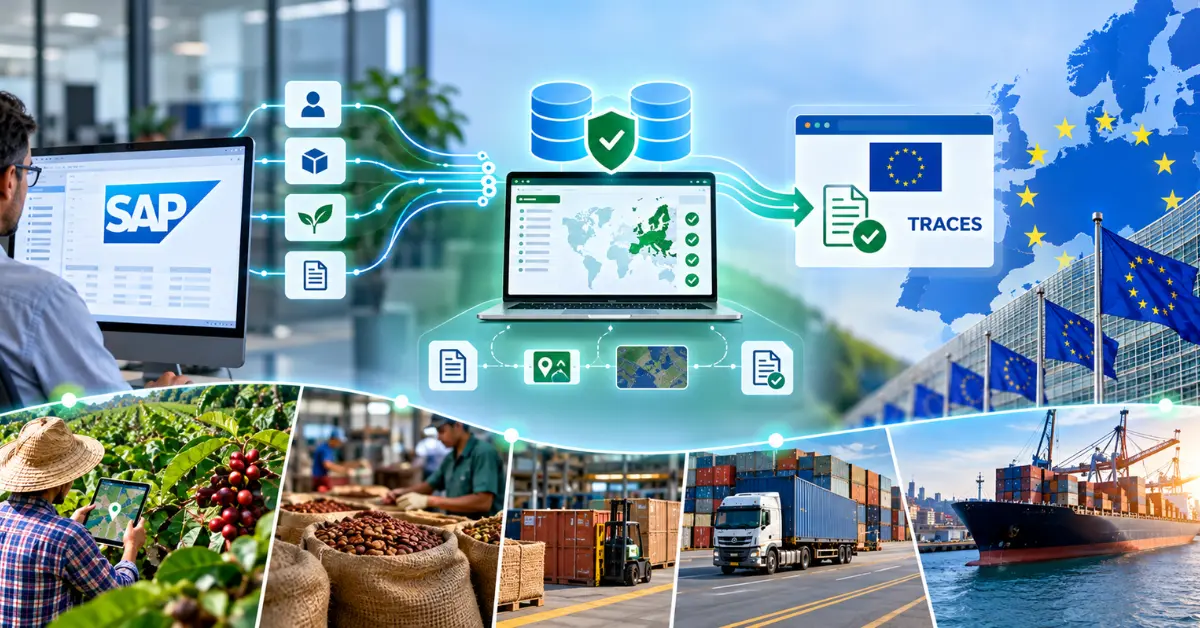
EUDR ERP Integration with SAP is the API-based connection between your SAP ERP (SAP ECC or S/4HANA) and an EUDR due diligence platform, so that supplier master data, material records, and delivery transactions flow automatically into geolocation validation, deforestation risk assessment, and Due Diligence Statement (DDS) filing in the EU TRACES system, with the official DDS reference number synced back into SAP. It matters because SAP stores supplier addresses and purchase orders, but not GPS polygons, deforestation risk scores, or TRACES-formatted DDS payloads.
Key Takeaways
EUDR applies to large and medium operators from 30 December 2026 and to micro and small operators from 30 June 2027, under Regulation (EU) 2023/1115 as amended by (EU) 2025/2650.
SAP holds most of the supplier and transaction data EUDR needs, but none of the geospatial, risk-scoring, or DDS-formatting logic. Closing that gap is the whole point of the integration.
A connected flow removes spreadsheet re-keying, cuts filing errors, and keeps DDS reference numbers in sync between compliance and procurement teams.
Under the 2025 simplification, only the first operator files a DDS while downstream operators pass the reference number. Integration keeps every reference attached to the correct SAP document.
December 2026 is approaching. Is your supply chain actually ready?
Move from spreadsheets and fragmented supplier data to a traceable, audit-ready EUDR workflow with TraceX.
It is the automated data bridge between SAP and your EUDR compliance system, so supplier and transaction data becomes a filed DDS without manual re-entry.
EUDR ERP Integration with SAP connects the system where your procurement, inventory, and supplier records already live to the system that proves your commodities are deforestation-free. In practice, SAP stays the source of truth for what you buy and from whom, while a compliance layer handles what SAP was never built to do: hold plot-level GeoJSON, run deforestation risk analysis, and format a Due Diligence Statement that the EU TRACES system will accept.
The distinction that matters here is master data versus transactional data. Master data is the stable reference information, such as farmer and cooperative IDs, supplier addresses, certification details, and material codes. Transactional data is the operational events: purchase orders, goods receipts, and deliveries. A working integration moves both across the API boundary automatically, so nothing is copied into a spreadsheet and re-typed by a compliance analyst.
Discover how EUDR ERP integration can bridge procurement and enterprise data with geolocation, traceability, risk, evidence, and DDS workflows.
Why EUDR ERP Integration with SAP Matters Before 30 December 2026
Because manual DDS preparation does not scale to thousands of suppliers and shipments in the months before the deadline.
EUDR ERP Integration with SAP matters most for operators running large, fragmented supply chains. A cocoa, coffee, or rubber importer may push thousands of suppliers and tens of thousands of transactions through SAP every year. Under Regulation (EU) 2023/1115 as amended by (EU) 2025/2650, large and medium operators must comply from 30 December 2026, and micro and small operators from 30 June 2027. Every relevant product placed on the EU market from that date needs a valid DDS standing behind it.
Without integration, compliance teams export supplier master data into spreadsheets, re-key farm and certification details into a due diligence system, cross-check for duplicates, and then file into TRACES by hand. That workflow is slow and error-prone, and a single mis-keyed plot or missing certificate can invalidate a filing. EUDR ERP Integration with SAP removes the re-keying step entirely, which is why importers increasingly treat it as core compliance infrastructure rather than an optional add-on
Discover how EUDR interoperability and system integration can help businesses create a connected compliance workflow without replacing their existing enterprise systems.
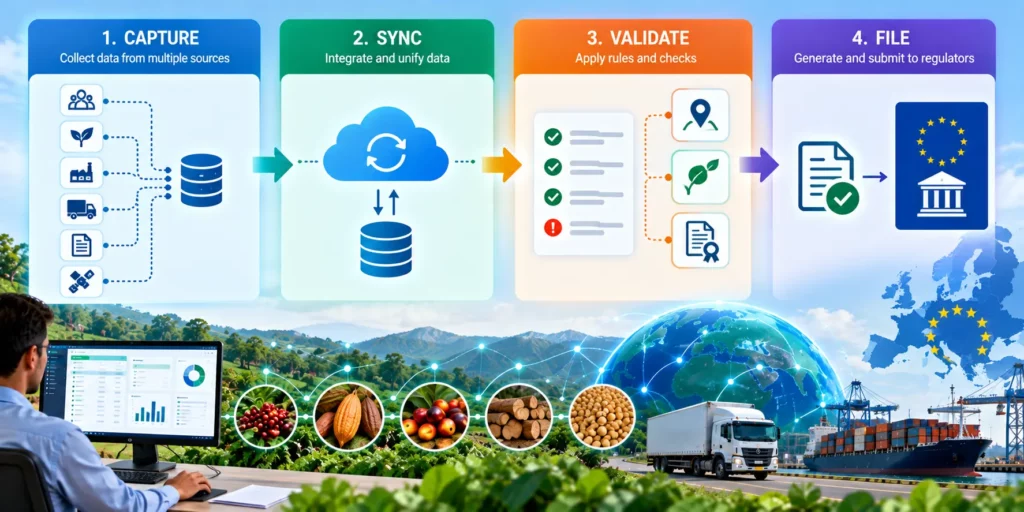
Data moves in four connected layers: field capture, SAP sync, validation and risk scoring, and DDS filing to TRACES with reference sync-back.
EUDR ERP Integration with SAP works as a bidirectional pipeline. Field data such as GPS polygons, crop records, and ownership documents is collected first, often through mobile apps that work offline in smallholder regions where connectivity is unreliable. Supplier profiles, shipment data, and procurement records are then pulled from SAP through a connector, so procurement keeps working inside SAP while compliance data flows in the background.
Next, the platform validates GeoJSON plot boundaries and runs deforestation and legality risk checks against satellite data. Any non-negligible risk must be mitigated before goods are placed on the market. Once the evidence is complete, a Due Diligence Statement is generated and submitted to EU TRACES, and the official DDS reference number flows back into SAP to keep master data and compliance records in sync. Because the 2025 simplification lets only the first operator file a DDS while downstream operators pass the reference number along, a well-designed EUDR ERP Integration with SAP also keeps each reference attached to the correct SAP material and delivery document.
Why SAP cannot handle EUDR on its own
SAP stores supplier addresses, transactions, and inventory. It does not store GPS polygons, deforestation risk scores, or TRACES-formatted DDS payloads. Those three requirements sit outside standard ERP capability, and that gap is exactly what the integration layer is built to fill. This is why EUDR ERP Integration with SAP is a connection between two systems rather than a single module bolted onto the ERP.
EUDR ERP Integration with SAP: Manual Workflow vs Connected Platform
A connected platform replaces spreadsheet exports and manual re-entry with automated, audit-ready data flow and reference sync-back.
The gap between a manual EUDR workflow and a true EUDR ERP Integration with SAP shows up most clearly in four places: where the data lives, how DDS filings are produced, how errors are caught, and how audit evidence is retained. The table below contrasts the two approaches.
Dimension
Manual workflow
Connected EUDR ERP Integration with SAP
Supplier & transaction data
Exported from SAP to spreadsheets, re-keyed into a DDS tool
Synced from SAP via connector, no re-entry [pending product-team sign-off]
Geolocation & risk
Plots checked ad hoc, risk assessed offline
GeoJSON validated and risk scored against satellite data
DDS filing
Filed manually in TRACES, one payload at a time
Auto-generated and submitted to TRACES via API
Reference numbers
Tracked in a separate sheet, easily lost
Synced back to the originating SAP document
Error risk
High: mis-keyed plots and duplicates invalidate filings
Lower: validation catches issues before submission
Audit evidence
Scattered across files and inboxes
Centralised, 5-year retention by design
TraceX EUDR Solutions is built to connect to enterprise ERPs and the EU TRACES API, so supplier data, GeoJSON validation, and DDS generation run as one flow rather than a chain of manual hand-offs
For SAP environments specifically, the goal is simple: procurement keeps working in SAP, compliance keeps working in TraceX, and the DDS reference number moves between them without anyone re-typing a plot boundary Certifications such as FSC, RSPO, and Fairtrade support risk mitigation but do not replace the EUDR obligations for plot-level geolocation, DDS filing, and evidence retention.
See how TraceX connects SAP to EUDR due diligence and TRACES
When evaluating EUDR ERP Integration with SAP, separate genuine automation from a portal that still needs manual uploads. The strongest options connect natively to SAP ECC and S/4HANA, validate plot geometry at the point of capture, file directly into TRACES over an API, and write the DDS reference number back to the originating SAP document. Segregated accounting, which keeps compliant and non-compliant volumes separate, should be enforced by design because it is a mandatory EUDR requirement, and all evidence must be retained for at least five years. Use the checklist below to pressure-test any option before you commit.
Buyer Evaluation Checklist
Native connector for both SAP ECC and S/4HANA, not just a generic file import.
Bidirectional sync so DDS reference numbers return to the correct SAP document.
GeoJSON plot validation at the point of capture, with offline mobile collection.
Deforestation and legality risk scoring against satellite data before placement.
Direct DDS submission to EU TRACES over an API, not manual portal logins.
Segregated accounting and 5-year evidence retention enforced by design.
Support for the downstream-operator model: passing a DDS reference, not re-filing.
Ultimately, EUDR ERP Integration with SAP is a data-integrity problem more than a filing problem. Get the connection right and the DDS becomes a by-product of clean, validated data already sitting in your systems, rather than a scramble in the final weeks before 30 December 2026.
Frequently Asked Questions
Can SAP file an EUDR DDS on its own?
No. SAP stores supplier addresses, purchase orders, and inventory, but not GPS polygons, deforestation risk scores, or TRACES-formatted DDS payloads. EUDR ERP Integration with SAP adds the geospatial, risk, and filing logic that standard SAP does not provide.
Does EUDR ERP Integration with SAP work with S/4HANA?
Yes. The strongest integrations offer connectors for both SAP ECC and S/4HANA, mapping existing master data to the EUDR data model so procurement continues working in SAP while compliance data flows to the platform.
When does EUDR compliance start?
EUDR applies from 30 December 2026 for large and medium operators and from 30 June 2027 for micro and small operators, under Regulation (EU) 2023/1115 as amended by (EU) 2025/2650.
What data flows between SAP and the compliance platform?
Master data such as supplier, farmer, and material records, and transactional data such as orders and deliveries, flow from SAP to the platform. Validated DDS reference numbers flow back to SAP, keeping both systems in sync.
Does the 2025 simplification change how integration works?
Yes. Only the first operator files a DDS while downstream operators pass the reference number along. A good EUDR ERP Integration with SAP keeps each reference attached to the correct SAP document so downstream shipments are not stopped.
Do FSC or RSPO certifications replace EUDR obligations?
No. FSC, RSPO, and Fairtrade certifications support risk mitigation but do not replace the EUDR requirements for plot-level geolocation, DDS filing, and five-year evidence retention.
How does integration reduce compliance risk?
By validating plot geometry and risk before submission and removing manual re-entry, integration lowers the chance of a mis-keyed plot or missing certificate invalidating a filing, while centralising audit evidence for the required five years.
Start using TraceX
Transparency, Trust, & Success for your Climate Journey.
We use cookies on our website to give you the most relevant experience by remembering your preferences and repeat visits. By clicking “Accept All”, you consent to the use of ALL the cookies. However, you may visit "Cookie Settings" to provide a controlled consent.
This website uses cookies to improve your experience while you navigate through the website. Out of these, the cookies that are categorized as necessary are stored on your browser as they are essential for the working of basic functionalities of the website. We also use third-party cookies that help us analyze and understand how you use this website. These cookies will be stored in your browser only with your consent. You also have the option to opt-out of these cookies. But opting out of some of these cookies may affect your browsing experience.
Necessary cookies are absolutely essential for the website to function properly. These cookies ensure basic functionalities and security features of the website, anonymously.
Cookie
Duration
Description
cookielawinfo-checkbox-analytics
11 months
This cookie is set by GDPR Cookie Consent plugin. The cookie is used to store the user consent for the cookies in the category "Analytics".
cookielawinfo-checkbox-functional
11 months
The cookie is set by GDPR cookie consent to record the user consent for the cookies in the category "Functional".
cookielawinfo-checkbox-necessary
11 months
This cookie is set by GDPR Cookie Consent plugin. The cookies is used to store the user consent for the cookies in the category "Necessary".
cookielawinfo-checkbox-others
11 months
This cookie is set by GDPR Cookie Consent plugin. The cookie is used to store the user consent for the cookies in the category "Other.
cookielawinfo-checkbox-performance
11 months
This cookie is set by GDPR Cookie Consent plugin. The cookie is used to store the user consent for the cookies in the category "Performance".
viewed_cookie_policy
11 months
The cookie is set by the GDPR Cookie Consent plugin and is used to store whether or not user has consented to the use of cookies. It does not store any personal data.
Functional cookies help to perform certain functionalities like sharing the content of the website on social media platforms, collect feedbacks, and other third-party features.
Performance cookies are used to understand and analyze the key performance indexes of the website which helps in delivering a better user experience for the visitors.
Analytical cookies are used to understand how visitors interact with the website. These cookies help provide information on metrics the number of visitors, bounce rate, traffic source, etc.
Advertisement cookies are used to provide visitors with relevant ads and marketing campaigns. These cookies track visitors across websites and collect information to provide customized ads.
Download the 2026 Traceability Scorecard and Benchmark Your Supply Chain Across 10 Critical Capabilities.
Download our eBook
Don’t Wait for an Audit to Find Your EUDR Gaps
The 2026 Simplification Package changes how HS codes, DDS pass-through and geolocation rules apply to you. Get the free guide and 20-point readiness checklist before enforcement catches you unprepared.