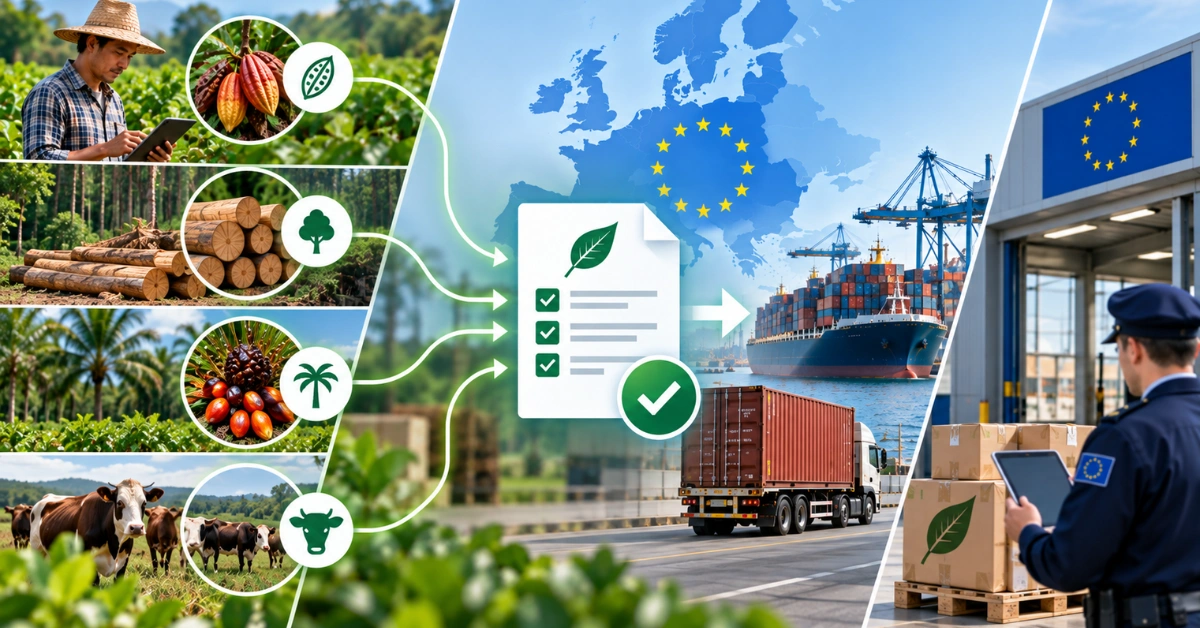
Quick summary: EUDR Simplified Declaration examples show how eligible small producers can simplify reporting, reuse declaration identifiers, and manage traceability data.
The EUDR Simplified Declaration examples makes it easier to understand when viewed through real-world supply-chain scenarios. From small coffee and cocoa producers to rubber suppliers and sawmills, eligible micro and small primary operators can use the simplified route to reduce repetitive reporting while maintaining the required product and production information. These examples show how the Simplified Declaration works in practice, who may qualify, how declaration identifiers move through the supply chain, and why accurate traceability data remains essential for EUDR compliance.
Key Takeaways
The Simplified Declaration is a one-time reporting route for eligible micro and small primary operators; it is not automatically available to every small company.
Eligibility depends on company size, primary-operator status, low-risk-country classification and producing the relevant products themselves.
The SD requires structured operator, activity, product, commodity, country and production-location information.
SD production location can use GeoJSON, postal address(es) or cadastral identifier(s).
A declaration identifier is assigned by the EUDR Information System and accompanies relevant products through the supply chain.
An SD remains valid indefinitely unless major changes occur and can be updated when required.
Authorised representatives can submit SDs for eligible operators under a written mandate.
The operational opportunity is to connect producer data, product data, reporting and shipment traceability into one repeatable workflow.
What Is an EUDR Simplified Declaration?
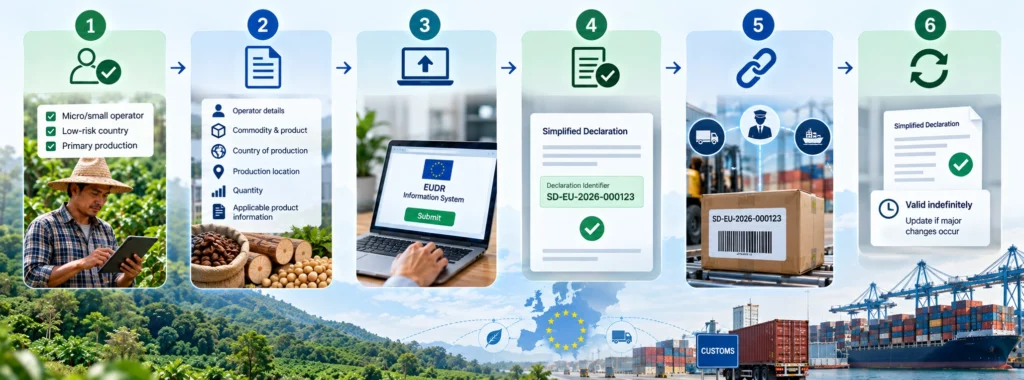
The EUDR Simplified Declaration is a one-time submission in the EUDR Information System for eligible micro or small primary operators. Instead of preparing a separate due diligence statement (DDS) for every relevant shipment, an eligible operator can submit an SD covering relevant products it produces. The Information System assigns a declaration identifier that accompanies the relevant products through the supply chain instead of a DDS reference number.
Who Can Use the EUDR Simplified Declaration?
The SD route is designed for a specific category of operators: a micro or small primary operator established in a low-risk country that places on the market or exports relevant products it itself produced in that country. A small trader buying commodities from other producers is therefore not automatically eligible simply because of its company size.
What Does the Simplified Declaration Contain?
The declaration contains structured information about the operator, activity, relevant commodity and product, country of production, production location and applicable product or HS information. For SD producers, production location may be provided using GeoJSON geometry, postal address(es), or cadastral identifier(s).
Is Your Business Eligible for the EUDR Simplified Declaration?Understand your eligibility, organize producer and product data, and streamline your EUDR reporting workflow.
How Does the EUDR Simplified Declaration Work?
EUDR Simplified Declaration Real World Examples
Example 1: A Small Coffee Farmer Exporting Coffee
Imagine a small coffee producer in a low-risk country. The farmer operates the coffee-producing land, produces the coffee themselves, is a micro or small undertaking, and exports their own coffee to an EU buyer. If eligible, the farmer can submit one Simplified Declaration covering relevant coffee products rather than preparing a separate DDS for every shipment. The SD can include operator, activity, coffee, country of production, production location and product/HS information. The farmer receives a declaration identifier that accompanies the relevant products through the supply chain.
Real-world impact: 10 coffee shipments do not necessarily mean 10 DDS submissions; an eligible producer can use one SD.
Example 2: A Small Rubber Producer
Consider a small rubber producer operating in a low-risk country. The producer harvests rubber from its own production areas and sells it to an EU-based manufacturer. The producer may qualify if the eligibility conditions are met. The key distinction is that the producer is the primary operator producing the commodity, rather than a trader buying rubber from other producers. The SD can cover relevant products produced by the operator rather than being recreated for every shipment.
Example 3: A Small Sawmill Selling Its Own Wood
Consider a small forestry business that produces and sells timber. If it operates in a low-risk country, qualifies as a micro or small undertaking and meets the SD conditions, it may use the Simplified Declaration route. For wood, the EUDR requirement remains substantive: the wood must have been harvested without inducing forest degradation after 31 December 2020. The SD is not a ‘small company, so we do nothing’ exemption.
Example 4: A Small Cocoa Producer With Multiple Shipments
A small cocoa producer supplies an EU chocolate manufacturer and ships cocoa in January, March, June and September. If eligible, the operator can submit the SD once rather than create a separate DDS for each shipment. The declaration remains valid indefinitely unless major changes occur, making the route particularly relevant to repeated exports of the same relevant products.
Example 5: A Small Coffee Cooperative Using an Authorised Representative
Eligible small primary operators without the resources or expertise to manage the EUDR Information System can use an authorised representative established in the EU, acting under a written mandate. A practical model is: Small Producer → Production Data → Authorised Representative → EUDR Information System → Simplified Declaration → Declaration Identifier → EU Buyer/Downstream Supply Chain.
Example 6: Postal Address Instead of GeoJSON
Suppose an eligible small coffee producer has production areas that are difficult to manage digitally. For an SD, the production location may be provided using GeoJSON geometry, postal address(es), or cadastral identifier(s). This can simplify digital onboarding for eligible producers that do not already have GIS capabilities.
Example 7: What Happens When the Producer Has a Major Change?
A small cocoa producer submits an SD in January. Six months later, a major change affects information in the declaration. The producer should not simply continue treating the original information as unchanged. The SD can be updated, and the update can trigger the applicable risk profiling process. A better workflow is: Create SD → Monitor Data → Detect Major Change → Update SD → Maintain Compliance Record.
Example 8: Small Producer vs Trader — Why the Distinction Matters
Company A is a small coffee farmer producing coffee on its own land and exporting it. If it meets the eligibility conditions, it may use the SD. Company B is a small coffee trader buying coffee from 50 farmers and reselling it to an EU customer. Being small does not automatically make Company B eligible. The operator role, country classification and production relationship matter.
Small company ≠ automatically eligible for Simplified Declaration.
Example 9: Declaration Identifier at Customs
An eligible small coffee producer exports coffee to the EU. After submission, the Information System provides a declaration identifier. That identifier accompanies the relevant products through the supply chain and must be made available to customs before release for free circulation or export, as applicable. The flow is: Producer → SD → Declaration Identifier → Export Shipment → Customs → EU Buyer.
Example 10: Automating SD Preparation
Imagine a small coffee producer using a digital traceability platform containing farmer/operator information, coffee product information, production country, farm locations, cadastral information, HS codes, quantities and supporting evidence. The data can be structured into a workflow: Traceability Data → Validate Eligibility → Validate Product & Commodity Data → Validate Production Location → Prepare SD Data → Submit → Store Declaration Identifier → Link Identifier to Shipments. The value is not just fewer declarations; it is connecting producer data, product data and regulatory reporting into one repeatable workflow.
EUDR Simplified Declaration: Before vs After
Traditional DDS Workflow
Simplified Declaration Workflow
Small Producer → Shipment 1 → DDS
Eligible Small Primary Producer → One SD
Small Producer → Shipment 2 → DDS
→ Declaration Identifier
Small Producer → Shipment 3 → DDS
→ Shipment 1
Small Producer → Shipment 4 → DDS
→ Shipment 2 → Shipment 3 → Shipment 4
How TraceX Helps with EUDR Simplified Declarations
TraceX EUDR Solutions helps eligible micro and small primary operators organize, validate and connect the data required for EUDR Simplified Declarations in one digital workflow. From producer and commodity information to production locations and declaration identifiers, TraceX can reduce manual data handling and maintain a traceable compliance record. The platform can also connect SD data with suppliers, products and shipments, making EUDR compliance part of day-to-day supply-chain operations.
Ready to Simplify Your EUDR Compliance?
Connect supplier data, production locations, traceability and EUDR reporting in one platform.
The EUDR Simplified Declaration can make compliance more manageable for eligible small primary producers, especially those making repeated exports. Simplification does not mean less accountability. The strongest approach is to maintain accurate producer, commodity, product and production-location data, keep the declaration current when major changes occur, and connect the declaration identifier to relevant trade flows.
Frequently Asked Questions (FAQ’s)
What is an EUDR Simplified Declaration?
A one-time EUDR Information System submission for eligible micro or small primary operators meeting the applicable conditions.
Who is eligible for an EUDR Simplified Declaration?
Eligible micro or small primary operators established in a low-risk country that place on the market or export relevant products they themselves produced in that country.
Is an SD the same as a DDS?
No. It is a distinct reporting route designed for eligible operators and can avoid repetitive per-shipment DDS submissions.
How long is an SD valid?
Indefinitely unless major changes occur.
Can an authorised representative submit an SD?
Yes, under a written mandate and the applicable representative conditions.
Can production location be provided without GeoJSON?
For the SD, the current Information System documentation allows GeoJSON, postal address(es) or cadastral identifier(s).
Does being a small trader make a company eligible?
No. Small size alone is not enough; the specific eligibility conditions must be met.
Can SD preparation be automated?
The current EUDR Information System API documentation provides operations for submitting, updating, withdrawing and retrieving Simplified Declarations, making structured digital workflows relevant for automation.
Start using TraceX
Transparency, Trust, & Success for your Climate Journey.
We use cookies on our website to give you the most relevant experience by remembering your preferences and repeat visits. By clicking “Accept All”, you consent to the use of ALL the cookies. However, you may visit "Cookie Settings" to provide a controlled consent.
This website uses cookies to improve your experience while you navigate through the website. Out of these, the cookies that are categorized as necessary are stored on your browser as they are essential for the working of basic functionalities of the website. We also use third-party cookies that help us analyze and understand how you use this website. These cookies will be stored in your browser only with your consent. You also have the option to opt-out of these cookies. But opting out of some of these cookies may affect your browsing experience.
Necessary cookies are absolutely essential for the website to function properly. These cookies ensure basic functionalities and security features of the website, anonymously.
Cookie
Duration
Description
cookielawinfo-checkbox-analytics
11 months
This cookie is set by GDPR Cookie Consent plugin. The cookie is used to store the user consent for the cookies in the category "Analytics".
cookielawinfo-checkbox-functional
11 months
The cookie is set by GDPR cookie consent to record the user consent for the cookies in the category "Functional".
cookielawinfo-checkbox-necessary
11 months
This cookie is set by GDPR Cookie Consent plugin. The cookies is used to store the user consent for the cookies in the category "Necessary".
cookielawinfo-checkbox-others
11 months
This cookie is set by GDPR Cookie Consent plugin. The cookie is used to store the user consent for the cookies in the category "Other.
cookielawinfo-checkbox-performance
11 months
This cookie is set by GDPR Cookie Consent plugin. The cookie is used to store the user consent for the cookies in the category "Performance".
viewed_cookie_policy
11 months
The cookie is set by the GDPR Cookie Consent plugin and is used to store whether or not user has consented to the use of cookies. It does not store any personal data.
Functional cookies help to perform certain functionalities like sharing the content of the website on social media platforms, collect feedbacks, and other third-party features.
Performance cookies are used to understand and analyze the key performance indexes of the website which helps in delivering a better user experience for the visitors.
Analytical cookies are used to understand how visitors interact with the website. These cookies help provide information on metrics the number of visitors, bounce rate, traffic source, etc.
Advertisement cookies are used to provide visitors with relevant ads and marketing campaigns. These cookies track visitors across websites and collect information to provide customized ads.
Download the 2026 Traceability Scorecard and Benchmark Your Supply Chain Across 10 Critical Capabilities.
Download our eBook
Don’t Wait for an Audit to Find Your EUDR Gaps
The 2026 Simplification Package changes how HS codes, DDS pass-through and geolocation rules apply to you. Get the free guide and 20-point readiness checklist before enforcement catches you unprepared.