PPWR Compliance for Pharma Importers Spain: The Obligation Map
Published
, 8 minute read
Share this article
Quick summary: PPWR compliance for pharma importers Spain: registration, EPR, minimisation and Declaration of Conformity duties from 12 August 2026, explained.
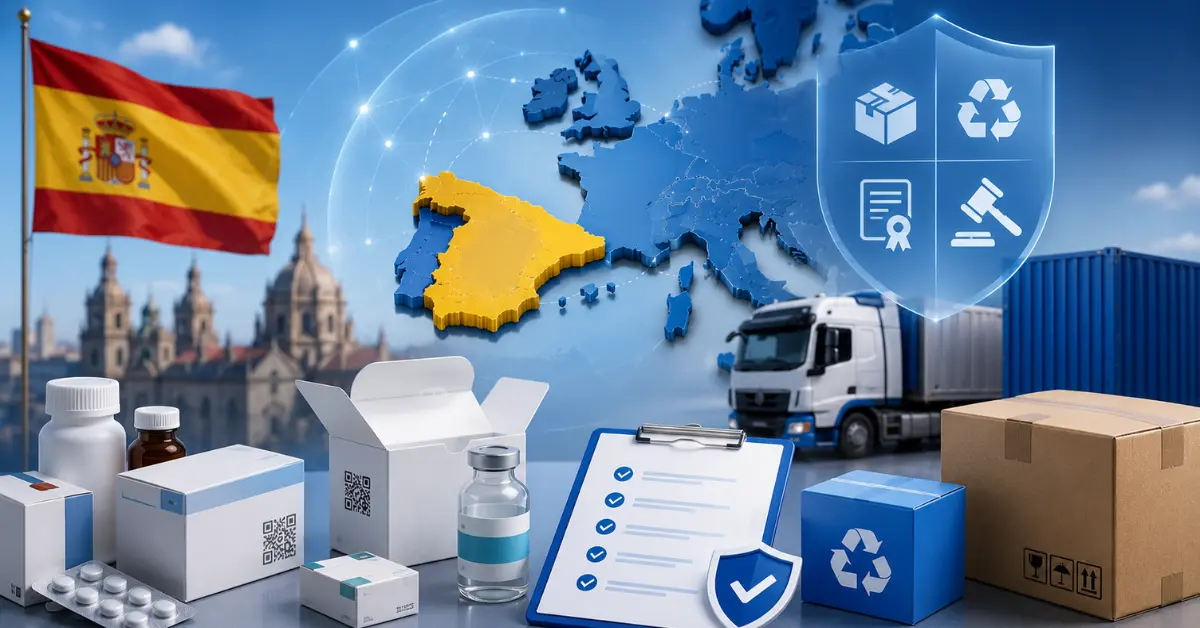
PPWR compliance for pharma importers Spain means meeting the EU Packaging and Packaging Waste Regulation (Regulation (EU) 2025/40) at the same time as Spain’s national packaging law, Royal Decree 1055/2022. Any pharma company that first places packaged medicinal products on the Spanish market including importers and intra-EU acquirers is treated as a producer and carries both PPWR product obligations and Spanish Extended Producer Responsibility (EPR) duties. PPWR has applied generally since 12 August 2026, and it is directly binding, so there is no national transposition to wait for.
Key takeaways
Two layers, not one. You must satisfy EU-wide PPWR product rules and Spain’s Royal Decree 1055/2022 EPR regime together.
Importers are producers. The entity first placing packaged medicine on the Spanish market must register in the Registro de Productores de Producto and join a SCRAP.
The exemption is narrow. Only immediate (primary) packaging may qualify on safety grounds; secondary and transport packaging must comply in full.
Documentation is the deliverable. Since 12 August 2026 you need a technical file, an EU Declaration of Conformity and a unique identifier on each packaging unit.
What does PPWR compliance for pharma importers Spain actually require?
PPWR compliance for pharma importers Spain requires two overlapping workstreams: the directly-applicable EU product rules under Regulation (EU) 2025/40, and producer registration and reporting under Spain’s Royal Decree 1055/2022. Neither replaces the other.
Many pharma importers assume that medicinal packaging sits outside general packaging law, or that joining a Spanish EPR scheme is enough on its own. Both assumptions create exposure. PPWR is a regulation, not a directive, which means it applies uniformly across all 27 member states with direct effect and no local transposition. Royal Decree 1055/2022, meanwhile, still governs how you register as a producer, how you finance packaging-waste management, and how you report tonnage in Spain. The practical result is that a Spanish pharma importer must run PPWR product conformity and national EPR obligations as a single, evidence-backed programme.
PPWR goes beyond packaging waste. From packaging design and recyclability to recycled content, reuse, substances of concern, labelling, conformity assessment and documentation, businesses need to prepare across the packaging lifecycle.
Who counts as a producer for pharma importers in Spain?
Under Royal Decree 1055/2022, the importer or intra-EU acquirer that first places packaged medicinal products on the Spanish market is the producer and must register in the Registro de Productores de Producto (packaging section) and join an EPR system.
For pharma importers, the producer definition is broad and it captures you even when the medicine was manufactured elsewhere in the EU. Once you are the first entity placing the packaged product on the Spanish market, three obligations follow:
Register in the Registro de Productores de Producto (RPP), packaging section, before placing product on the market.
Join a collective EPR scheme (SCRAP, such as Ecoembes for household packaging) or operate an individual system (SIRAP).
Declare packaging annually by weight and material, split by category (household, commercial, industrial) and by single-use versus reusable.
A non-EU or foreign manufacturer must appoint an authorised representative in Spain; where it does not, the obligation falls to the importer. Producers placing under 15 tonnes of packaging on the market annually may file a simplified declaration. Getting the producer determination right is the foundation of PPWR compliance for pharma importers Spain, because it decides who registers, who pays EPR fees, and who signs the conformity paperwork.
Which pharma packaging is exempt from PPWR and which is not?
For PPWR compliance for pharma importers Spain, only immediate (primary) packaging in direct contact with the medicine may qualify for a narrow safety exemption; secondary and transport packaging must comply in full.
There is no blanket sector exemption for pharmaceuticals. Primary packaging blister packs, vials, ampoules, pre-filled syringes may be exempted from recyclability and recycled-content requirements where a compliant material would compromise the safety, quality or efficacy of the medicine. That exemption is conditional: the justification must be documented in the packaging technical file, not simply assumed. Secondary packaging (outer cartons, patient-information leaflets, grouped packs) and tertiary or transport packaging receive no such relief and must meet minimisation, recyclability assessment and Declaration of Conformity duties like any other packaging. This is where most Spanish pharma importers underestimate their scope.
From primary and secondary packaging to transport packaging, plastic, paper, glass, metal and multilayer formats, PPWR requirements can vary depending on the packaging and how it is used.
Mapping every format to the correct tier is central to PPWR compliance for pharma importers Spain, because a mislabelled exemption is exactly what an auditor will probe first.
What August 2026 obligations apply to pharma importers under PPWR?
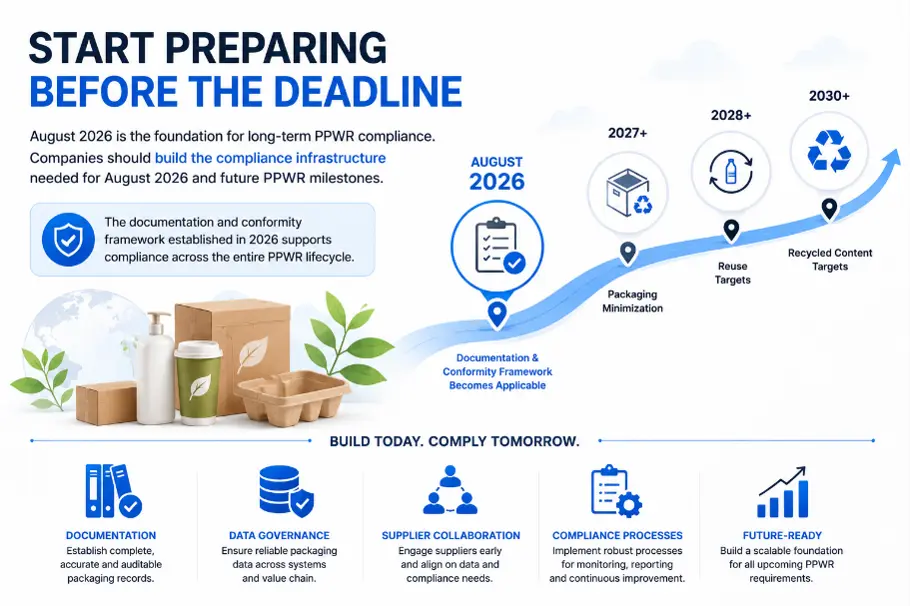
Since 12 August 2026, PPWR compliance for pharma importers Spain includes packaging minimisation, substance-of-concern restrictions, a unique identifier on each packaging unit, conformity assessment, a technical file and an EU Declaration of Conformity.
The obligations that bite first are documentation and design, not distant recycling targets:
Minimisation, packaging reduced to the weight and volume necessary for safety, hygiene and functionality, with the assessment evidenced.
Substances of concern, heavy-metal limits and PFAS restrictions in relevant formats, tracked at material level.
Unique identification on each packaging unit, which must coexist with existing serialised 2D codes under the Falsified Medicines Directive.
Conformity assessment plus a technical file and an EU Declaration of Conformity for every packaging format placed on the market.
Recyclability grading and recycled-content minimums phase in from 2030, at which point the primary-packaging exemption becomes the pharma importer’s most important defence. Treated as a rolling programme, PPWR compliance for pharma importers Spain is a data problem before it is a packaging problem: building the evidence base now is far cheaper than reconstructing it later, especially since changing a primary packaging material can trigger a variation filing and years of stability testing.
How TraceX supports PPWR compliance for pharma importers Spain
The TraceX PPWR platform gives pharma importers one system to map every SKU to its packaging components, weights and materials, generate the evidence behind each Declaration of Conformity, and track EPR reporting across Spanish and EU markets
Most importers start from packaging specifications scattered across ERP exports, supplier PDFs and spreadsheets the exact fragmentation that makes a defensible technical file so hard to assemble. To operationalise PPWR compliance for pharma importers Spain, the platform centralises component-level packaging data, links each format to its minimisation and conformity evidence, and keeps a single source of truth for Royal Decree 1055/2022 tonnage declarations .The benefit is audit-ready documentation you can produce on demand, rather than a scramble each reporting cycle.
PPWR does not reward the importer with the greenest packaging it rewards the importer who can prove conformity fastest. For pharma, where a material change can take years to validate, the winning strategy is to treat packaging data as regulated master data now, so that both the Spanish EPR declaration and the EU Declaration of Conformity draw from the same verified source.
See how the TraceX platform turns scattered packaging specs into audit-ready PPWR evidence for the Spanish market.
The table below contrasts manual PPWR compliance for pharma importers Spain with a platform-led approach.
Requirement
Manual approach
TraceX platform
Producer registration & EPR reporting
Rebuilt each cycle from spreadsheets
Single source for RPP + SCRAP tonnage
Technical file & Declaration of Conformity
Assembled per SKU, ad hoc
Evidence linked to each packaging format
Packaging minimisation evidence
Hard to reconstruct
Component-level data captured once
Exemption justification (primary packs)
Undocumented, high audit risk
Justification stored with the record
Multi-market scaling (EU + Spain)
Duplicated manual effort
Reusable data model across markets
Buyer evaluation checklist
When you evaluate a system for PPWR compliance for pharma importers Spain, confirm it can do the following:
☐ Hold component-level packaging data (material, weight, format) at SKU level.
☐ Generate and version an EU Declaration of Conformity and technical file per format.
☐ Store the documented justification for any primary-packaging safety exemption.
☐ Produce Royal Decree 1055/2022 tonnage declarations by category and reusability.
☐ Track substance-of-concern and minimisation evidence over time.
☐ Scale the same packaging data model across other EU markets without rework.
Frequently Asked Questions
Does PPWR apply to pharmaceutical packaging in Spain?
Yes. There is no blanket pharma exemption. Only certain immediate (primary) packaging may qualify for a conditional safety exemption from recyclability and recycled-content rules; secondary and transport packaging must comply fully.
Is a pharma importer a ‘producer’ under Spanish packaging law?
Generally yes. Under Royal Decree 1055/2022, the entity first placing packaged medicinal products on the Spanish market including importers and intra-EU acquirers is the producer and must register and report.
What must a Spanish pharma importer register for?
Registration in the Registro de Productores de Producto (packaging section) and participation in an EPR system a collective SCRAP such as Ecoembes, or an individual SIRAP.
When did PPWR obligations start applying?
PPWR (Regulation (EU) 2025/40) entered into force on 11 February 2025 and has applied generally since 12 August 2026, with further requirements phasing in through 2030 and beyond.
What documentation is required from 12 August 2026?
Conformity assessment, a technical file and an EU Declaration of Conformity for each packaging format, plus a unique identifier on each packaging unit and minimisation evidence.
Do PPWR identifiers replace Falsified Medicines Directive codes?
No. PPWR data carriers must coexist with the serialised 2D codes already required under the Falsified Medicines Directive; both need to appear and be managed together.
What is the smartest first step for importers?
Centralise component-level packaging data now so the Spanish EPR declaration and the EU Declaration of Conformity draw from the same verified source, reducing audit risk before the 2030 requirements arrive.
Start using TraceX
Transparency, Trust, & Success for your Climate Journey.
We use cookies on our website to give you the most relevant experience by remembering your preferences and repeat visits. By clicking “Accept All”, you consent to the use of ALL the cookies. However, you may visit "Cookie Settings" to provide a controlled consent.
This website uses cookies to improve your experience while you navigate through the website. Out of these, the cookies that are categorized as necessary are stored on your browser as they are essential for the working of basic functionalities of the website. We also use third-party cookies that help us analyze and understand how you use this website. These cookies will be stored in your browser only with your consent. You also have the option to opt-out of these cookies. But opting out of some of these cookies may affect your browsing experience.
Necessary cookies are absolutely essential for the website to function properly. These cookies ensure basic functionalities and security features of the website, anonymously.
Cookie
Duration
Description
cookielawinfo-checkbox-analytics
11 months
This cookie is set by GDPR Cookie Consent plugin. The cookie is used to store the user consent for the cookies in the category "Analytics".
cookielawinfo-checkbox-functional
11 months
The cookie is set by GDPR cookie consent to record the user consent for the cookies in the category "Functional".
cookielawinfo-checkbox-necessary
11 months
This cookie is set by GDPR Cookie Consent plugin. The cookies is used to store the user consent for the cookies in the category "Necessary".
cookielawinfo-checkbox-others
11 months
This cookie is set by GDPR Cookie Consent plugin. The cookie is used to store the user consent for the cookies in the category "Other.
cookielawinfo-checkbox-performance
11 months
This cookie is set by GDPR Cookie Consent plugin. The cookie is used to store the user consent for the cookies in the category "Performance".
viewed_cookie_policy
11 months
The cookie is set by the GDPR Cookie Consent plugin and is used to store whether or not user has consented to the use of cookies. It does not store any personal data.
Functional cookies help to perform certain functionalities like sharing the content of the website on social media platforms, collect feedbacks, and other third-party features.
Performance cookies are used to understand and analyze the key performance indexes of the website which helps in delivering a better user experience for the visitors.
Analytical cookies are used to understand how visitors interact with the website. These cookies help provide information on metrics the number of visitors, bounce rate, traffic source, etc.
Advertisement cookies are used to provide visitors with relevant ads and marketing campaigns. These cookies track visitors across websites and collect information to provide customized ads.
Download the 2026 Traceability Scorecard and Benchmark Your Supply Chain Across 10 Critical Capabilities.
Download our eBook
Don’t Wait for an Audit to Find Your EUDR Gaps
The 2026 Simplification Package changes how HS codes, DDS pass-through and geolocation rules apply to you. Get the free guide and 20-point readiness checklist before enforcement catches you unprepared.