Quick summary: Deposit return systems under PPWR require EU Member States to hit 90% collection by 2029 (Article 50). See the scope, deadlines, exemptions and how to comply.
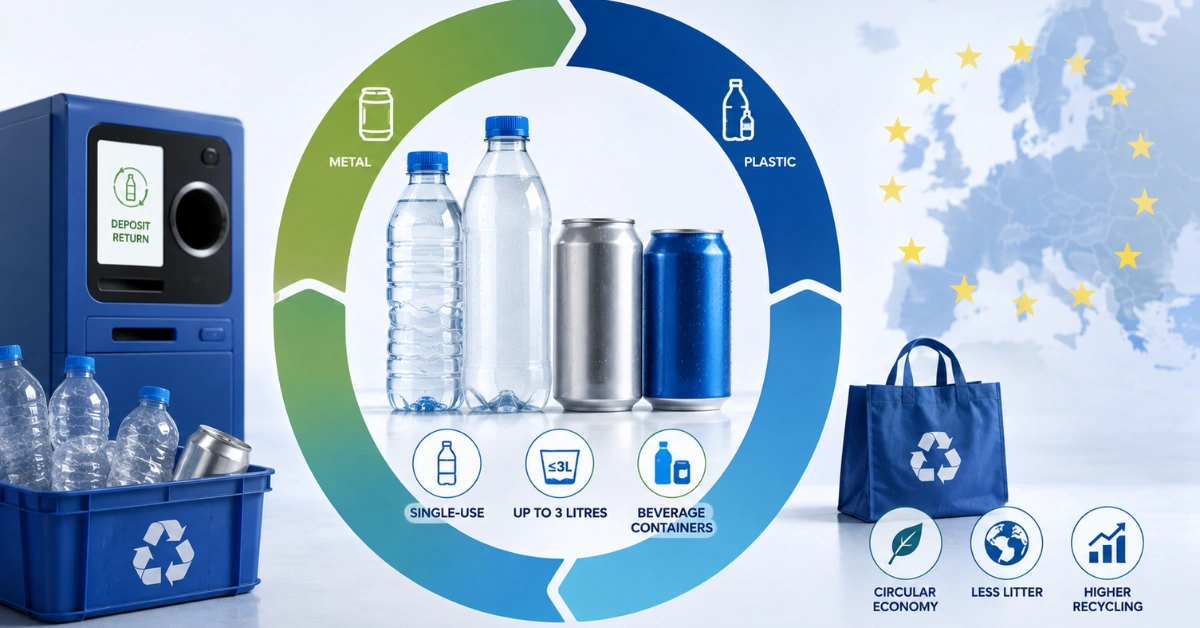
Deposit return systems under the EU Packaging and Packaging Waste Regulation (PPWR, Regulation (EU) 2025/40) are the collection mechanism EU Member States must use to recover single-use beverage packaging. Under Article 50, every Member State must ensure separate collection of at least 90% by weight of single-use plastic beverage bottles and single-use metal beverage containers up to three litres by 1 January 2029 and set up a deposit-and-return scheme to get there. The 90% is a Member-State target, but the operational load lands on producers, brand owners and final distributors: SKU-level marking, deposit accounting, per-market registration and audit-ready packaging data.
Key takeaways
Deposit return systems are governed by Article 50 of PPWR; minimum operating rules sit in Annex X.
Scope: single-use plastic beverage bottles and single-use metal beverage containers up to 3 litres. Glass and beverage cartons are expected but not strictly mandatory.
Hard date: Member States must hit 90% separate collection by 1 January 2029.
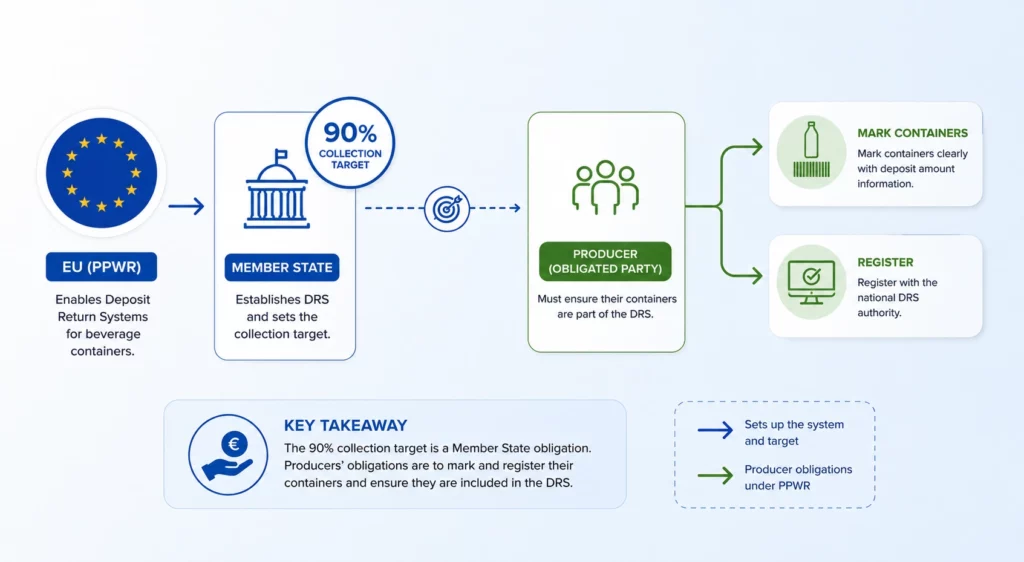
The 90% is a Member-State obligation, not a per-company one but your obligations flow through the national scheme.
TraceX platform gives you one packaging data layer that feeds DRS, EPR, recyclability and labelling together
Consult with TraceX to understand how Deposit Return Systems under PPWR could impact your business and what you should prepare for.
TraceX can help you assess your current packaging data, identify compliance gaps, and build a more structured approach to managing packaging information across products, materials, suppliers and markets.
What Deposit Return Systems Under PPWR Actually Require
A deposit return system (DRS, sometimes “deposit-and-return scheme”) charges a small refundable deposit at the point of sale that the consumer reclaims when they return the empty container. PPWR makes deposit return systems the default route for hitting the Regulation’s beverage-collection target, and Article 50 sets the obligation while Annex X sets the minimum requirements each national scheme must meet.
In practice, Annex X requires every deposit return system to share a common backbone:
A deposit charged at the point of sale, set high enough to motivate returns.
A non-profit, independent system operator (or coordinated operators) running the scheme.
Non-discriminatory, equal access for all producers and importers.
Data-collection and control procedures for reporting and reconciliation.
Final distributors must accept in-scope deposit packaging and refund the deposit take-back cannot be tied to a new purchase.
If you place beverages on any EU market, the practical consequence is that the same product needs scheme-compliant marking, a scheme-recognised barcode, and deposit accounting for every country whose scheme it enters.
Deposit Return Systems: Member-State vs Producer Obligations
The single most misread point about deposit return systems under PPWR is who is actually bound. The 90% separate-collection target is a Member-State obligation not a number each producer must hit. A brand does not “fail” Article 50 by missing 90%; the Member State does.
The obligation reaches your business indirectly, through the national measures adopted to reach that target. That is where deposit return systems become an operational reality for producers, brand owners and final distributors:
Registration with each national scheme, per Member State, before making packaging available.
Marking every in-scope SKU with the clear, unambiguous DRS label the national scheme recognises.
Distinct market GTINs so a reverse-vending machine in one country reads and refunds correctly.
Deposit accounting and reporting — reconciling deposits collected, refunded and remitted to the scheme operator.
Miss any of these and you don’t just risk fines unlabelled or unregistered packaging simply can’t be made available on that market. Deposit return systems turn a sustainability target into a day-to-day market-access gate.
Want to understand what a Producer Responsibility Organisation (PRO) does and how it fits into packaging compliance?
Read our guide on Producer Responsibility Organisations (PROs) to understand their role in EPR, how producers work with PROs, registration and reporting responsibilities, and what businesses should consider when managing packaging compliance across EU markets.
Deposit Return Systems Scope, Deadlines and Exemptions
Scope: what is in and what is out
The mandatory core of deposit return systems is narrow but high-volume: single-use plastic beverage bottles up to 3 litres and single-use metal beverage containers up to 3 litres. Member States may exempt very small formats below 0.1 litre where participation isn’t technically feasible, and may exempt milk and milk products. For glass beverage bottles and beverage cartons, Member States “shall endeavour” to set up schemes (Article 50(8)) expected, but not a hard requirement everywhere.
Deadline and the exemption route
The date to plan around is 1 January 2029, when Member States must be achieving 90% separate collection through their deposit return systems. A Member State can be exempted from setting one up only on strict conditions: a separate-collection rate of at least 80% by weight in calendar year 2026, notified to the Commission with an implementation plan by 1 January 2028. Even then, the exemption lapses if collection stays below 90% for three consecutive years. In short: most markets are heading toward mandatory schemes, so “we might be exempt” is not a compliance strategy.
Deposit Return Systems and the Multi-Regulation Data Problem
Here’s the trap most teams walk into: they treat DRS as a standalone labelling job. But DRS marking sits at the intersection of several PPWR obligations that all converge on the same bottle or can Article 50 deposit marking, Article 12 harmonised sorting labels, Article 6 recyclability grading, and Article 7 recycled-content rates. A sleeve or adhesive that satisfies the reverse-vending machine can quietly wreck the recyclability grade of the container it’s stuck to.
So the real problem behind deposit return systems compliance isn’t drawing a logo it’s data. You need one trusted, per-SKU, per-market record of packaging composition, GTINs, deposit status, label artwork and recyclability grade, kept in sync as artwork and materials change. Manage that in scattered spreadsheets and every regulation gets its own conflicting version of the truth.
Is your business ready for the EU’s new packaging rules?
Read our guide on PPWR Compliance Requirements to understand the key requirements around packaging design, recyclability, recycled content, labelling, EPR, reporting, and compliance documentation.
How TraceX Supports Deposit Return Systems Compliance
The TraceX PPWR platform is built on a single principle that fits DRS perfectly: one data layer, many regulations. Instead of a separate tracker for DRS, another for EPR and a third for labelling, you hold each packaging component once and let every obligation read from it.
For deposit return systems specifically, that means the platform can help you:
Inventory every beverage SKU against each national deposit return scheme it enters, with distinct market GTINs tracked in one place.
Flag sleeve, adhesive or label constructions that satisfy the DRS machine but conflict with the recyclability grade.
Keep deposit status, registration and reporting evidence audit-ready per Member State.
Publish machine-readable, audit-ready component data back to procurement and brand owners.
The proof point is leverage: the same data layer you stand up for DRS is the one that already answers your EPR fee calculations, recyclability grading and Article 12 labelling so compliance work compounds instead of multiplying.
Book a TraceX platform demo and we’ll map your beverage SKUs to the national schemes they enter GTINs, labels and deposit evidence in one view.
Point solutions sell you a deposit-return tracker, an EPR tool and a labelling checker three systems, three versions of the truth. PPWR’s obligations were never designed to be siloed; they all read from the same bottle. Own your packaging data once and let deposit return systems, EPR, recyclability and labelling all draw from it. One data layer, many regulations.
Deposit Return Systems: Manual Tracking vs a Platform
A quick side-by-side of how DRS compliance plays out with spreadsheets versus a purpose-built data layer:
Compliance dimension
Spreadsheets & manual tracking
TraceX platform
SKU × market mapping
Manual rows; breaks as SKUs and markets grow
Every SKU mapped to each national DRS in one view
Distinct market GTINs
Copied by hand; error-prone
Tracked and validated per scheme
Label vs recyclability conflict
Invisible until a grade drops
Flagged before artwork is locked
Deposit accounting evidence
Emails and ad-hoc files
Audit-ready record per Member State
Reuse across PPWR articles
Re-entered for EPR, labelling, recyclability
Read once; feeds every obligation
Change management
Silent version drift
Single source of truth, updated in sync
Deposit Return Systems Readiness: A Buyer’s Checklist
Use this to pressure-test your own readiness or any tool you’re evaluating for DRS compliance:
Can you list every in-scope SKU (plastic and metal beverage, ≤3L) by market in under a minute?
Do you know which national DRS scheme each SKU is registered with?
Are your distinct market GTINs validated against each scheme’s requirements?
Can you prove a DRS label choice hasn’t degraded the container’s recyclability grade?
Is your deposit accounting reconcilable and audit-ready per Member State?
Does the same packaging data also feed your EPR and Article 12 labelling work?
Can you produce evidence on demand for an enforcement authority after 12 August 2026?
Frequently Asked Questions (FAQ’s)
What are deposit return systems under PPWR?
Deposit return systems under PPWR are collection schemes, governed by Article 50 of Regulation (EU) 2025/40, in which a refundable deposit is charged on single-use beverage packaging and repaid when the empty container is returned. They are the mechanism Member States use to reach PPWR’s beverage-collection target.
What is the PPWR deposit return systems deadline?
By 1 January 2029, Member States must ensure separate collection of at least 90% by weight of single-use plastic beverage bottles and metal beverage containers up to 3 litres in principle through a deposit return system.
Which packaging is in scope for deposit return systems?
The mandatory core is single-use plastic beverage bottles and single-use metal beverage containers up to 3 litres. Member States may exempt formats below 0.1 litre and milk products, and “shall endeavour” to include glass bottles and beverage cartons.
Is the 90% target something my company has to hit?
No. The 90% separate-collection rate is a Member-State obligation. Your company’s obligations registration, DRS marking, distinct GTINs and deposit accounting flow through the national scheme adopted to reach it.
Can a country avoid setting up deposit return systems?
Only under strict conditions: a separate-collection rate of at least 80% by weight in 2026, notified with an implementation plan by 1 January 2028. The exemption lapses if collection stays below 90% for three consecutive years, so most markets are heading toward mandatory schemes.
Do deposit return systems create a Digital Product Passport?
No. PPWR does not create a Digital Product Passport that is an ESPR instrument. PPWR’s deposit return systems rely on scheme labelling, GTINs and reporting, not a DPP.
How does TraceX help with deposit return systems compliance?
The TraceX platform holds your packaging data once and lets deposit return systems, EPR, recyclability grading and Article 12 labelling all read from it mapping SKUs to national schemes, tracking GTINs and keeping evidence audit-ready
Start using TraceX
Transparency, Trust, & Success for your Climate Journey.
We use cookies on our website to give you the most relevant experience by remembering your preferences and repeat visits. By clicking “Accept All”, you consent to the use of ALL the cookies. However, you may visit "Cookie Settings" to provide a controlled consent.
This website uses cookies to improve your experience while you navigate through the website. Out of these, the cookies that are categorized as necessary are stored on your browser as they are essential for the working of basic functionalities of the website. We also use third-party cookies that help us analyze and understand how you use this website. These cookies will be stored in your browser only with your consent. You also have the option to opt-out of these cookies. But opting out of some of these cookies may affect your browsing experience.
Necessary cookies are absolutely essential for the website to function properly. These cookies ensure basic functionalities and security features of the website, anonymously.
Cookie
Duration
Description
cookielawinfo-checkbox-analytics
11 months
This cookie is set by GDPR Cookie Consent plugin. The cookie is used to store the user consent for the cookies in the category "Analytics".
cookielawinfo-checkbox-functional
11 months
The cookie is set by GDPR cookie consent to record the user consent for the cookies in the category "Functional".
cookielawinfo-checkbox-necessary
11 months
This cookie is set by GDPR Cookie Consent plugin. The cookies is used to store the user consent for the cookies in the category "Necessary".
cookielawinfo-checkbox-others
11 months
This cookie is set by GDPR Cookie Consent plugin. The cookie is used to store the user consent for the cookies in the category "Other.
cookielawinfo-checkbox-performance
11 months
This cookie is set by GDPR Cookie Consent plugin. The cookie is used to store the user consent for the cookies in the category "Performance".
viewed_cookie_policy
11 months
The cookie is set by the GDPR Cookie Consent plugin and is used to store whether or not user has consented to the use of cookies. It does not store any personal data.
Functional cookies help to perform certain functionalities like sharing the content of the website on social media platforms, collect feedbacks, and other third-party features.
Performance cookies are used to understand and analyze the key performance indexes of the website which helps in delivering a better user experience for the visitors.
Analytical cookies are used to understand how visitors interact with the website. These cookies help provide information on metrics the number of visitors, bounce rate, traffic source, etc.
Advertisement cookies are used to provide visitors with relevant ads and marketing campaigns. These cookies track visitors across websites and collect information to provide customized ads.
Download the 2026 Traceability Scorecard and Benchmark Your Supply Chain Across 10 Critical Capabilities.
Download our eBook
Don’t Wait for an Audit to Find Your EUDR Gaps
The 2026 Simplification Package changes how HS codes, DDS pass-through and geolocation rules apply to you. Get the free guide and 20-point readiness checklist before enforcement catches you unprepared.