FSC Traceability: 9 Capabilities Every Modern System Needs
Published
, 8 minute read
Share this article
Quick summary: FSC traceability now spans data, not just claims. See the 9 capabilities every modern FSC traceability system needs — and how to evaluate one before you buy.
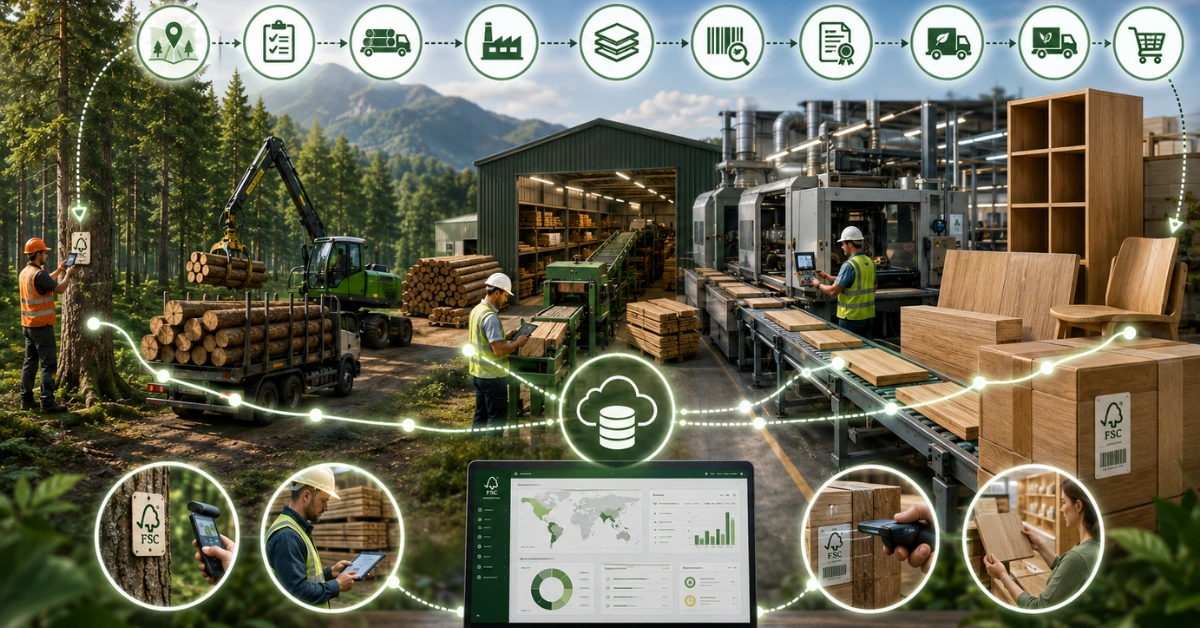
FSC traceability is the ability to follow FSC-certified material through every stage of the supply chain from forest source to finished product while recording transactions, reconciling volumes, and verifying that claims and evidence hold up under audit. A modern FSC traceability system is judged on nine capabilities: end-to-end traceability, transaction and volume recording, volume reconciliation, claims verification, risk and exception detection, evidence management, identity control, configurable rules and workflows, and data governance.
Key takeaways
Data, not just claims. FSC traceability has shifted from proving a claim to proving the data behind it source, movement, volume, and evidence.
Nine capabilities. Assess any FSC traceability system against nine capabilities before you commit.
Know the boundary. FSC Trace records and matches transactions for FSC-certified trades; broader multi-commodity and EUDR obligations often need a wider architecture.
Certification ≠ compliance. FSC Chain of Custody strengthens evidence but does not replace EUDR due diligence, geolocation, or a Due Diligence Statement.
Want to assess where your current FSC traceability setup stands?
Walk through your existing processes, identify data and traceability gaps, and explore how you can build a more connected FSC and regulatory compliance workflow.
FSC traceability used to end at a certificate code on an invoice. That is no longer enough. Buyers, auditors, and regulators increasingly ask where material came from, how it moved, whether the volumes reconcile, and whether the associated claims and supporting evidence can be independently verified. In practice, FSC traceability has become a data-management problem as much as a certification one.
FSC Trace, the Forest Stewardship Council’s digital platform, reflects this shift. It lets certificate holders record and match transactions, links supporting documents such as harvest permits directly to those transactions, and writes matched records to a blockchain so they cannot be altered afterwards. It is free, voluntary, and available to FSC certificate holders, with core features live and functionality expanding through 2026.
At the same time, the EU Deforestation Regulation (EUDR) raises the bar. Under Regulation (EU) 2025/2650, large and medium operators and traders must comply from 30 December 2026, and micro and small operators from 30 June 2027, against a 31 December 2020 deforestation cut-off. FSC certification strengthens the credibility of EUDR evidence but it does not replace geolocation, due diligence, or the Due Diligence Statement. That gap is exactly why FSC traceability capabilities now matter to your buying decision.
Want to understand FSC Certification, Chain of Custody, FSC claims, and verification requirements? Read our complete guide to FSC Certification and see what it takes to build a credible, traceable forest-product supply chain.
FSC traceability: the 9 capabilities to evaluate
If you are choosing a digital FSC traceability system, these are the nine capabilities to assess before you decide. Each maps to a question a buyer, auditor, or regulator can realistically ask.
1. End-to-end traceability. Can you trace certified material back through every relevant stage forest or source, supplier, processor, manufacturer, buyer with the batch and transaction links intact? Traceability is only as strong as the weakest missing link.
2. Transaction & volume recording. Does the system capture what actually moves purchases, sales, species, FSC claim type, quantity, volume, trading partners, and dates? FSC Trace records certificate codes, claim type, species, volumes, and product information for each matched trade.
Want to understand FSC Chain of Custody, how it works, what the different FSC claims mean, and how businesses can maintain traceability across the supply chain? Read our complete guide to FSC Chain of Custody.
3. Volume reconciliation. Can your claimed output be supported by your input? Reconciliation surfaces over-claiming, missing transactions, conversion losses, and inventory gaps, using configurable variance tolerances between matched buyer and seller records.
4. Claims verification. Are supplier certification status, certificate validity, product scope, and claim eligibility verified at the point of transaction not months later in an audit? FSC Trace reflects certification status when transactions are entered.
Want to understand FSC Claims, what they mean, how they work, and how businesses can communicate responsible sourcing with confidence? Read our complete guide to FSC Claims and understand the different claim types, requirements, and verification process.
5. Risk & exception detection. Can the system flag what does not look right an expired certificate, volume exceeding available material, missing source data, or unmatched transactions and route it through exception-based workflows instead of manual review of everything?
6. Evidence management. Are certificates, permits, legality documents, and geolocation linked to the transaction they support, not stored separately? FSC Trace attaches supporting documents directly to transactions to keep due-diligence information together.
7. Identity control. Who entered the data, who approved it, and who can change it? Role-based access, approval controls, and audit trails matter when multiple companies exchange sensitive commercial data FSC Trace is built around controlled, permissioned data sharing.
8. Configurable rules, workflows & UX. Can validation logic, approval routing, and data-capture UX be configured to your products and processes rather than forcing one rigid workflow? Look for direct entry, bulk upload, and API integration all supported by FSC Trace.
9. Data governance. Can you trust the data underneath everything else ownership, quality, completeness, accuracy, validation, version control, and retention? Bad supplier data cascades into bad reconciliation, unreliable claims, and weak audit evidence.
How the FSC traceability capabilities work together
These are not nine independent features. Strong FSC traceability is a connected chain: identity control governs who can act, transaction capture feeds traceability, traceability enables volume reconciliation, reconciliation supports claims verification, verification triggers risk and exception handling, and evidence management makes the whole record auditable with data governance sitting underneath, and configurable rules and UX running across the top. A weakness at any stage propagates to every stage after it.
Audit and enforcement readiness is a retrieval problem. When a competent authority or certification body asks a question, the winner is not whoever collected the most data it is whoever can retrieve the specific transaction, volume, and evidence that answers it, in minutes. FSC traceability that cannot be retrieved on demand is not really traceability.
How TraceX supports FSC traceability and EUDR readiness
TraceX Sustainable Sourcing Solutions helps businesses move from an FSC claim to compliance-ready supply-chain data by connecting supplier, source or plot, material, transaction, batch, processing, product, and shipment into a single evidence trail. That closes the gap between FSC traceability and the plot-level geolocation, supplier risk assessment, deforestation checks, and Due Diligence Statement workflow that EUDR requires.
The strategic point is simple: the same foundational data layer that supports FSC traceability can serve EUDR, and other regulations after it. Instead of rebuilding traceability per rule, you build it once and reuse it one data layer, many regulations.
Is your FSC data ready for the next level of traceability?
See how TraceX connects FSC-related supply-chain data with broader EUDR and traceability workflows.
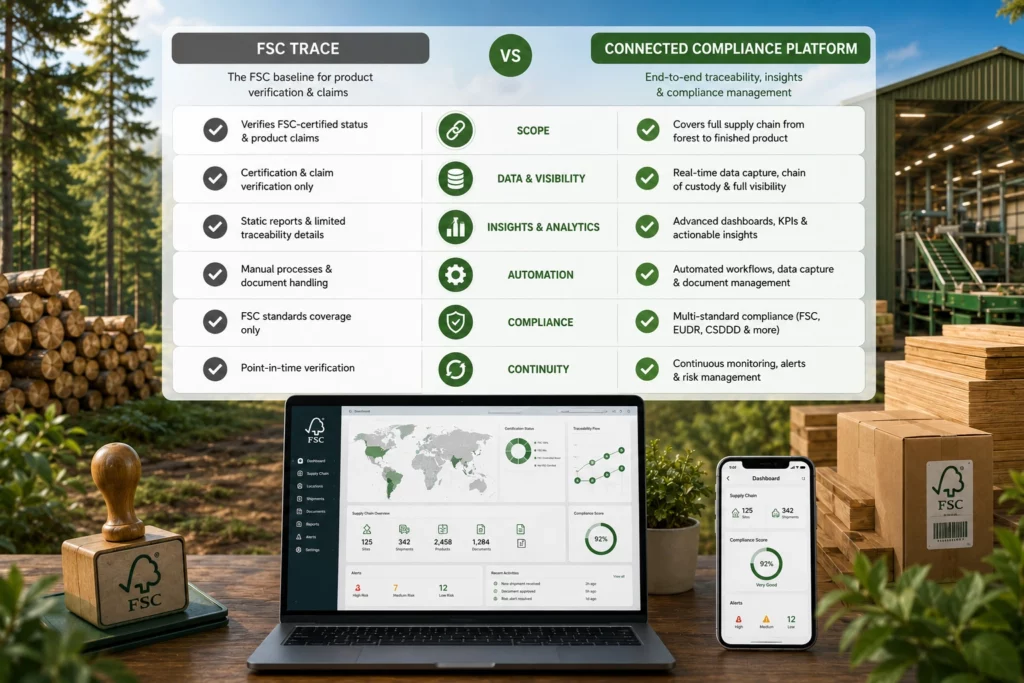
FSC traceability with FSC Trace vs. a connected platform
FSC Trace provides the certified-transaction backbone for FSC traceability. Companies with multi-commodity, multi-regulation, or plot-level EUDR obligations often need a wider architecture layered on top. The table below compares the baseline against a connected traceability platform.
Capability
FSC Trace (baseline)
Connected platform (TraceX)
Certified transaction recording & matching
Core strength
Ingests / connects to it
Plot-level geolocation & deforestation checks
Limited
Built-in mapping & assessment
Multi-commodity, multi-regulation scope
FSC-focused
One data layer, many regulations
EUDR due diligence & DDS workflow
Supports EUDR data sharing
End-to-end DDS workflow
Supplier onboarding & risk assessment
Partner list & status checks
Onboarding + risk scoring
Exception management at scale
Basic matching flags
Configurable exception queues
Your FSC traceability buyer evaluation checklist
Use this checklist when you shortlist or trial an FSC traceability system. If a vendor cannot demonstrate each item live, treat it as a gap.
End-to-end trace from source to finished product, with batch and transaction links intact.
Structured transaction and volume records, including species and FSC claim type.
Automated volume reconciliation with configurable tolerance rules.
Claims and certificate-status verification at the point of transaction.
Risk and exception detection with exception-based workflows, not blanket manual review.
Evidence linked directly to the transaction it supports.
Role-based identity control, approvals, and audit trails.
Configurable rules, workflows, and integration via bulk upload and API.
Documented data governance ownership, quality, validation, and retention.
Frequently Asked Questions (FAQ’s)
What is FSC traceability?
FSC traceability is the ability to follow FSC-certified material through every stage of the supply chain source, supplier, processor, manufacturer, buyer while recording transactions, reconciling volumes, and verifying that claims and evidence can be independently checked.
What is FSC Trace and how does it relate to FSC traceability?
FSC Trace is the Forest Stewardship Council’s free digital platform for recording and matching FSC-certified transactions. It provides the certified-transaction backbone of FSC traceability; matched records are written to a blockchain and cannot be altered afterwards.
Does FSC certification satisfy EUDR compliance?
No. FSC Chain of Custody strengthens the credibility of EUDR evidence, but it does not replace due diligence, plot-level geolocation, or the Due Diligence Statement. EUDR remains a separate legal obligation.
When does EUDR apply?
Under Regulation (EU) 2025/2650, large and medium operators and traders must comply from 30 December 2026, and micro and small operators from 30 June 2027, against a 31 December 2020 deforestation cut-off.
What is volume reconciliation in FSC traceability?
Volume reconciliation checks that claimed output is supported by recorded input, surfacing over-claiming, missing transactions, and conversion losses using configurable tolerance rules between matched buyer and seller records.
Why does data governance matter for FSC traceability?
Data governance is the foundation. Poor supplier or master data cascades into unreliable reconciliation, questionable claims, and weak audit evidence so ownership, quality, validation, and retention underpin every other capability.
How do I evaluate an FSC traceability system?
Assess it against nine capabilities: end-to-end traceability, transaction and volume recording, reconciliation, claims verification, risk and exception detection, evidence management, identity control, configurable workflows, and data governance.
Start using TraceX
Transparency, Trust, & Success for your Climate Journey.
We use cookies on our website to give you the most relevant experience by remembering your preferences and repeat visits. By clicking “Accept All”, you consent to the use of ALL the cookies. However, you may visit "Cookie Settings" to provide a controlled consent.
This website uses cookies to improve your experience while you navigate through the website. Out of these, the cookies that are categorized as necessary are stored on your browser as they are essential for the working of basic functionalities of the website. We also use third-party cookies that help us analyze and understand how you use this website. These cookies will be stored in your browser only with your consent. You also have the option to opt-out of these cookies. But opting out of some of these cookies may affect your browsing experience.
Necessary cookies are absolutely essential for the website to function properly. These cookies ensure basic functionalities and security features of the website, anonymously.
Cookie
Duration
Description
cookielawinfo-checkbox-analytics
11 months
This cookie is set by GDPR Cookie Consent plugin. The cookie is used to store the user consent for the cookies in the category "Analytics".
cookielawinfo-checkbox-functional
11 months
The cookie is set by GDPR cookie consent to record the user consent for the cookies in the category "Functional".
cookielawinfo-checkbox-necessary
11 months
This cookie is set by GDPR Cookie Consent plugin. The cookies is used to store the user consent for the cookies in the category "Necessary".
cookielawinfo-checkbox-others
11 months
This cookie is set by GDPR Cookie Consent plugin. The cookie is used to store the user consent for the cookies in the category "Other.
cookielawinfo-checkbox-performance
11 months
This cookie is set by GDPR Cookie Consent plugin. The cookie is used to store the user consent for the cookies in the category "Performance".
viewed_cookie_policy
11 months
The cookie is set by the GDPR Cookie Consent plugin and is used to store whether or not user has consented to the use of cookies. It does not store any personal data.
Functional cookies help to perform certain functionalities like sharing the content of the website on social media platforms, collect feedbacks, and other third-party features.
Performance cookies are used to understand and analyze the key performance indexes of the website which helps in delivering a better user experience for the visitors.
Analytical cookies are used to understand how visitors interact with the website. These cookies help provide information on metrics the number of visitors, bounce rate, traffic source, etc.
Advertisement cookies are used to provide visitors with relevant ads and marketing campaigns. These cookies track visitors across websites and collect information to provide customized ads.
Download the 2026 Traceability Scorecard and Benchmark Your Supply Chain Across 10 Critical Capabilities.
Download our eBook
Don’t Wait for an Audit to Find Your EUDR Gaps
The 2026 Simplification Package changes how HS codes, DDS pass-through and geolocation rules apply to you. Get the free guide and 20-point readiness checklist before enforcement catches you unprepared.