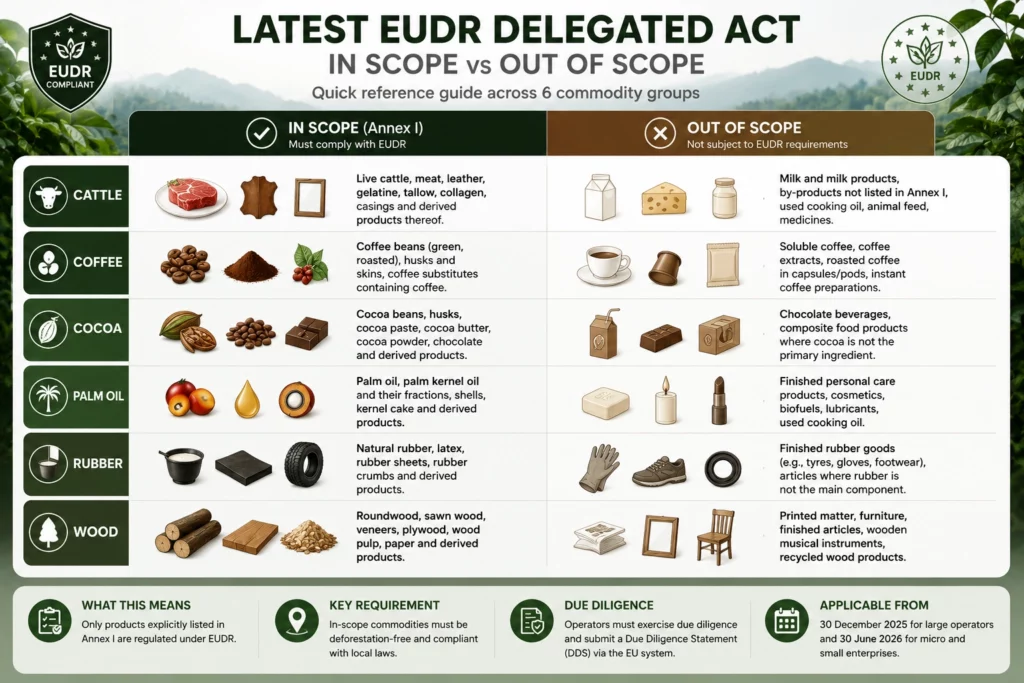
Latest EUDR Delegated Act: Is Your Product Still in Scope?
Published
, 11 minute read
Share this article
Quick summary: The latest EUDR delegated act reshapes Annex I by adding soluble coffee and palm oil derivatives, removing leather and select rubber products, and creating a second compliance timeline for newly added goods.
The latest EUDR delegated act, adopted by the European Commission on 13 July 2026, does not change the seven covered commodities or the 30 December 2026 start date. It rewrites Annex I the product-by-product list of HS/CN codes that decides scope. Soluble coffee and a wide set of palm oil derivatives are added; cattle leather, most of a retreaded tyre, and several rubber and vehicle products are removed; and waste, samples, and packaging exemptions are confirmed. Newly added products get until 30 December 2027. The act is adopted but not yet final it is still in Parliament/Council scrutiny and not yet published in the Official Journal.
Key takeaways
The latest EUDR delegated act reshapes Annex I only the seven commodities (cattle, cocoa, coffee, palm oil, rubber, soya, wood) and the enforcement dates are unchanged.
Added to scope: soluble coffee (CN 2101 11 00), frozen cattle tongues (CN ex 0206 21 00), and palm oil oleochemicals plus soap made using oil palm.
Removed from scope: cattle hides, skins and leather (CN 4101, 4104, 4107), retreaded tyres beyond the new tread (CN ex 4012 90 30), soybeans for sowing, articles of vulcanised rubber, conveyor and transmission belts, and aircraft and vehicle seats.
Two clocks now run: existing in-scope products apply from 30 December 2026; newly added products apply from 30 December 2027.
Scope now depends on the commodity actually used (the “ex” prefix) and on species (Bos, Elaeis, Hevea) it is a data-lineage question, not a product-name lookup.
The act is adopted but not yet in force treat the new scope as provisional until it appears in the Official Journal.
The latest EUDR delegated act, adopted on 13 July 2026, has quietly changed which of your products the EU Deforestation Regulation actually covers without touching the regulation itself. The EUDR (Regulation (EU) 2023/1115) is the law that requires companies to prove goods are deforestation-free before placing them on, or exporting them from, the EU market. What the delegated act does is amend Annex I the list that spells out, HS code by HS code, exactly which goods fall under the rules. Change that list and you change real obligations, even though the headline regulation is untouched. For most compliance teams it reduces to a single question: is your product still on the list?
Not sure which of your SKUs the latest EUDR delegated act still touches?
TraceX Cleara AI maps every product to its HS/CN code and flags in-scope, out-of-scope, and newly-added items against the current Annex I with a version history so you can prove why.
What the latest EUDR delegated act actually changes
The latest EUDR delegated act keeps the seven relevant commodities exactly as they were: cattle, cocoa, coffee, oil palm, rubber, soya and wood. It does not reopen the regulation and it does not move any deadline. Instead it rewrites the product list underneath those commodities. Because Annex I is expressed in Combined Nomenclature (CN) customs codes, a single code moving on or off the list can pull an entire category of goods into or out of due diligence regardless of what the product is called on your invoice.
The change is the final piece of the Commission’s EUDR simplification package first published on 4 May 2026. The draft was open for public feedback until 1 June 2026; the version adopted on 13 July 2026 keeps the draft’s additions and removes more products than the draft did, following that feedback. It was adopted together with an implementing act updating the EUDR Information System. Crucially, the act still has to clear a Parliament and Council scrutiny period before it can be published in the Official Journal and take effect.
The Commission estimates the wider simplification package could cut affected companies’ annual compliance costs by roughly ~75% against the original design, with environmental benefits of around ~€7bn per year figures worth watching, because they frame every removal as relief and every addition as a manageable exception.
Decode EUDR HS Codes with Confidence Read our complete guide to EUDR HS Codes and Product Classification.
Which products the latest EUDR delegated act adds
The additions share one logic: each is made from a commodity already covered, but sat outside the list leaving a gap where deforestation risk could quietly relocate downstream. The latest EUDR delegated act closes those gaps.
Soluble coffee (CN 2101 11 00) — extracts, essences and concentrates of coffee now join green and roasted beans. Same plant, same risk, previously outside scope.
Frozen cattle tongues (CN ex 0206 21 00) — added to match the fresh tongues already covered, removing an odd fresh-in / frozen-out split.
Palm oil oleochemicals and soap — the largest block of additions: fatty acids, fatty alcohols, glycerol and related derivatives made using oil palm, plus soap containing palm oil. This lands hardest on chemicals, cosmetics, detergent and food-ingredient firms, where the finished product name says nothing about the palm-oil feedstock inside it.
A carve-out matters here: palm oil derivatives used to manufacture medicinal products for human or veterinary use are excluded, as are certain palm oil derivatives used as feedstock for biofuels.
Which products the latest EUDR delegated act removes
The removals run the other way products where the compliance effort was judged disproportionate to the deforestation benefit. Under the latest EUDR delegated act, the notable exits are:
Cattle leather — raw, tanned and further-prepared hides and skins (CN 4101, 4104, 4107) are deleted. Leather is a low-value by-product of the meat trade, and finished-leather buyers have little leverage to extract reliable origin data from suppliers far up the chain. The Commission has flagged it will revisit leather in the 2030 general review.
Retreaded tyres — only the new rubber tread stays in scope (CN ex 4012 90 30); the used casing does not, rewarding circular reuse.
Vulcanised rubber goods — conveyor and transmission belts and other articles of vulcanised rubber (CN 4010, 4016) leave, on the basis of low natural-rubber content.
Soybeans for sowing (CN moved to 1201 90 00) and aircraft / motor-vehicle seats (carved out of CN ex 9401) also come out.
A word of caution the celebratory coverage skips: a removal is not a delete-and-forget. Removed categories still need a documented rationale for standing controls down and, until the act is published in the Official Journal, they are not legally out yet.
Latest EUDR delegated act: what is exempt and clarified
Beyond adds and removes, the latest EUDR delegated act settles several grey areas that have caused real confusion for operators:
Waste, used and second-hand goods — anything qualifying as waste under the EU Waste Framework Directive, plus used and second-hand products, is confirmed outside scope, so repair, reuse and recycling are not penalised.
Samples and testing products — goods used up or destroyed in analysis, examination or testing are exempt.
Packaging — single-use and reusable packaging that merely carries another product is out; packaging sold as a product in its own right stays in.
Marketing materials and correspondence — labels and information materials accompanying a product, and items of correspondence, are excluded.
Species and the “ex” prefix — cattle means the Bos genus; oil palm means Elaeis; rubber means Hevea. Bamboo, rattan, reeds and lime bark sit outside wood. Where an entry carries “ex”, it applies only when a covered commodity was actually used.
Our take: the latest EUDR delegated act turns scope into a versioned dataset
Here is the part most “what changed” summaries miss. The latest EUDR delegated act is being read as relief a shorter list, a lighter load. But look at the mechanics and a different story appears: scope is no longer a one-time checklist. It is a living, version-controlled dataset.
Consider the evidence. Annex I has now moved twice in eight months, while the 30 December 2026 deadline has not moved once. The act is adopted but not final, so the “answer” to whether a product is in scope is provisional. And the two-clock structure existing products from 30 December 2026, newly added products from 30 December 2027 means the same supplier programme now carries two live compliance dates at the same time. Relief on paper; more state to track in practice.
The deeper shift is that the “ex” prefix and the species definitions turn scope into a data-lineage question. Whether CN ex 0206 21 00 or a palm oil derivative is in scope no longer depends on the product name on the label, it depends on which commodity, and which species, was actually used to make it. You cannot answer that from a spreadsheet of finished-good descriptions. You answer it from traceable origin data linked to each SKU and its HS code.
That is why the winners will not treat the latest EUDR delegated act as a memo to read once. They will treat product-to-HS-code mapping as governed data: versioned, timestamped, and auditable, so that when Annex I moves a third time and it will, with a general review due in 2030 they can show exactly what they concluded, when, and why. And because the same origin and supplier data also feeds CSDDD, CSRD and packaging rules, the smart move is to build it once, in one data layer, rather than rebuild it every time a delegated act lands.
How TraceX Helps
As EUDR product scope evolves, businesses need more than a one-time HS/CN code check. TraceX EUDR solutions help enterprises connect product classification with supplier and farm traceability, validated GeoJSON data, satellite-backed deforestation risk assessments, legality documentation, and automated DDS workflows with EU TRACES integration. This enables businesses to identify in-scope supply chains, maintain audit-ready evidence, and adapt their compliance processes as regulatory requirements change.
Turn a moving scope into a defensible record
The latest EUDR delegated act won’t be the last change to Annex I. If your scope lives in a spreadsheet, every amendment means starting over with no history to prove your reasoning.
Latest EUDR delegated act: manual scope tracking vs. TraceX
Task
Manual / spreadsheet
TraceX
Re-scoping after an Annex I change
Rebuild the spreadsheet by hand; easy to miss the “ex” prefix and species carve-outs
Re-runs product-to-HS-code mapping against the current Annex I automatically
Two-clock deadline tracking (2026 vs 2027)
Manual tagging; no alerting when a 2027-added product nears its date
Flags existing vs newly-added items and their separate application dates
Proving why a product was in / out
No history last edit overwrites the last
Version history and audit trail for every scope decision
Commodity / species lineage (Bos, Elaeis, Hevea)
Relies on product name, not feedstock
Links scope to the commodity and species actually used, at plot level
Reuse across CSDDD, CSRD, packaging
Separate trackers per regulation
One data layer feeding multiple frameworks
Latest EUDR delegated act: a buyer readiness checklist
Use this to decide whether the latest EUDR delegated act changes anything for you before your next filing cycle:
Re-run product scoping against the amended Annex I focus on derived products and feedstocks, not finished-product names.
Flag anything newly in scope (soluble coffee, palm oil oleochemicals, soap, frozen cattle tongues) and start supplier engagement now against the 30 December 2027 date.
For removed categories (leather, retreaded tyres, vulcanised rubber, sowing soybeans, vehicle seats), document the stand-down rationale but keep collecting data until Official Journal publication.
Confirm species and “ex” logic for borderline products is the feedstock actually Bos, Elaeis or Hevea?
Record the scope decision with a date and source, so you can show your reasoning when Annex I moves again.
Connect the same origin/supplier data to your CSDDD, CSRD and packaging obligations to avoid rebuilding it per regulation.
Frequently Asked Questions (FAQ’s)
What did the latest EUDR delegated act change on 13 July 2026?
It amended Annex I of the EUDR the list of covered products without touching the seven commodities or the enforcement dates. It adds soluble coffee, palm oil oleochemicals and soap, and frozen cattle tongues; removes cattle leather, most of a retreaded tyre, vulcanised rubber articles, conveyor and transmission belts, soybeans for sowing, and vehicle seats; and confirms exemptions for waste, samples and packaging.
Does the latest EUDR delegated act move the EUDR deadline?
No. The main application date stays 30 December 2026 for large and medium operators and traders (and micro/small operators already under the EU Timber Regulation). Other micro and small operators have until 30 June 2027. Only newly added products get extra time, applying from 30 December 2027.
Is the latest EUDR delegated act final law yet?
No. It was adopted by the Commission on 13 July 2026 but is in a Parliament and Council scrutiny period (typically two months, extendable by two months), during which either body can object. If no objection is raised it is published in the Official Journal and takes effect. Prepare on the adopted text, but treat it as provisional until publication.
Is cattle leather still covered by the EUDR?
Under the latest EUDR delegated act, raw, tanned and further-prepared cattle hides, skins and leather (CN 4101, 4104, 4107) are removed from Annex I. Keep collecting due diligence data until the act is published in the Official Journal, and note the Commission plans to revisit leather in its 2030 general review.
Are palm oil derivatives now in scope under the latest EUDR delegated act?
Yes a wide set of palm oil oleochemicals (fatty acids, fatty alcohols, glycerol and related derivatives) and soap made using oil palm are added, where oil palm was actually used. Derivatives used to make medicinal products, and certain derivatives used as biofuel feedstock, are excluded.
How do the “ex” codes and species definitions affect scope?
An “ex” prefix means the code applies only when a covered commodity was actually used to make the product. Species definitions narrow this further: cattle means Bos, oil palm means Elaeis, rubber means Hevea. So scope depends on the feedstock and species behind a product, not its name which makes traceable origin data essential.
What should companies do now about the latest EUDR delegated act?
Re-scope products against the amended Annex I, prioritise supplier engagement for newly added items, document stand-down rationales for removed items, and build a single version-controlled record of your scope decisions and origin data one that also serves CSDDD, CSRD and packaging rules.
Start using TraceX
Transparency, Trust, & Success for your Climate Journey.
We use cookies on our website to give you the most relevant experience by remembering your preferences and repeat visits. By clicking “Accept All”, you consent to the use of ALL the cookies. However, you may visit "Cookie Settings" to provide a controlled consent.
This website uses cookies to improve your experience while you navigate through the website. Out of these, the cookies that are categorized as necessary are stored on your browser as they are essential for the working of basic functionalities of the website. We also use third-party cookies that help us analyze and understand how you use this website. These cookies will be stored in your browser only with your consent. You also have the option to opt-out of these cookies. But opting out of some of these cookies may affect your browsing experience.
Necessary cookies are absolutely essential for the website to function properly. These cookies ensure basic functionalities and security features of the website, anonymously.
Cookie
Duration
Description
cookielawinfo-checkbox-analytics
11 months
This cookie is set by GDPR Cookie Consent plugin. The cookie is used to store the user consent for the cookies in the category "Analytics".
cookielawinfo-checkbox-functional
11 months
The cookie is set by GDPR cookie consent to record the user consent for the cookies in the category "Functional".
cookielawinfo-checkbox-necessary
11 months
This cookie is set by GDPR Cookie Consent plugin. The cookies is used to store the user consent for the cookies in the category "Necessary".
cookielawinfo-checkbox-others
11 months
This cookie is set by GDPR Cookie Consent plugin. The cookie is used to store the user consent for the cookies in the category "Other.
cookielawinfo-checkbox-performance
11 months
This cookie is set by GDPR Cookie Consent plugin. The cookie is used to store the user consent for the cookies in the category "Performance".
viewed_cookie_policy
11 months
The cookie is set by the GDPR Cookie Consent plugin and is used to store whether or not user has consented to the use of cookies. It does not store any personal data.
Functional cookies help to perform certain functionalities like sharing the content of the website on social media platforms, collect feedbacks, and other third-party features.
Performance cookies are used to understand and analyze the key performance indexes of the website which helps in delivering a better user experience for the visitors.
Analytical cookies are used to understand how visitors interact with the website. These cookies help provide information on metrics the number of visitors, bounce rate, traffic source, etc.
Advertisement cookies are used to provide visitors with relevant ads and marketing campaigns. These cookies track visitors across websites and collect information to provide customized ads.
Download the 2026 Traceability Scorecard and Benchmark Your Supply Chain Across 10 Critical Capabilities.
Download our eBook
Don’t Wait for an Audit to Find Your EUDR Gaps
The 2026 Simplification Package changes how HS codes, DDS pass-through and geolocation rules apply to you. Get the free guide and 20-point readiness checklist before enforcement catches you unprepared.