Packaging Minimization Under PPWR: Article 10 Requirements and How to Comply
Published
, 10 minute read
Share this article
Quick summary: Packaging minimization is a binding PPWR obligation from 2030. Learn what Article 10 requires, which packaging is banned, and how to prove compliance.
Packaging minimization under PPWR (Regulation (EU) 2025/40, Article 10) is the legal obligation for manufacturers and importers to design packaging so its weight and volume are reduced to the minimum necessary to keep the packaging functional. From 1 January 2030, packaging that adds only perceived volume double walls, false bottoms, unnecessary layers cannot be placed on the EU market unless a narrow design-right, trademark, or geographical-indication exemption applies. Compliance must be proven in technical documentation under Annex VII, assessed against the Annex IV performance criteria.
Key takeaways
Packaging minimization is binding from 1 January 2030 for large, medium, and micro/small operators alike PPWR gives no general small-business exemption.
Article 10 has two duties: (1) reduce weight and volume to the minimum necessary, and (2) do not place packaging that only inflates perceived volume.
Compliance is evidence-based. You must document, per Annex IV performance criterion, why the weight or volume cannot be reduced further in the Annex VII technical file.
Harmonised standards are coming. The Commission must ask CEN to prepare or update minimisation standards by 12 February 2027; conformity to them creates a presumption of compliance.
Packaging minimization interlocks with the Article 24 empty-space ratio for grouped, transport, and e-commerce packaging the two obligations must be evidenced together.
Replace Manual Compliance Work with One Platform
No more rebuilding technical dossiers by hand or tracking versions in email. Watch how TraceX automates packaging documentation and Declarations of Conformity end to end.
Packaging minimization is the requirement, set out in Article 10 of the PPWR, that every unit of packaging placed on the EU market carries no more material or volume than it needs to protect, present, and deliver the product inside it. In plain terms: if you can take weight or space out of the pack without breaking its function, PPWR says you must.
Article 10(1) frames the core duty around the design of the pack itself its weight and volume must be reduced to the minimum necessary to ensure functionality, taking account of the shape and material used. This is a design obligation, not a labelling one: it bites at the moment packaging is created, and it is assessed against measurable performance criteria rather than a manufacturer’s opinion of what looks reasonable.
The obligation sits inside PPWR’s wider prevention agenda, which aims to cut per-capita packaging waste across the EU. But for a compliance team, this obligation is not a sustainability aspiration it is a market-access gate. Packaging that fails Article 10 from 1 January 2030 cannot lawfully be placed on the market.
Why Packaging Minimization Compliance Is Harder Than It Looks
Most teams underestimate the minimization duty because it sounds like a design tweak. In practice, proving it is a data problem and that is where compliance stalls.
The pain: minimization is a documentation burden, not a design one
Article 10 does not ask you to make packaging smaller and move on. It asks you to demonstrate, criterion by criterion, why each pack is already at its minimum. That means evidence for every SKU:
Which Annex IV performance criteria apply to each packaging format.
The specific design requirement that prevents any further reduction in weight or volume.
Test results, studies, modelling, or simulations supporting the minimum you claim.
For a mid-sized manufacturer with hundreds or thousands of SKUs, gathering that evidence by hand across spreadsheets, supplier PDFs, and disconnected packaging specs is where packaging minimization quietly becomes unmanageable. Data lives in different teams, in different formats, and rarely maps cleanly to a single pack. Miss one criterion for one SKU and the technical file is incomplete which is the same as non-compliant when a market surveillance authority asks.
PPWR READINESS
Packaging Minimization Under PPWR: Don’t Wait Until 2030
A common misconception is that packaging minimization requirements only begin on 1 January 2030. In reality, packaging minimization has been a compliance obligation for years under the Packaging and Packaging Waste Directive (PPWD). When the PPWR starts applying on 12 August 2026, businesses are still expected to demonstrate compliance using the existing Essential Requirements and EN 13428:2004 until the end of 2029. The 2030 milestone introduces an updated methodology and future harmonized standards, but it does not create packaging minimization as a new obligation.
It’s also important not to confuse packaging minimization (Article 10) with the 50% empty space ratio requirement (Article 24) they are separate requirements with different compliance approaches.
For businesses, the takeaway is clear: packaging minimization should already be embedded into packaging design, technical documentation, and conformity assessments well before 2030.
PPWR compliance is more than meeting a deadline—it’s about building the right processes.
Discover the key requirements, common challenges, and practical steps to achieve and maintain compliance.
Packaging minimization under Article 10 breaks into four concrete obligations. Read together, they define what a compliant pack and a compliant file must look like.
Packaging minimization duty 1: reduce weight and volume to the minimum
By 1 January 2030, the manufacturer or importer must ensure packaging is designed so its weight and volume are reduced to the minimum necessary for functionality, accounting for the shape and material used. Functionality includes protection, hygiene and safety, and the practical needs of the product but it does not include marketing appeal.
Packaging minimization duty 2: no packaging that only inflates perceived volume
Article 10(2) prohibits packaging that fails the Annex IV performance criteria and packaging whose features exist only to make the product look bigger. The regulation names the usual offenders explicitly: double walls, false bottoms, and unnecessary layers. If a design element adds no protective or functional value and simply enlarges the pack, Article 10 treats it as non-compliant.
Packaging minimization exemptions: narrow and evidence-heavy
Two carve-outs exist, and both are limited:
Protected design or trademark: where the packaging design is protected by a registered Community design or design right, or its shape is a protected trademark, the rights were protected before 11 February 2025, and applying minimization would alter the design’s novelty or individual character (or stop a trademark distinguishing the product).
Geographical indication / quality scheme: where the packaged product benefits from a protected geographical indication under Union law (for example wine, spirit drinks, or craft and industrial products) or a recognised quality scheme.
These are not general escape hatches. If you rely on an exemption, you must still be able to show that the specific condition is met the burden of proof stays with the operator.
Packaging minimization timeline: what applies when
The dates matter for planning your compliance runway:
12 August 2026 — PPWR general application. Minimisation criteria under the existing framework continue to apply during the transition.
12 February 2027 — the Commission must request CEN to prepare or update harmonised standards defining how to calculate and measure packaging minimization, including maximum weight and volume limits for common formats.
End of 2029 — the existing minimisation requirements and their standard remain in effect.
1 January 2030 — Article 10(1) and 10(2) apply in full. This is the hard compliance line for packaging minimization.
Selling online in the EU? PPWR introduces new packaging obligations for e-commerce businesses. Learn how to comply with packaging minimization, empty space requirements, and documentation obligations.
Article 10(4) is explicit: compliance must be demonstrated in the Annex VII technical documentation. A credible packaging minimization file contains three things for every pack: an explanation of the technical specifications, standards, and conditions used to assess it against Annex IV; the identification, for each performance criterion, of the design requirement preventing further reduction; and the test results, studies, modelling, or simulations behind the claimed minimum. For reusable packaging, the assessment also has to reflect the characteristics that make it reusable under Article 11.
The capability that closes the gap: structured, SKU-level evidence
This is where a purpose-built platform changes the economics of compliance. TraceXPPWR Solutions is designed to turn packaging minimization from a manual documentation scramble into a structured, repeatable workflow:
Centralised packaging inventory — every SKU, format, component, weight, and volume in one system rather than scattered spreadsheets.
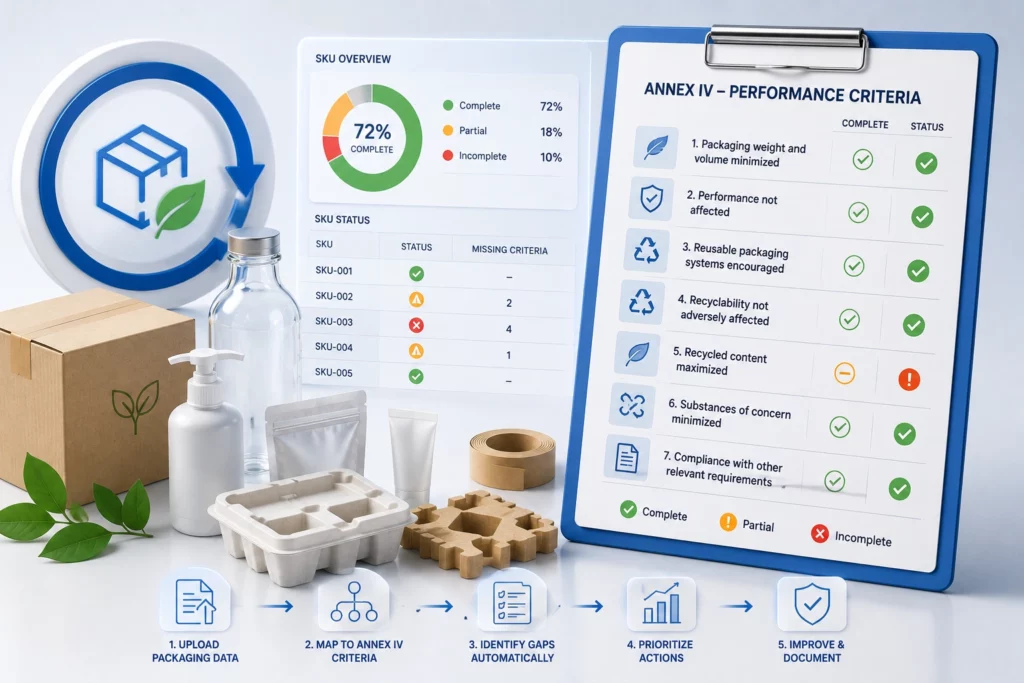
Criterion-level mapping — each pack mapped against the applicable Annex IV performance criteria, so gaps are visible before an authority finds them.
Evidence capture — supplier documents, test results, and design justifications attached to the pack they support, ready to export as an Annex VII file.
Standards alignment — [confirm capability] structured to adopt the CEN harmonised standards once published, so the presumption of compliance can be claimed.
The benefit is straightforward: instead of reconstructing evidence under audit pressure, your packaging minimization documentation is continuously maintained and audit-ready.
Your Practical Checklist for the 12 August Deadline
Know exactly what “Phase 1 ready” looks like. The handbook walks you through the obligations and evidence you need to have in place.
Manual vs Automated Packaging Minimization Compliance
Compliance task
Manual approach
TraceX Cleara AI
Packaging inventory
Fragmented spreadsheets, version drift
Single source of truth, all SKUs
Annex IV criterion mapping
Manual, easy to miss a criterion
Structured mapping, gaps flagged
Evidence for ‘minimum necessary’
Hunted down per audit
Attached to each pack, always on
Annex VII file assembly
[X] weeks, error-prone
Export-ready, continuously updated
Standards/presumption of compliance
Tracked by hand
[Confirm] built to adopt CEN standards
Audit readiness
Reactive scramble
Continuous, defensible trail
Packaging Minimization Compliance Checklist for Buyers
Use this checklist to evaluate whether your process or a tool you are assessing can actually deliver minimization compliance under Article 10:
Can you list every packaging SKU with its weight, volume, materials, and components in one place?
Is each pack mapped to the applicable Annex IV performance criteria?
For every criterion, can you name the design requirement that prevents further reduction?
Do you hold the test results, studies, or simulations that justify the claimed minimum?
Can you export a complete Annex VII technical file per pack on demand?
Have you identified any packs relying on a design-right, trademark, or GI exemption — and the evidence for it?
Is your process ready to adopt the CEN harmonised standards once published?
Does your evidence stay current as packaging changes, or does it decay between audits?
Frequently Asked Questions (FAQ’s)
When does packaging minimization become mandatory under PPWR?
Article 10 minimisation applies from 1 January 2030. PPWR itself has been generally applicable since 12 August 2026, but the full Article 10(1) and 10(2) duties take effect on the 2030 date. Always verify against EUR-Lex, as timelines have shifted.
Does packaging minimization apply to small businesses?
Yes. PPWR does not provide a general exemption for micro or small enterprises. The core minimization obligations apply to all operators placing packaging on the EU market, regardless of size.
What packaging features does Article 10 specifically prohibit?
Article 10(2) targets features that only increase perceived product volume, naming double walls, false bottoms, and unnecessary layers, as well as packaging that fails the Annex IV performance criteria.
How do I prove packaging minimization compliance?
Through the Annex VII technical documentation: the specifications and standards used to assess the pack against Annex IV, the design requirement preventing further reduction for each criterion, and the supporting test results, studies, modelling, or simulations.
What are the exemptions to packaging minimization?
Two narrow ones: packaging protected by a registered design or trademark (protected before 11 February 2025, where minimization would alter its novelty, individual character, or distinctiveness), and packaging for products with a protected geographical indication or recognised quality scheme.
How does packaging minimization relate to the empty-space ratio?
Article 10 (minimization) and Article 24 (empty-space ratio for grouped, transport, and e-commerce packaging) work together the empty space in a pack must stay within the Article 24 limit of [confirm: 40% or 50%], and both must be evidenced. The Commission’s guidance clarifies the relationship.
Do harmonised standards make packaging minimization easier?
Yes. Once CEN publishes the standards the Commission must request by 12 February 2027, conformity to them creates a presumption of compliance — a faster, more defensible route than proving minimization criterion by criterion from scratch.
Start using TraceX
Transparency, Trust, & Success for your Climate Journey.
We use cookies on our website to give you the most relevant experience by remembering your preferences and repeat visits. By clicking “Accept All”, you consent to the use of ALL the cookies. However, you may visit "Cookie Settings" to provide a controlled consent.
This website uses cookies to improve your experience while you navigate through the website. Out of these, the cookies that are categorized as necessary are stored on your browser as they are essential for the working of basic functionalities of the website. We also use third-party cookies that help us analyze and understand how you use this website. These cookies will be stored in your browser only with your consent. You also have the option to opt-out of these cookies. But opting out of some of these cookies may affect your browsing experience.
Necessary cookies are absolutely essential for the website to function properly. These cookies ensure basic functionalities and security features of the website, anonymously.
Cookie
Duration
Description
cookielawinfo-checkbox-analytics
11 months
This cookie is set by GDPR Cookie Consent plugin. The cookie is used to store the user consent for the cookies in the category "Analytics".
cookielawinfo-checkbox-functional
11 months
The cookie is set by GDPR cookie consent to record the user consent for the cookies in the category "Functional".
cookielawinfo-checkbox-necessary
11 months
This cookie is set by GDPR Cookie Consent plugin. The cookies is used to store the user consent for the cookies in the category "Necessary".
cookielawinfo-checkbox-others
11 months
This cookie is set by GDPR Cookie Consent plugin. The cookie is used to store the user consent for the cookies in the category "Other.
cookielawinfo-checkbox-performance
11 months
This cookie is set by GDPR Cookie Consent plugin. The cookie is used to store the user consent for the cookies in the category "Performance".
viewed_cookie_policy
11 months
The cookie is set by the GDPR Cookie Consent plugin and is used to store whether or not user has consented to the use of cookies. It does not store any personal data.
Functional cookies help to perform certain functionalities like sharing the content of the website on social media platforms, collect feedbacks, and other third-party features.
Performance cookies are used to understand and analyze the key performance indexes of the website which helps in delivering a better user experience for the visitors.
Analytical cookies are used to understand how visitors interact with the website. These cookies help provide information on metrics the number of visitors, bounce rate, traffic source, etc.
Advertisement cookies are used to provide visitors with relevant ads and marketing campaigns. These cookies track visitors across websites and collect information to provide customized ads.
Download the 2026 Traceability Scorecard and Benchmark Your Supply Chain Across 10 Critical Capabilities.
Download our eBook
Don’t Wait for an Audit to Find Your EUDR Gaps
The 2026 Simplification Package changes how HS codes, DDS pass-through and geolocation rules apply to you. Get the free guide and 20-point readiness checklist before enforcement catches you unprepared.