AI Email Parser for Compliance: Turn Supplier Inboxes Into Audit-Ready Records
Published
, 12 minute read
Share this article
Quick summary: See how TraceX's AI email parser automates supplier data extraction for EUDR, PPWR, and DPP compliance and cuts due diligence prep by 80%.
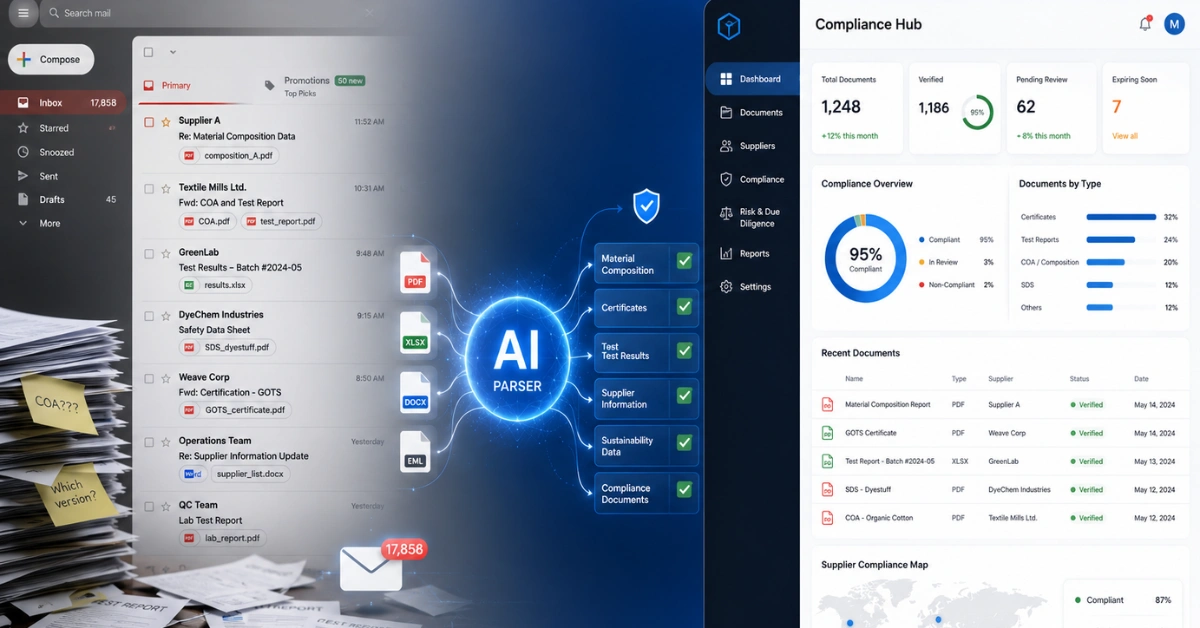
Picture the inbox of a compliance manager at a mid-sized cocoa exporter in early December. There are 312 unread supplier emails. Some have PDF certificates attached. A few have GPS coordinates pasted into the email body. Two have photos of handwritten land titles. One supplier sent a GeoJSON file with no commodity reference. None of it is in the format the EU TRACES system actually wants. That inbox is the bottleneck for EU Deforestation Regulation (EUDR) compliance. Increasingly, organizations are turning to AI-powered parsers for compliance to extract, structure, and validate information from fragmented supplier documents, transforming unstructured emails, PDFs, images, and geospatial files into standardized, audit-ready data that can support EUDR due diligence workflows.
It will soon be the bottleneck for the EU’s Packaging and Packaging Waste Regulation (PPWR) and the Digital Product Passport (DPP) under the Ecodesign for Sustainable Products Regulation (ESPR) too. The volume isn’t going down it’s about to multiply across three concurrent regulations.
This article walks through what an AI email parser actually does for compliance teams, which jobs it eliminates, what the buyer-intent signals look like, and how TraceX’s regulatory compliance platform handles the messy reality of supplier communication under EUDR, PPWR, and DPP.
Key takeaways Compliance teams handling EUDR, PPWR, and DPP submissions are buried in unstructured supplier emails: PDFs, scanned certificates, GeoJSON files, and inconsistent spreadsheets. An AI email parser reads every inbound supplier email, extracts the structured data regulators require (geolocation, KYC, certifications, shipment IDs), validates it, and drafts the compliance record automatically. Result: 70–90% less manual data entry, faster supplier onboarding, and a defensible audit trail across every regulation that needs primary supply-chain data.
Across TraceX’s EUDR customer base, compliance teams report spending an average of 11–14 minutes per supplier submission on manual data extraction and validation. For an exporter with 800 active suppliers, that’s 160+ working hours per quarter before a single Due Diligence Statement is filed.
What is an AI parser for compliance?
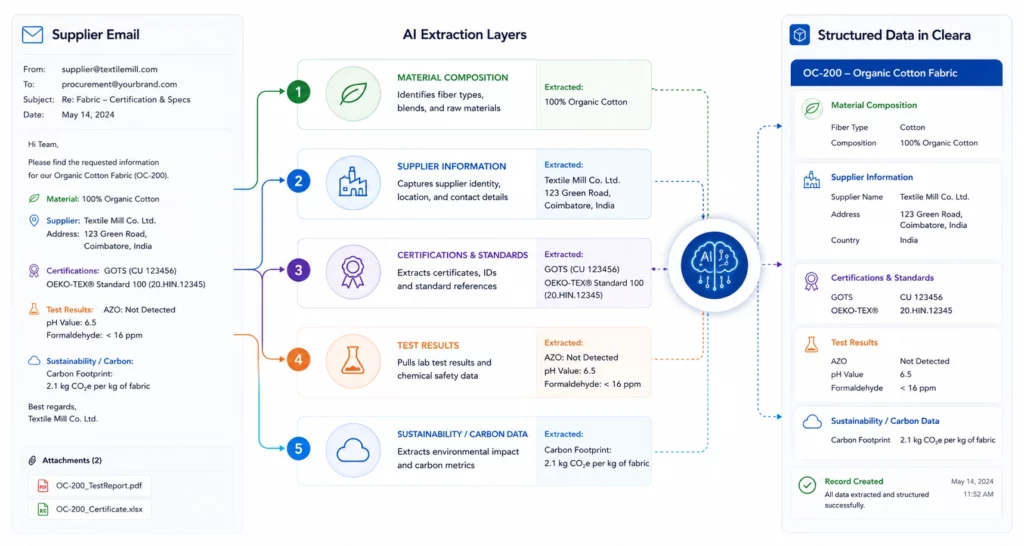
An AI parser for compliance is a system that monitors a shared inbox (or webhook endpoint), reads every inbound supplier email and attachment, and extracts structured regulatory data supplier identity, product codes, shipment references, geolocation polygons, certifications, and supporting evidence into a compliance platform without manual data entry. It also validates what it extracts against the rules that EUDR, PPWR, or DPP submissions require, flags what’s missing, and drafts the compliance record automatically.
The AI parser, built into TraceX’s Regulatory Compliance Platform, handles inbound supplier email in any structure typed text, scanned PDFs, photos of certificates, Excel attachments, KML/GeoJSON files and turns them into draft Due Diligence Statements, risk assessments, or DPP data blocks ready for review.
The five data layers it actually extracts
Supplier identity: legal name, address, registration ID, contact information, country of origin.
Product data: commodity type, HS code, batch number, volume, lot reference, harvest or production date.
Shipment references: bill of lading, invoice number, container ID, port of loading, expected ETA.
Supporting documentation: KYC documents, land tenure records, certification PDFs (Fairtrade, Rainforest Alliance, FSC), test reports.
Why EUDR, PPWR, and DPP compliance data is so hard to collect manually
The three regulations look different on the surface, but they share the same hidden problem: each one demands primary, supplier-level, lot-level data that today lives scattered across email threads, WhatsApp messages, paper records, and disconnected spreadsheets.
EUDR — Deforestation-free sourcing
EUDR requires every relevant commodity entering or leaving the EU to be backed by a Due Diligence Statement linking the product to a specific plot of land, with GPS polygons of 4+ hectares (or single-point coordinates for smaller plots), proven to be deforestation-free after December 31, 2020. The data has to be submitted to the EU’s TRACES system in a structured format. The supplier emails feeding that data are not structured.
Discover how leading companies are improving supplier onboarding, streamlining data collection, and creating a single source of truth for EUDR compliance.
PPWR demands packaging-level data: material composition, recycled content percentages, recyclability scores, and the identity of the upstream packaging supplier. Most of this still arrives as a PDF spec sheet from the converter, attached to an email no one logs systematically.
Learn which PPWR requirements apply to your business, what information must be collected, and the practical steps companies should take to achieve packaging compliance.
DPP, rolling out under ESPR for batteries, textiles, electronics, and other priority categories, requires a structured digital record for each product covering material origins, durability, repairability, and end-of-life information. The data has to be GS1-compatible and machine-readable. Today, that information is buried in supplier emails too.
Discover the key data elements required for Digital Product Passports and learn how to prepare your products and supply chains for the next generation of EU sustainability regulations.
Photos of land titles, screenshots of Google Maps, scanned certificates in regional languages
PPWR
Per-component material composition, recycled content %, recyclability score, supplier chain of custody
PDF spec sheets from converters, sustainability reports with no machine-readable data layer
DPP
GS1-aligned structured data: material origin, durability, repairability, end-of-life, embedded carbon
Email threads with attached technical sheets, no unified product ID across the supply chain
EUDR-covered commodities (cattle, cocoa, coffee, oil palm, rubber, soy, wood) account for roughly €70 billion in annual EU imports, and the regulation requires plot-level geolocation evidence for every shipment (European Commission, 2024). Without structured supplier data, every DDS becomes a manual extraction project.
Curious what your supplier inbox looks like after the AI parser does its work?
Watch a 4-minute Cleara walkthrough showing real EUDR supplier emails turned into draft DDS records including geolocation validation against JRC and Hansen satellite datasets.
The 5 Jobs-to-be-Done an AI parser handles for compliance teams
“Help me extract structured compliance data from messy supplier emails.”
The parser reads the email body and every attachment PDFs, images, Excel files, GeoJSON, scanned documents in non-Latin scripts and pulls out the structured fields needed for a DDS, a PPWR record, or a DPP entry. No copy-paste. No re-typing. Suppliers can keep emailing the way they always have.
“Validate supplier geolocation against deforestation datasets automatically.”
Extracted GPS coordinates and polygons are validated against JRC and Hansen satellite datasets in real time. If a polygon overlaps a deforestation alert post-2020, the system flags it before the supplier is onboarded not after a shipment is rejected at port.
“Create draft DDS, risk assessments, and DPP records without manual entry.”
Once data is extracted and validated, the platform drafts the compliance record automatically: an EUDR Due Diligence Statement ready for TRACES submission, a packaging risk assessment under PPWR, or a Digital Product Passport block following GS1 standards. The compliance manager reviews and approves they don’t build it from scratch.
“Flag what’s missing before submission, not after.”
The parser checks every record against the field-level requirements of EUDR, PPWR, or DPP. Missing harvest date? It pings the supplier automatically. Polygon below 4 hectares but no single-point coordinate? It asks. Inconsistent commodity type between the invoice and the GeoJSON? It surfaces the conflict before submission.
“Maintain a defensible audit trail across thousands of supplier touchpoints.”
Every parsed email, every extracted field, every supplier clarification request, every validation check is logged with timestamps and supplier identifiers. When an auditor or EU Competent Authority asks how a specific DDS was created, the answer is traceable to the original supplier email.
How the TraceX AI parser actually works (end-to-end)
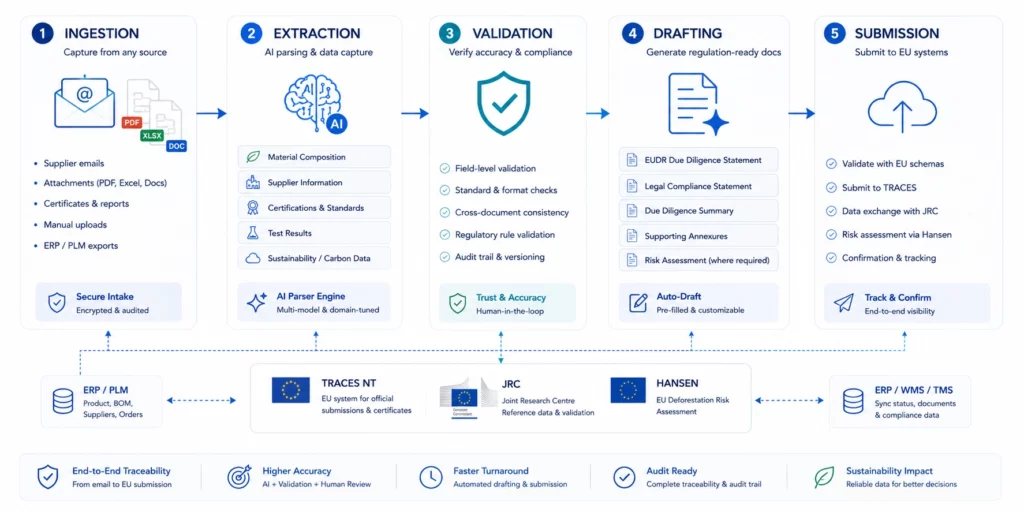
Here’s the workflow from inbound supplier email to TRACES-ready DDS, in five stages:
Stage 1 — Ingestion
A dedicated inbox ([email protected] or your own forwarded domain) receives supplier emails. The parser also accepts uploads from supplier portals, WhatsApp Business webhooks, and ERP/procurement system integrations.
Stage 2 — Extraction
An agentic AI layer reads the email body and every attachment. For images and scanned PDFs, it runs OCR in multiple. It pulls supplier identity, product data, shipment references, geolocation, and certificates into named fields.
Stage 3 — Validation
Geolocation polygons are checked against JRC and Hansen satellite datasets. Certificates are cross-referenced against issuing-body registries where APIs exist. HS codes are validated against customs databases. Missing or inconsistent fields are flagged.
Stage 4 — Drafting
A draft compliance record is created a DDS, a PPWR record, or a DPP data block pre-populated with the validated supplier data. The compliance manager opens the draft, reviews the auto-flagged issues, and approves or sends clarification requests.
Stage 5 — Submission and audit log
Approved DDS records are auto-submitted to TRACES via API. PPWR and DPP records are exported in the formats their respective registries require. Every step the original email, the extracted fields, the validation results, the reviewer actions is logged on the blockchain-backed audit trail.
Real-world examples: what the parser handles across EUDR, PPWR, and DPP
Example 1 — Cocoa exporter, EUDR
A West African cocoa cooperative sends 400 supplier emails per quarter to its EU buyer. Each email contains a scanned KYC document, a photo of a hand-drawn plot map, and GPS coordinates pasted in the body. TraceX AI feature extracts the supplier identity from the KYC, converts the plot photo into approximate polygon coordinates, validates the GPS data against Hansen 2020+ forest loss layers, and drafts a DDS per shipment. The compliance team’s role shrinks to reviewing flagged exceptions.
Example 2 — Beverage brand, PPWR
A European beverage company needs to report the recycled content of every PET bottle, label, and cap across 14 packaging suppliers. Spec sheets arrive as PDF emails. The parser reads the technical sheets, extracts the material composition and recycled content percentages, validates against PPWR reporting thresholds, and consolidates the data into a single packaging compliance record ready for regulator submission.
Example 3 — Electronics manufacturer, DPP
A consumer electronics brand preparing for DPP rollout under ESPR receives material declarations from 60+ component suppliers. Cleara parses each declaration, extracts material origin, recyclability data, and embedded carbon figures, and creates GS1-compatible DPP data blocks linked to the product’s unique identifier. The DPP is QR-code-ready before the product hits the shelf.
Manual extraction vs. AI parser: the operational gap
Compliance workflow step
Manual extraction today
AI parser
Reading supplier email
Compliance analyst opens each email manually
Auto-ingested, classified, and routed
Extracting fields from PDFs/images
Copy-paste into spreadsheets, manual OCR
Multilingual OCR + structured field extraction
Geolocation validation
Manual cross-check against Global Forest Watch
Auto-validated against JRC + Hansen layers
Identifying missing data
Caught only during DDS review or audit
Flagged at extraction, supplier auto-pinged
DDS / DPP drafting
Built from scratch in TRACES or Excel
Pre-drafted; compliance team reviews & approves
Audit trail
Email threads + folder structure (fragile)
Blockchain-backed, immutable per-field log
Time per supplier submission
11–14 minutes
1–2 minutes review only
How to evaluate an AI email parser for compliance use
If you’re shortlisting tools, here’s the checklist that separates a generic document-parsing API from a compliance-grade parser:
Regulation-specific schemas — does it map fields directly to EUDR DDS, PPWR, and ESPR DPP requirements, or is it generic OCR?
Geolocation handling — can it ingest GeoJSON, KML, shapefiles, and raw GPS, and validate against satellite forest-loss datasets?
Multilingual OCR — supplier emails come from India, Vietnam, Côte d’Ivoire, Brazil, Indonesia. Latin-script-only parsers will fail.
TRACES integration — does it submit DDS records via the official EU API, or does someone still have to log in and upload?
Audit trail — is every parsed field, every validation result, every reviewer action stored immutably?
ERP and procurement connectors — does it plug into SAP, Oracle, NetSuite, or sit as a silo?
Supplier-facing portal — can suppliers correct flagged data themselves, or does every clarification round-trip through compliance?
The bottom line: compliance is going to scale faster than headcount
EUDR’s enforcement window is going live for large operators in December 2026, with SMEs joining in mid-2027. PPWR substantive obligations begin phasing in across 2026–2030. DPP requirements are rolling out by ESPR product category over the same window. The compliance workload is multiplying but compliance team headcount is not.
An AI email parser is the only realistic answer that doesn’t require either (a) hiring 5–10 more compliance analysts or (b) rejecting suppliers who can’t submit data in a perfect format. It meets suppliers where they already are in email and turns that messy reality into clean, defensible, regulator-ready records.
TraceX’s Regulatory Compliance Platform, is purpose-built for this. It’s already in production at agri-commodity exporters supplying the EU across coffee, cocoa, palm oil, spices, rubber, and timber and it’s the same architecture that handles PPWR packaging data and DPP product data blocks today.
See your own supplier inbox parsed live.
Bring 5–10 real supplier emails to a 30-minute walkthrough and watch them turn into structured EUDR, PPWR, or DPP records in real time. We’ll show you the validation against JRC/Hansen layers, the auto-flagged data gaps, and the draft DDS ready for TRACES submission.
What is an AI email parser in the context of EUDR compliance?
It’s a system that reads inbound supplier emails including PDF attachments, images, and GeoJSON files extracts the data EUDR requires (geolocation polygons, KYC, certifications, shipment references), validates it against satellite deforestation datasets, and drafts a Due Diligence Statement for TRACES submission. TraceX’s AI parser is built for this end-to-end.
Can an AI parser handle scanned and handwritten supplier documents?
Yes. The platform uses multilingual OCR trained on the formats common in emerging-market supply chains scanned land titles, handwritten plot maps, regional-language certificates. Where confidence is low, the parser flags the document for human review rather than guessing.
Does the parser work for PPWR and Digital Product Passport (DPP) data too, or only EUDR?
Yes it handles all three. EUDR draws on supplier geolocation and KYC; PPWR draws on packaging material composition and recycled content from converter spec sheets; DPP draws on component-level material and durability data. The parser’s extraction layer is regulation-agnostic the validation and drafting layers are regulation-specific.
How does the parser validate supplier-submitted GPS or GeoJSON data?
The platform cross-checks every polygon and coordinate against JRC and Hansen forest-loss layers, datasets for real-time deforestation monitoring. Any polygon overlapping post-2020 forest loss is flagged before the supplier is approved for EUDR-relevant shipments.
How is this parser different from a generic document-extraction API?
Generic parsers extract fields. This parser extracts fields, maps them to EUDR/PPWR/DPP schemas, validates them against authoritative datasets and registries, drafts the regulatory record, submits via TRACES API, and logs every step on a blockchain-backed audit trail. Compliance teams don’t have to build the workflow on top it’s the workflow.
Start using TraceX
Transparency, Trust, & Success for your Climate Journey.
We use cookies on our website to give you the most relevant experience by remembering your preferences and repeat visits. By clicking “Accept All”, you consent to the use of ALL the cookies. However, you may visit "Cookie Settings" to provide a controlled consent.
This website uses cookies to improve your experience while you navigate through the website. Out of these, the cookies that are categorized as necessary are stored on your browser as they are essential for the working of basic functionalities of the website. We also use third-party cookies that help us analyze and understand how you use this website. These cookies will be stored in your browser only with your consent. You also have the option to opt-out of these cookies. But opting out of some of these cookies may affect your browsing experience.
Necessary cookies are absolutely essential for the website to function properly. These cookies ensure basic functionalities and security features of the website, anonymously.
Cookie
Duration
Description
cookielawinfo-checkbox-analytics
11 months
This cookie is set by GDPR Cookie Consent plugin. The cookie is used to store the user consent for the cookies in the category "Analytics".
cookielawinfo-checkbox-functional
11 months
The cookie is set by GDPR cookie consent to record the user consent for the cookies in the category "Functional".
cookielawinfo-checkbox-necessary
11 months
This cookie is set by GDPR Cookie Consent plugin. The cookies is used to store the user consent for the cookies in the category "Necessary".
cookielawinfo-checkbox-others
11 months
This cookie is set by GDPR Cookie Consent plugin. The cookie is used to store the user consent for the cookies in the category "Other.
cookielawinfo-checkbox-performance
11 months
This cookie is set by GDPR Cookie Consent plugin. The cookie is used to store the user consent for the cookies in the category "Performance".
viewed_cookie_policy
11 months
The cookie is set by the GDPR Cookie Consent plugin and is used to store whether or not user has consented to the use of cookies. It does not store any personal data.
Functional cookies help to perform certain functionalities like sharing the content of the website on social media platforms, collect feedbacks, and other third-party features.
Performance cookies are used to understand and analyze the key performance indexes of the website which helps in delivering a better user experience for the visitors.
Analytical cookies are used to understand how visitors interact with the website. These cookies help provide information on metrics the number of visitors, bounce rate, traffic source, etc.
Advertisement cookies are used to provide visitors with relevant ads and marketing campaigns. These cookies track visitors across websites and collect information to provide customized ads.
Download the 2026 Traceability Scorecard and Benchmark Your Supply Chain Across 10 Critical Capabilities.
Download our eBook
Don’t Wait for an Audit to Find Your EUDR Gaps
The 2026 Simplification Package changes how HS codes, DDS pass-through and geolocation rules apply to you. Get the free guide and 20-point readiness checklist before enforcement catches you unprepared.