Farm Digitization for Contract Farming: Turn Grower Networks into Revenue
Published
, 8 minute read
Share this article
Quick summary: Farm digitization for contract farming turns paper grower networks into revenue: cut side-selling and spoilage, win premium buyers, and stay audit-ready.
Farm Digitization for Contract Farming replaces paper agreements and spreadsheet records with structured, farm-level data: geo-tagged plots, digitized contracts, input and crop-cycle tracking, and connected procurement and payments. It gives agribusinesses real-time visibility into committed volumes, cuts side-selling and spoilage, and unlocks premium, audit-ready market access. The result is a grower network that behaves like a reliable revenue base rather than a fragmented cost center.
Key takeaways
Digitization converts fragmented grower data into one source of truth linked to procurement, compliance, and payments.
It protects revenue five ways: premium market access, less side-selling, lower spoilage, faster payments, and new sustainability income.
Real cases prove it: GEFP secured McDonald’s and KFC supply-chain trust; SGI opened carbon-credit revenue; MTR Foods built brand premium on verified origin.
The bottleneck is first-mile data capture, so mobile-first, offline-capable tools matter most.
Pilots are easy; scale is the test. Choose a platform built for tens of thousands of farmers across seasons.
Managing contract farmers through spreadsheets, paper records, and disconnected systems makes it difficult to see what is happening across your grower network.
TraceX Farm Management Platform helps digitize farmer onboarding, farm and crop records, contracts, field activities, inputs, harvests, and procurement in one connected platform.
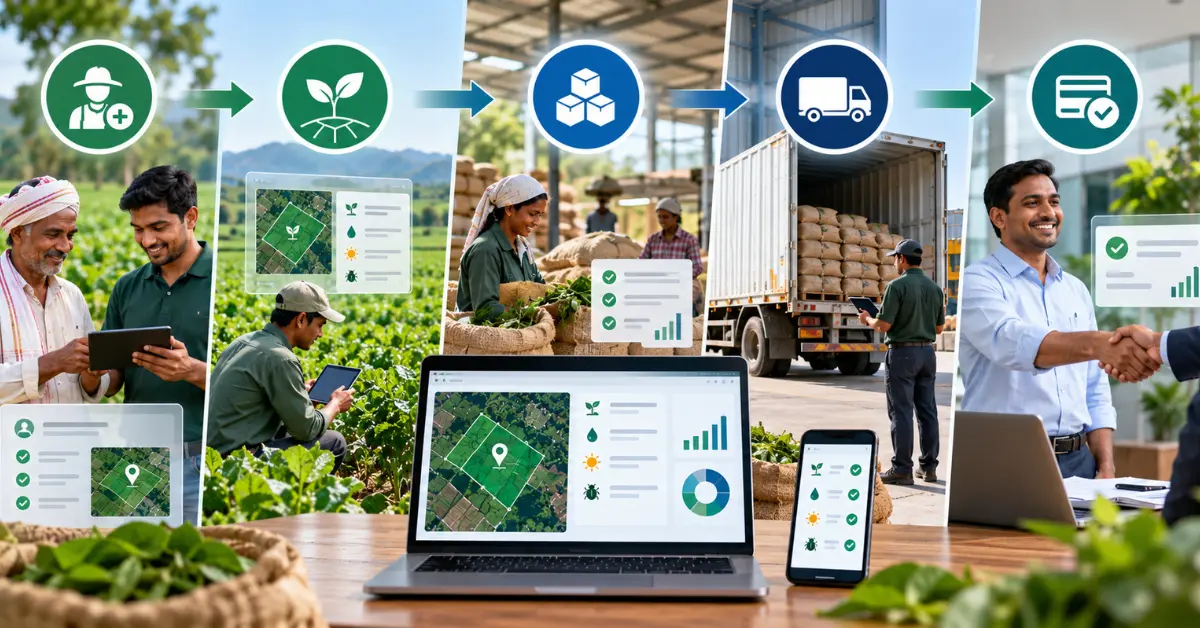
Farm Digitization for Contract Farming is the shift from paper-based grower relationships to structured, data-driven systems. In practice that means geo-tagging farms at onboarding, capturing plot-level data, digitizing contracts, and tracking crop cycles, input usage, and harvest declarations through mobile-first tools that work offline in the field.
The point is not the data for its own sake. A well-built platform connects that farmer data to procurement, compliance, and payment systems, so every sourcing decision, contract, and shipment runs off one source of truth. That is what separates Farm Digitization for Contract Farming from a folder of spreadsheets: the records are live, linked, and act on each other.
Why Contract Farming Breaks Without Farm Digitization
Without Farm Digitization for Contract Farming, a grower network runs on fragmented data and trust. Companies managing hundreds or thousands of contract farmers hit the same wall: records live in notebooks and spreadsheets, payments run late, quality varies plot to plot, and audit requests trigger a scramble.
Each of those is a revenue leak, not just an inconvenience. Late payments push farmers toward the nearest cash buyer, so the volume you financed walks out the gate as side-selling. Inconsistent quality means rejected lots and lost premium. Missing records mean a buyer audit, or an EUDR or FSMA request, stalls your shipments. Manual teams reconciling contracts, receipts, and field photos across formats tend to sink under exactly this work.
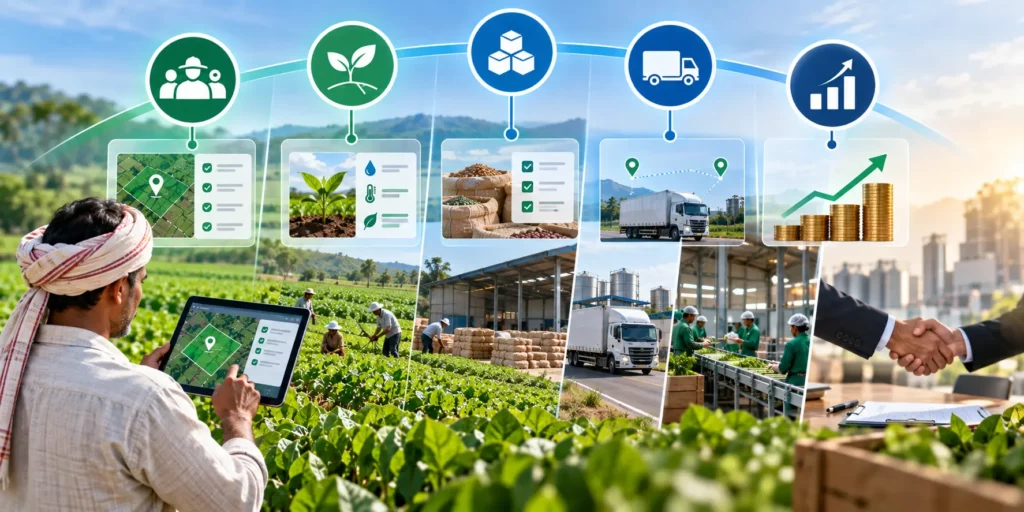
Digital farm management brings these activities into one connected platform, giving agribusinesses better visibility, control, and traceability across the farm-to-market journey.
Understand the key challenges in contract farming and how digital farm management can help businesses improve visibility, coordination, and traceability across their grower network.
How Farm Digitization for Contract Farming Drives Revenue
Farm Digitization for Contract Farming drives revenue through five levers, and it helps to name them plainly rather than hide behind the word efficiency. The table below maps each lever to what the platform does in practice.
Revenue lever
How digitization delivers it
Premium & retained market access
Audit-ready traceability and compliance records let you keep and win premium contracts with buyers, retailers, and export chains that demand proof of origin.
Less side-selling
Real-time visibility into committed volume and timely payments protect the crop you financed from leaking to spot buyers.
Lower spoilage & rejections
Better crop planning, input support, and quality monitoring cut rejected lots and post-harvest loss.
Faster payments, secure supply
Digitized, on-time payments retain farmers and lock in next season’s volume.
New sustainability income
Verified plot and practice data unlocks sustainability premiums and carbon-credit documentation.
Together these move Farm Digitization for Contract Farming from a cost line to a margin story: you protect the volume you already pay for, and you open new income you could not document before.
Farm Digitization for Contract Farming in the Real World
The clearest case for Farm Digitization for Contract Farming is what it does on real grower networks. These are drawn from TraceX’s published case studies.
Green Earth Fresh Produce (GEFP): premium buyer trust
GEFP works directly with smallholder farmers in the Nilgiris to grow Iceberg lettuce, a sensitive crop supplied to Vista Processed Foods, a vendor for global chains including McDonald’s and KFC in India. It adopted the TraceX farm-to-fork platform for digital onboarding of farmers and plots, real-time monitoring from sowing to harvest, digitized procurement, and QR-code traceability, backed by compliance-ready reports.
Business outcome: batch-level traceability and audit-ready documentation secured the trust of demanding corporate buyers, while digitized procurement reduced spoilage. In a supply chain feeding McDonald’s and KFC, that traceability is the price of staying on the premium supplier list.
McPatel Foods:McPatel Foods used TraceX to digitize farmer registration, profiling, agreements, crop management, input distribution, harvest planning, and procurement across its potato supply chain. The solution digitally linked farmer agreements with sourcing records, giving the company greater visibility into farmer participation, procurement, and traceability across its domestic and export operations.
Business outcome:Digital farmer agreements reduced paperwork, improved onboarding efficiency, strengthened procurement traceability, and created a centralized, verifiable audit trail helping McPatel Foods improve sourcing transparency and readiness for international buyers.
MTR Foods uses TraceX blockchain traceability to trace the Byadgi chilli in its products back to source, building a transparent story for a consumer brand.
Business outcome: verified origin supports a trust-and-quality brand premium, the kind of claim shoppers increasingly pay for
What to Look for in a Farm Digitization Platform
When you evaluate Farm Digitization for Contract Farming platforms, weight the capabilities that decide whether the system survives contact with the field and then scales:
Mobile-first, offline data capture for first-mile onboarding and field records.
Multi-language support so field technicians and farmers can use it in the field.
Digitized contracts and farmer agreements linked to acreage, crop plans, and procurement schedules.
Integration with ERP, traceability, and payment systems, not a data silo.
Built-in compliance reporting (EUDR, FSMA, sustainability) so audits are a report, not a project.
Proven scale: longitudinal farmer records and cross-season continuity for tens of thousands of growers.
Pilots are easy; scale is where most digitization stalls. The agribusinesses that win are the ones whose platform holds thousands of farmer records across seasons without breaking, and connects them straight to procurement and payments. Data readiness is becoming the difference between a preferred supplier and a replaceable one.
TraceX’s Farm Management Platform helps agribusinesses digitize and manage contract-farming operations from farmer onboarding to procurement. Businesses can create digital farmer profiles, capture farm and crop information, manage contracts and agreements, track farm activities and inputs, plan harvests, and connect production data with procurement. By bringing farmer, farm, crop, and sourcing information into one connected platform, TraceX gives organizations greater visibility across their grower network while reducing fragmented spreadsheets and manual processes. This creates a structured digital foundation for traceable procurement, better supplier engagement, operational efficiency, quality management, and stronger buyer readinessturning a distributed network of contract farmers into a more visible, manageable, and commercially valuable supply chain.
To see digital onboarding, first-mile capture, connected procurement and payments, and audit-ready compliance on one system.
Farm Digitization for Contract Farming: Manual vs Platform
Most agribusinesses weighing Farm Digitization for Contract Farming face a build-or-buy call. The table sets the manual model against a purpose-built platform such as the TraceX platform.
Capability
Manual / spreadsheets
TraceX platform
Farmer & plot onboarding
Paper forms, re-keyed later, errors common
Digital onboarding with geo-tagged plots
Field data capture
Notebooks and photos, offline gaps
Mobile-first, offline capture at first mile
Contracts & payments
Disconnected from delivery data
Digitized agreements linked to procurement and payment
Compliance reporting
Rebuilt by hand per audit
EUDR/FSMA/ESG reports generated from source data
Scale
Breaks past a few hundred farmers
Built for tens of thousands across seasons
Buyer Evaluation Checklist
Score each platform you shortlist against these:
Captures first-mile data offline and syncs when connected.
Links digitized contracts to acreage, crop plans, and payment.
Gives real-time visibility into committed volume to curb side-selling.
Generates audit-ready compliance reports without a manual rebuild.
Supports verified sustainability and carbon-credit documentation.
Proven at your target farmer count, with cross-season records.
Frequently Asked Questions
What is farm digitization for contract farming?
It is the move from paper grower agreements and spreadsheets to structured digital systems: geo-tagged plots, digitized contracts, and tracked crop cycles, all connected to procurement, compliance, and payment. The records are live and linked, not static files.
How does farm digitization increase revenue in contract farming?
Through five levers: premium and retained market access from audit-ready traceability, less side-selling, lower spoilage and rejections, faster payments that secure supply, and new income from verified sustainability and carbon data.
Can you give a real example of contract farming digitization?
Green Earth Fresh Produce (GEFP) digitized its Nilgiris lettuce network on the TraceX platform to earn the trust of buyers like the McDonald’s and KFC supply chains, and Sustainable Green Initiative used verified plantation data to enable carbon-credit documentation.
Does digitization reduce side-selling by contract farmers?
Yes. Real-time visibility into committed volume plus timely digital payments removes the two main reasons farmers divert crop to spot buyers, protecting the volume you financed.
What features matter most in a contract farming platform?
Mobile-first offline capture, multi-language support, digitized contracts linked to procurement and payment, ERP and traceability integration, built-in compliance reporting, and proven scale across seasons.
Is farm digitization only useful for large agribusinesses?
No. Any operation managing more than a few hundred farmers benefits, but the value compounds at scale, where manual records break and audit and payment errors multiply.
How does digitization help with EUDR or FSMA compliance?
Geo-tagged plots and structured field data generate audit-ready reports on demand, so a compliance request becomes a report rather than a multi-week reconstruction project.
Start using TraceX
Transparency, Trust, & Success for your Climate Journey.
We use cookies on our website to give you the most relevant experience by remembering your preferences and repeat visits. By clicking “Accept All”, you consent to the use of ALL the cookies. However, you may visit "Cookie Settings" to provide a controlled consent.
This website uses cookies to improve your experience while you navigate through the website. Out of these, the cookies that are categorized as necessary are stored on your browser as they are essential for the working of basic functionalities of the website. We also use third-party cookies that help us analyze and understand how you use this website. These cookies will be stored in your browser only with your consent. You also have the option to opt-out of these cookies. But opting out of some of these cookies may affect your browsing experience.
Necessary cookies are absolutely essential for the website to function properly. These cookies ensure basic functionalities and security features of the website, anonymously.
Cookie
Duration
Description
cookielawinfo-checkbox-analytics
11 months
This cookie is set by GDPR Cookie Consent plugin. The cookie is used to store the user consent for the cookies in the category "Analytics".
cookielawinfo-checkbox-functional
11 months
The cookie is set by GDPR cookie consent to record the user consent for the cookies in the category "Functional".
cookielawinfo-checkbox-necessary
11 months
This cookie is set by GDPR Cookie Consent plugin. The cookies is used to store the user consent for the cookies in the category "Necessary".
cookielawinfo-checkbox-others
11 months
This cookie is set by GDPR Cookie Consent plugin. The cookie is used to store the user consent for the cookies in the category "Other.
cookielawinfo-checkbox-performance
11 months
This cookie is set by GDPR Cookie Consent plugin. The cookie is used to store the user consent for the cookies in the category "Performance".
viewed_cookie_policy
11 months
The cookie is set by the GDPR Cookie Consent plugin and is used to store whether or not user has consented to the use of cookies. It does not store any personal data.
Functional cookies help to perform certain functionalities like sharing the content of the website on social media platforms, collect feedbacks, and other third-party features.
Performance cookies are used to understand and analyze the key performance indexes of the website which helps in delivering a better user experience for the visitors.
Analytical cookies are used to understand how visitors interact with the website. These cookies help provide information on metrics the number of visitors, bounce rate, traffic source, etc.
Advertisement cookies are used to provide visitors with relevant ads and marketing campaigns. These cookies track visitors across websites and collect information to provide customized ads.
Download the 2026 Traceability Scorecard and Benchmark Your Supply Chain Across 10 Critical Capabilities.
Download our eBook
Don’t Wait for an Audit to Find Your EUDR Gaps
The 2026 Simplification Package changes how HS codes, DDS pass-through and geolocation rules apply to you. Get the free guide and 20-point readiness checklist before enforcement catches you unprepared.