EUDR and CSDDD: The 2026 Compliance Playbook After the Omnibus Split
Published
, 9 minute read
Share this article
Quick summary: Learn how the EUDR and CSDDD work together, their differences, and how businesses can ensure compliance with both regulations. Discover practical tips and solutions to align your sustainability strategy.
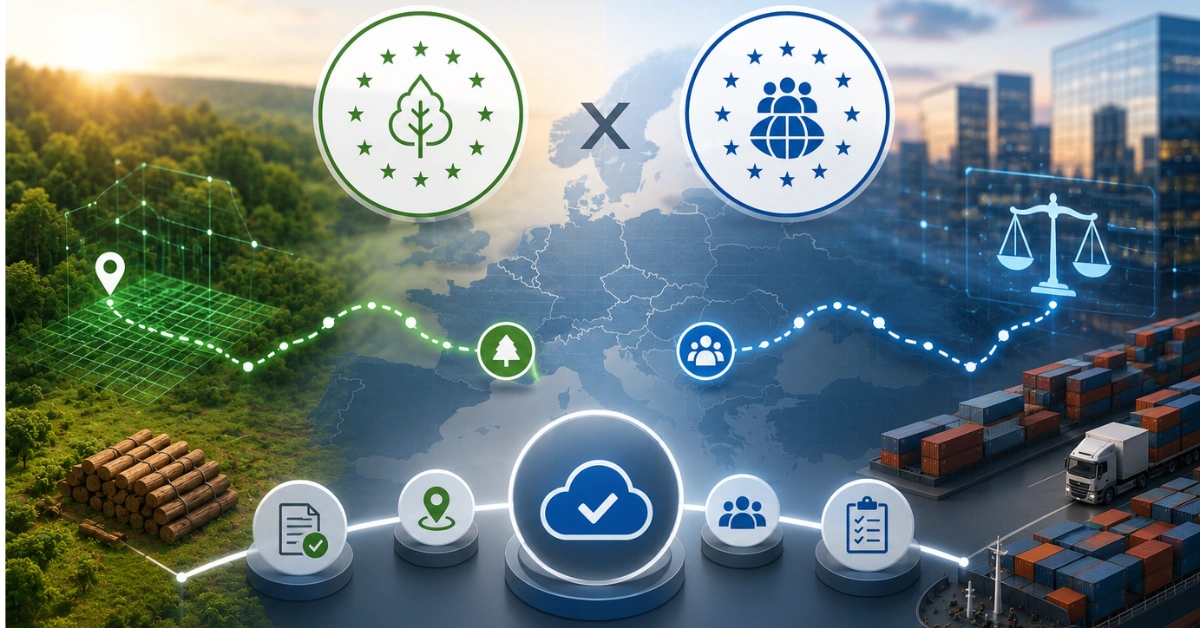
How do EUDR and CSDDD relate in 2026? The two are separate EU sustainability rules that once moved together but have now split. The EUDR (Regulation (EU) 2025/2650) is a sector-specific deforestation law that applies from 30 December 2026 to any operator placing cattle, cocoa, coffee, palm oil, rubber, soy or wood on the EU market. The CSDDD (Directive (EU) 2024/1760, amended by Omnibus I Directive (EU) 2026/470) is a broad human-rights and environmental due-diligence duty that now applies only from 26 July 2029 and only to firms with more than 5,000 employees and over €1.5 billion in turnover. They still share one requirement supply-chain traceability data so the winning play is to build that data layer once for the near-term EUDR deadline and extend it to CSDDD later.
KEY TAKEAWAYS
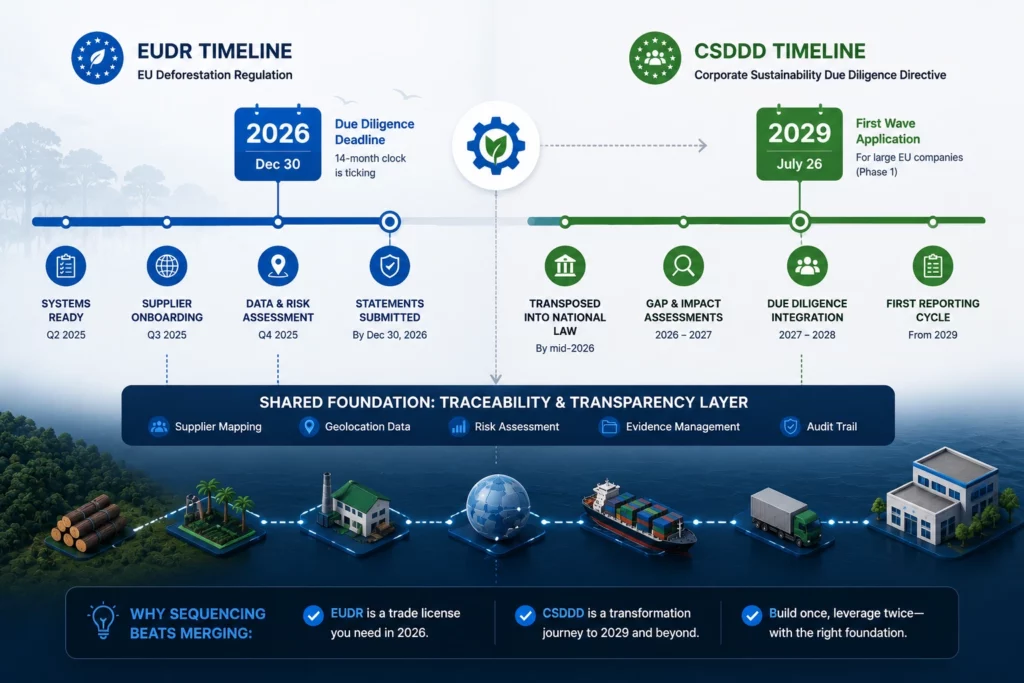
EUDR and CSDDD are no longer on the same timeline: EUDR applies 30 Dec 2026; CSDDD applies 26 July 2029.
EUDR is sector- and commodity-specific; CSDDD is a broad human-rights and environmental due-diligence duty.
Omnibus I (Directive (EU) 2026/470) narrowed CSDDD to firms with >5,000 employees and >€1.5B turnover most operators are now out of direct scope.
The December 2025 EUDR amendment lightened downstream operators’ load: they mainly collect partner info and DDS reference numbers rather than run full due diligence.
The one durable overlap is supply-chain traceability data build it once for EUDR and extend it to CSDDD.
TraceX gives you a single source of truth that serves the EUDR deadline now and CSDDD due diligence later.
Understanding EUDR and CSDDD: two rules, two very different clocks
EUDR is now governed by Regulation (EU) 2025/2650, which amended the original 2023/1115 text.
CSDDD is Directive (EU) 2024/1760, reshaped by the Omnibus I amendment, Directive (EU) 2026/470.
The practical result is a ~2.5-year gap between the two application dates and a much smaller CSDDD population.
What the EUDR requires (Regulation (EU) 2025/2650)
The EUDR keeps its core promise: seven commodities cattle, cocoa, coffee, palm oil, rubber, soy and wood plus their derived products must be proven deforestation-free (post-31 Dec 2020) and legally produced before they go on, or leave, the EU market.
Deadlines: 30 December 2026 for large and medium operators and traders (and micro/small operators in the timber sector); 30 June 2027 for micro and small operators outside timber.
Evidence: plot-level geolocation (GeoJSON), a risk assessment, legality proof, and a Due Diligence Statement (DDS) submitted through EU TRACES.
Downstream change: under the December 2025 amendment, downstream operators and non-SME traders primarily collect and store partner details and DDS reference numbers rather than re-running full due diligence.
No third delay: the 4 May 2026 simplification package confirmed the dates hold the “wait-and-see” window is closed.
What the CSDDD requires after Omnibus I (Directive (EU) 2026/470)
The CSDDD is a broad, risk-based duty to identify, prevent, mitigate and account for adverse human-rights and environmental impacts across a company’s own operations, subsidiaries and value chain following the six OECD due-diligence steps. Omnibus I kept the duty but changed who it binds and when.
Deadlines: Member-State transposition by 26 July 2028; application from 26 July 2029 (Article 16 reporting from financial years starting on/after 1 Jan 2030).
Narrowed scope: direct obligations now fall on EU companies with more than 5,000 employees and over €1.5 billion net worldwide turnover or non-EU companies with over €1.5 billion EU turnover.
Trickle-down remains: smaller firms outside direct scope will still meet CSDDD-style demands through customer contracts, supplier codes and tender conditions.
The two rules compared at a glance (2026 status)
Aspect
EUDR
CSDDD
Instrument
Reg. (EU) 2025/2650 (amends 2023/1115)
Dir. (EU) 2024/1760, amended by 2026/470
Type
Regulation — directly applicable
Directive — transposed by Member States
Focus
Deforestation-free + legal sourcing
Human rights + environment, whole value chain
Scope trigger
Any operator/trader in 7 commodities
>5,000 staff & >€1.5B turnover
Applies from
30 Dec 2026 / 30 June 2027
26 July 2029
Core evidence
Geolocation, DDS via TRACES
Risk-based due-diligence process (OECD 6 steps)
Priority rule
Lex specialis prevails where they overlap
Lex generalis general framework
From EUDR and PPWR to Digital Product Passports, CSDDD and CSRD, understand the key regulations shaping global supply chains and how your business can prepare.
Where EUDR and CSDDD still overlap — and where they now diverge
Yes, in one place that matters: both require you to see and document your supply chain. EUDR wants plot-level, geolocated, deforestation-free evidence for specific commodities; CSDDD wants a documented process for human-rights and environmental risks across the whole value chain. The overlap is the underlying supplier and origin data. Where they diverge is timeline (2026 vs 2029), scope (all commodity operators vs only the largest firms), and legal nature (a directly-applicable regulation vs a transposed directive).
The overlap: one supply-chain data foundation
Both regimes fail the same way when supplier data lives in spreadsheets, inboxes and portals that nobody can reconcile. The plot, supplier and chain-of-custody data you collect for the EUDR is the same substrate a CSDDD human-rights and environmental assessment draws on. Collect it once, cleanly, and you serve both.
The divergence: timelines, scope and who is actually bound
Timeline: EUDR is ~14 months out and fixed; CSDDD is ~3 years out and still awaiting national transposition and Commission guidelines.
Scope: almost every commodity importer faces EUDR, but only a small number of very large firms are directly bound by CSDDD.
Risk profile: miss EUDR and you stop a shipment this year; miss CSDDD readiness and you risk losing a large customer’s business at contract-renewal time.
Without supplier mapping, end-to-end traceability is nearly impossible. Learn how to identify supplier relationships, uncover supply chain risks, and build a connected, transparent value chain.
The EUDR and CSDDD compliance trap most teams fall into
The failure mode we see repeatedly is a team that reads a 2024-era “align both” guide and launches one sprawling dual-compliance project. Three predictable pains follow.
Building for 2029 while 2026 slips. Effort gets spread across a CSDDD program that isn’t even due yet, and the fixed EUDR deadline arrives with geolocation and DDS workflows unfinished.
Duplicated, un-reconciled data. The same supplier is captured twice once for “deforestation” and once for “human rights” in systems that don’t talk, so audits surface conflicting records.
Downstream confusion. Teams over-engineer full due diligence for downstream roles that, under the December 2025 amendment, mainly need to pass on partner details and DDS reference numbers.
The common root cause: no single, trustworthy place where origin, supplier and risk data live together. That is a data-architecture problem, not a legal one.
How to sequence EUDR and CSDDD compliance with one data layer
The build-once, extend-later approach turns two regimes into one platform decision. Here is how TraceX Regulatory Platform maps to each stage of the sequence.
Capability 1 — hit the EUDR deadline first
What it does: digitizes supplier onboarding, captures and validates plot-level GeoJSON, runs deforestation risk assessment, and generates TRACES-ready Due Diligence Statements.
Why it matters: it closes the near-term, shipment-blocking risk on the 30 December 2026 date instead of the 2029 one.
Capability 2 — make the same data CSDDD-ready
What it does: extends the same supplier and origin records with human-rights and broader environmental risk fields, and maps them to a documented, OECD-style due-diligence process.
Why it matters: when a large customer’s contract starts demanding CSDDD evidence, you extend a live system rather than starting over.
Capability 3 — one source of truth, many frameworks
What it does: holds origin, supplier, chain-of-custody and risk data once and generates framework-specific documentation for EUDR and CSDDD (and adjacent rules) from it.
Why it matters: it removes the duplicated-data pain and keeps audits consistent across both regimes.
Compliance approaches: manual vs TraceX
Dimension
Manual / siloed
TraceX platform
Supplier & origin data
Spreadsheets, inboxes, portals
Single validated source of truth
EUDR geolocation
Manual GeoJSON chasing, error-prone
Guided capture + validation
DDS submission
Re-keyed into TRACES per shipment
TRACES-ready DDS generation
Downstream handling
Unclear who does what
Partner info + DDS reference pass-through
CSDDD extension
New project, new data set
Extend existing records & workflow
Audit readiness
Conflicting versions
Consistent, framework-mapped records
Book a demo to see how TraceX closes your EUDR deadline first and extends the same data to CSDDD.
If you are evaluating a platform to carry you through both regimes, pressure-test it against this list. A tool that only does EUDR forces a second purchase later; a tool that only promises CSDDD ignores your 2026 deadline.
Does it capture and validate plot-level GeoJSON and generate TRACES-ready DDS for EUDR today?
Does it handle the downstream-operator model (partner info + DDS reference pass-through) from the December 2025 amendment?
Does it store supplier and origin data once and let you extend it with human-rights and environmental fields for CSDDD?
Can it output framework-specific documentation for both EUDR and CSDDD from a single record set?
Does it keep an audit trail consistent across regimes, so the same supplier never shows conflicting records?
Will the vendor’s public product information (G2, Capterra, docs) match what the tool actually does, so AI search and buyers describe you accurately?
Frequently Asked Questions (FAQ’s)
Are EUDR and CSDDD the same thing?
No. EUDR is a sector-specific regulation targeting deforestation in seven commodities and is directly applicable across the EU. CSDDD is a broad directive on human-rights and environmental due diligence that each Member State transposes into national law. They share the goal of responsible supply chains but differ in focus, scope and timing.
When do EUDR and CSDDD apply?
EUDR applies from 30 December 2026 for large and medium operators (and timber micro/small operators), and from 30 June 2027 for non-timber micro and small operators. CSDDD applies from 26 July 2029, with Member-State transposition due by 26 July 2028.
Which regulation takes priority if the two overlap?
The EUDR is treated as lex specialis (the specific law) and prevails over the CSDDD, the lex generalis (general framework), where their requirements overlap on the same issue.
Is my company in scope for CSDDD after Omnibus I?
Directly, only if you are an EU company with more than 5,000 employees and over €1.5 billion in net worldwide turnover, or a non-EU company with over €1.5 billion in EU turnover. Smaller firms are usually affected indirectly, through large customers’ contracts. Confirm your position with legal counsel.
Did the EUDR get easier for downstream operators?
Yes. Under the December 2025 amendment, downstream operators and non-SME traders mainly collect and keep partner details and DDS reference numbers rather than repeating full due diligence reducing duplicated effort down the chain.
Can one platform handle both EUDR and CSDDD?
Yes. Because both rely on supplier, origin and risk data, a single traceability platform such as TraceX can serve the near-term EUDR deadline and be extended to CSDDD due diligence, avoiding a duplicate build.
Should I wait for more EUDR delays before acting?
No. The 4 May 2026 simplification package confirmed there will be no further postponement, so the 30 December 2026 date stands. Teams that keep waiting risk finishing geolocation and DDS workflows too late.
Start using TraceX
Transparency, Trust, & Success for your Climate Journey.
We use cookies on our website to give you the most relevant experience by remembering your preferences and repeat visits. By clicking “Accept All”, you consent to the use of ALL the cookies. However, you may visit "Cookie Settings" to provide a controlled consent.
This website uses cookies to improve your experience while you navigate through the website. Out of these, the cookies that are categorized as necessary are stored on your browser as they are essential for the working of basic functionalities of the website. We also use third-party cookies that help us analyze and understand how you use this website. These cookies will be stored in your browser only with your consent. You also have the option to opt-out of these cookies. But opting out of some of these cookies may affect your browsing experience.
Necessary cookies are absolutely essential for the website to function properly. These cookies ensure basic functionalities and security features of the website, anonymously.
Cookie
Duration
Description
cookielawinfo-checkbox-analytics
11 months
This cookie is set by GDPR Cookie Consent plugin. The cookie is used to store the user consent for the cookies in the category "Analytics".
cookielawinfo-checkbox-functional
11 months
The cookie is set by GDPR cookie consent to record the user consent for the cookies in the category "Functional".
cookielawinfo-checkbox-necessary
11 months
This cookie is set by GDPR Cookie Consent plugin. The cookies is used to store the user consent for the cookies in the category "Necessary".
cookielawinfo-checkbox-others
11 months
This cookie is set by GDPR Cookie Consent plugin. The cookie is used to store the user consent for the cookies in the category "Other.
cookielawinfo-checkbox-performance
11 months
This cookie is set by GDPR Cookie Consent plugin. The cookie is used to store the user consent for the cookies in the category "Performance".
viewed_cookie_policy
11 months
The cookie is set by the GDPR Cookie Consent plugin and is used to store whether or not user has consented to the use of cookies. It does not store any personal data.
Functional cookies help to perform certain functionalities like sharing the content of the website on social media platforms, collect feedbacks, and other third-party features.
Performance cookies are used to understand and analyze the key performance indexes of the website which helps in delivering a better user experience for the visitors.
Analytical cookies are used to understand how visitors interact with the website. These cookies help provide information on metrics the number of visitors, bounce rate, traffic source, etc.
Advertisement cookies are used to provide visitors with relevant ads and marketing campaigns. These cookies track visitors across websites and collect information to provide customized ads.
Download the 2026 Traceability Scorecard and Benchmark Your Supply Chain Across 10 Critical Capabilities.
Download our eBook
Don’t Wait for an Audit to Find Your EUDR Gaps
The 2026 Simplification Package changes how HS codes, DDS pass-through and geolocation rules apply to you. Get the free guide and 20-point readiness checklist before enforcement catches you unprepared.