EUDR Risk Assessment: The Article 10 Criteria, Country Risk Tiers and Mitigation
Published
, 8 minute read
Share this article
Quick summary: EUDR risk assessment explained: the 11 Article 10 criteria, the low/standard/high country risk tiers, and how to mitigate non-negligible risk under Article 11 before you file the DDS.
An EUDR risk assessment is the stage of EU Deforestation Regulation due diligence where you decide whether a commodity carries a more-than-negligible risk of being linked to deforestation or illegal production. It weighs 11 criteria set out in Article 10 of Regulation (EU) 2023/1115, together with the country risk classification, and either clears the batch or triggers mitigation under Article 11 before a Due Diligence Statement (DDS) can be filed.
Updated September 2026. Reflects the December 2025 amendment (Regulation (EU) 2025/2650) and the 2026 simplification package. Application dates are confirmed: 30 December 2026 for large and medium operators, 30 June 2027 for micro and small enterprises. The 31 December 2020 deforestation cut-off is unchanged.
Key takeaways
It is the middle stage of due diligence — Collect information, then run the risk assessment, then mitigate, then file the DDS.
Risk is judged against 11 Article 10 criteria — Plus the country risk classification: low, standard or high.
The bar is negligible risk — Low-risk sourcing unlocks simplified due diligence; standard and high require full assessment and mitigation.
Non-compliance is costly — Fines of at least 4% of EU-wide annual turnover, product confiscation and market exclusion.
December 2026 is approaching. Is your supply chain actually ready?
Move from spreadsheets and fragmented supplier data to a traceable, audit-ready EUDR workflow with TraceX.
What is an EUDR risk assessment, and where does it fit?
An EUDR risk assessment is the middle stage of the regulation’s three-part due diligence system, sitting between information gathering and risk mitigation. Its legal basis is Article 10 of Regulation (EU) 2023/1115. The question it answers is simple: is there a more-than-negligible risk that these commodities are linked to deforestation or illegal production? Its inputs are geolocation coordinates, the country risk classification, supplier data and the 11 criteria. Its output is a documented risk conclusion that either clears the product or triggers mitigation.
Looking for the step-by-step how-to? This page is the regulatory reference for the criteria and classification. For the operational workflow, satellite screening and software comparison, see our guide: how to run a deforestation risk assessment.
Who needs an EUDR risk assessment, and when?
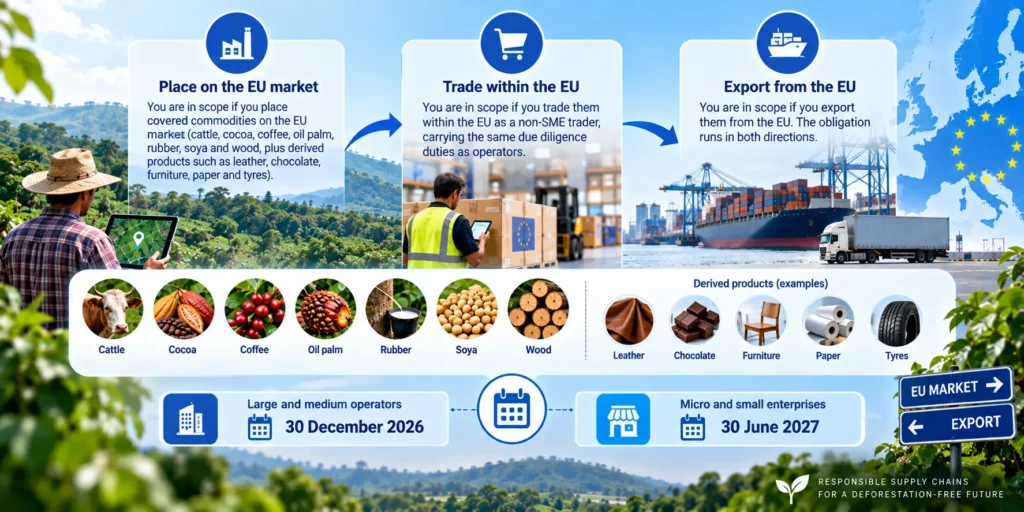
Liability follows the product, not just the producer, so the assessment applies more widely than many expect. You are in scope if you:
Place covered commodities on the EU market (cattle, cocoa, coffee, oil palm, rubber, soya and wood, plus derived products such as leather, chocolate, furniture, paper and tyres).
Trade them within the EU as a non-SME trader, carrying the same due diligence duties as operators.
Export them from the EU. The obligation runs in both directions.
The deadlines are 30 December 2026 for large and medium operators and 30 June 2027 for micro and small enterprises, under the December 2025 amendment.
The Article 10 criteria
These are the specific factors you must weigh to decide whether risk is negligible. Run every commodity batch through all eleven and record the conclusion.
Country or region risk classification assigned by the European Commission.
Presence of forests in the production area.
Presence and rights of indigenous peoples and local communities.
Credible claims or evidence of deforestation or forest degradation.
Prevalence of deforestation or forest degradation in the country or region.
Source and reliability of the information, and the geolocation data.
Concerns about the country of production or origin, such as corruption levels.
Complexity of the supply chain and the processing stage involved.
Risk of mixing with products of unknown or non-compliant origin.
Conclusions from the European Commission expert group and enforcement findings.
Complementary information on compliance, including certification or third-party verification.
Learn what Article 10 requires, which risk criteria operators need to consider, and how to build a documented, audit-ready risk assessment process.
→ Read Our Guide: EUDR Article 10
EUDR risk assessment by country risk classification
Your workload scales with the Commission’s country benchmark. Each sourcing country is classified low, standard or high, which sets the depth of due diligence required.
Country risk tier
What it signals
Due diligence required
Low
Low likelihood of deforestation-linked production
Simplified due diligence, but you must still confirm the tier and watch for mixing
Standard
Default where neither low nor high applies
Full due diligence: information, risk assessment and mitigation
High
Elevated deforestation prevalence or governance concerns
Full due diligence with enhanced scrutiny and a higher share of official checks
Sourcing from a low-risk country does not by itself make you compliant: you still confirm the classification, verify the data and watch for the risk of mixing. See our guide to EUDR country risk classifications for detail.
Learn how EUDR country risk classification works, what the different risk levels mean, and how businesses can incorporate country risk into their broader due diligence process.
These five steps map to what auditors expect to see documented. For the detailed operational how-to, including satellite screening and geolocation capture, follow the deforestation risk assessment hub.
Map the supply chain and collect geolocation for every plot, with polygons for larger plots and points for smaller ones.
Apply the country risk classification to set your baseline level of scrutiny.
Score against the 11 Article 10 criteria and reach a conclusion: negligible or non-negligible.
Mitigate any non-negligible risk and reassess until the residual risk is negligible.
Document and file the DDS in the EU Information System, and retain records for at least five years.
Risk mitigation under Article 11: what to do when risk is not negligible
If the assessment concludes the risk is more than negligible, you cannot place the product on the market until you mitigate it and a reassessment brings the residual risk down to negligible. Article 11 sets out this obligation. Negligible does not mean zero: it means risk has been assessed and mitigated to a defensible level you can show an auditor.
Typical mitigation measures
Collect additional or higher-quality data (better geolocation, missing legality documents).
Commission independent surveys, audits or third-party verification.
Engage or, where necessary, substitute suppliers that cannot provide adequate evidence.
Apply ongoing satellite monitoring of the sourcing region for new forest loss.
Then reassess
After mitigation, run the assessment again. Only a post-mitigation negligible conclusion clears the batch. Document every mitigation step and the reassessment, because that record is what an auditor will ask for. All documentation must be retained for at least five years.
Understand what EUDR Article 11 requires, which mitigation measures businesses can consider, and how to document actions taken to reduce identified risks.
→ Read Our Guide: EUDR Article 11
EUDR risk assessment software vs manual: which should you buy?
Most teams start in spreadsheets and hit a wall once geolocation volumes, supplier counts and audit demands grow. Here is how the two approaches compare for a buyer.
TraceX EUDR Solutions provide a staged, explainable risk-assessment workflow that evaluates supplier geolocations across satellite and Earth-observation datasets, assessing risk across five explicit dimensions. Its five-stage reasoning chain produces an auditor-defensible risk verdict for each plot, rather than relying on a single threshold-based flag. This is complemented by a Geometry Validator that performs approximately 13 automated integrity checks on every GeoJSON, with safe auto-correction where possible and rejection when geometry cannot be validated. Together, these capabilities help businesses move from fragmented geolocation data to validated, evidence-backed, plot-level EUDR risk assessment and audit readiness.
Capability
Manual / spreadsheet
Risk assessment software
Geolocation data
Manual, hard to validate polygons
Automated capture, polygon validation
Scoring the 11 criteria
Subjective, inconsistent
Rules-based across all 11 criteria
Country tiers
Updated by hand
Auto-synced to the Commission benchmark
Audit trail
Fragmented, version chaos
Time-stamped, 5-year retention, export-ready
Scale
Breaks beyond a few suppliers
Built for thousands of plots and SKUs
DDS filing
Re-keyed manually
Generated and filed from one record
See it end to end.
Map geolocation and score risk across all 11 criteria and file the DDS from one platform.
Use this as a final pre-filing review for every batch:
Geolocation coordinates captured for all plots, with polygons where required.
Country risk classification applied to each sourcing origin.
All 11 Article 10 criteria assessed and a risk conclusion recorded.
Non-negligible risks mitigated and reassessed to negligible.
Supplier evidence and certifications attached.
Frequently asked questions
Is an EUDR risk assessment mandatory?
Yes. For operators and non-SME traders placing covered commodities on, or exporting from, the EU market, the risk assessment is a required stage of due diligence under Article 10 of Regulation (EU) 2023/1115.
What are the EUDR risk assessment criteria?
The 11 Article 10 factors: country classification, presence of forests, indigenous and local community rights, evidence of deforestation, prevalence of deforestation, source and reliability of data, country-of-origin concerns such as corruption, supply-chain complexity, risk of mixing, Commission expert-group conclusions, and complementary information such as certification.
What is the difference between EUDR due diligence and the risk assessment?
Due diligence is the full three-part system: information collection, risk assessment and mitigation. The risk assessment is the middle stage that scores whether the risk of non-compliance is negligible.
How does the country risk classification affect my obligations?
Low-risk countries unlock simplified due diligence; standard and high-risk countries require full assessment and mitigation, and high-risk sourcing faces a higher share of official checks. You must still confirm the tier and watch for mixing even in low-risk countries.
What counts as negligible risk?
Negligible risk means that, after assessment and any mitigation, the chance of non-compliance is insignificant and documented. It does not mean zero risk, but it requires a defensible, reproducible methodology.
What happens if risk is not negligible?
You must apply mitigation under Article 11 (more data, audits, supplier engagement, monitoring), then reassess. Only a post-mitigation negligible conclusion allows the product onto the market.
Do low-risk countries still need a risk assessment?
Yes. Sourcing from a low-risk country unlocks simplified due diligence, but you must still confirm the classification, verify the data and watch for the risk of mixing with non-compliant product.
Can software run an EUDR risk assessment for me?
Software automates geolocation validation, criteria-based scoring, country-tier syncing, audit trails and DDS filing, removing the manual, error-prone parts. You retain accountability for the final conclusion.
Start using TraceX
Transparency, Trust, & Success for your Climate Journey.
We use cookies on our website to give you the most relevant experience by remembering your preferences and repeat visits. By clicking “Accept All”, you consent to the use of ALL the cookies. However, you may visit "Cookie Settings" to provide a controlled consent.
This website uses cookies to improve your experience while you navigate through the website. Out of these, the cookies that are categorized as necessary are stored on your browser as they are essential for the working of basic functionalities of the website. We also use third-party cookies that help us analyze and understand how you use this website. These cookies will be stored in your browser only with your consent. You also have the option to opt-out of these cookies. But opting out of some of these cookies may affect your browsing experience.
Necessary cookies are absolutely essential for the website to function properly. These cookies ensure basic functionalities and security features of the website, anonymously.
Cookie
Duration
Description
cookielawinfo-checkbox-analytics
11 months
This cookie is set by GDPR Cookie Consent plugin. The cookie is used to store the user consent for the cookies in the category "Analytics".
cookielawinfo-checkbox-functional
11 months
The cookie is set by GDPR cookie consent to record the user consent for the cookies in the category "Functional".
cookielawinfo-checkbox-necessary
11 months
This cookie is set by GDPR Cookie Consent plugin. The cookies is used to store the user consent for the cookies in the category "Necessary".
cookielawinfo-checkbox-others
11 months
This cookie is set by GDPR Cookie Consent plugin. The cookie is used to store the user consent for the cookies in the category "Other.
cookielawinfo-checkbox-performance
11 months
This cookie is set by GDPR Cookie Consent plugin. The cookie is used to store the user consent for the cookies in the category "Performance".
viewed_cookie_policy
11 months
The cookie is set by the GDPR Cookie Consent plugin and is used to store whether or not user has consented to the use of cookies. It does not store any personal data.
Functional cookies help to perform certain functionalities like sharing the content of the website on social media platforms, collect feedbacks, and other third-party features.
Performance cookies are used to understand and analyze the key performance indexes of the website which helps in delivering a better user experience for the visitors.
Analytical cookies are used to understand how visitors interact with the website. These cookies help provide information on metrics the number of visitors, bounce rate, traffic source, etc.
Advertisement cookies are used to provide visitors with relevant ads and marketing campaigns. These cookies track visitors across websites and collect information to provide customized ads.
Download the 2026 Traceability Scorecard and Benchmark Your Supply Chain Across 10 Critical Capabilities.
Download our eBook
Don’t Wait for an Audit to Find Your EUDR Gaps
The 2026 Simplification Package changes how HS codes, DDS pass-through and geolocation rules apply to you. Get the free guide and 20-point readiness checklist before enforcement catches you unprepared.