Responsible Supply Chains: What They Are and Why They Matter
Published
, 13 minute read
Share this article
Quick summary: Explore key regulations and compliance strategies for responsible agriculture supply chains. Learn how businesses can build sustainable, transparent, and ethical practices with the help of technology.
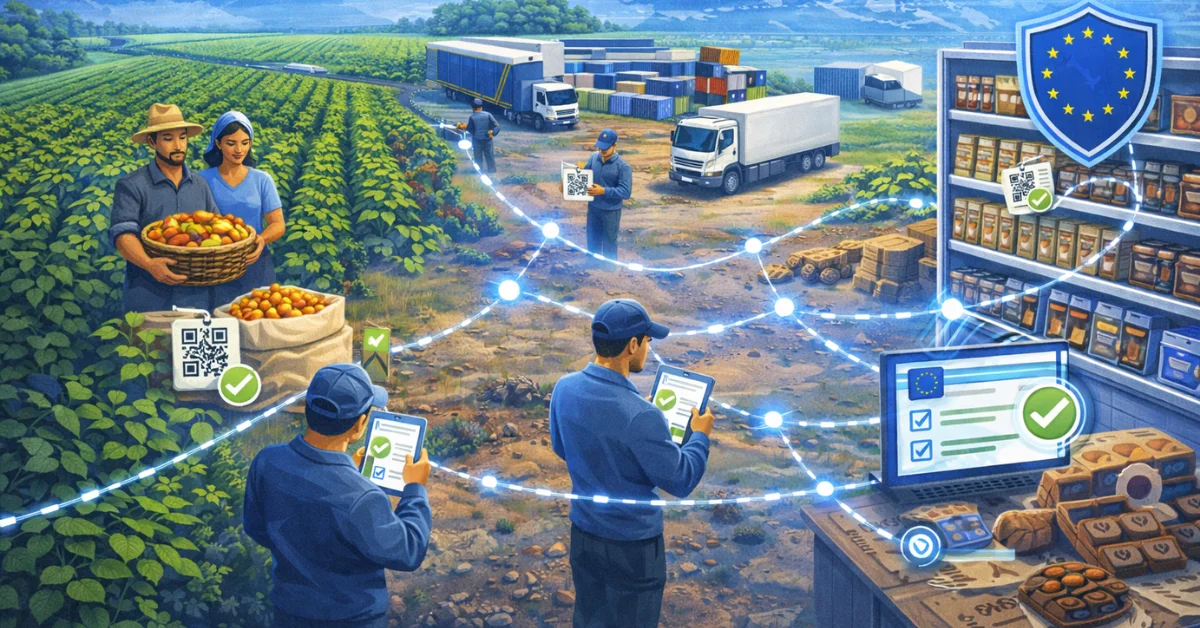
A responsible supply chain is one where every tier from the smallholder farm to the shelf is traceable, fair, and verifiable. In 2026, that means documented labour standards, deforestation-free sourcing, primary-data ESG reporting, and technology-backed compliance systems that satisfy EUDR, CSRD, and buyer due diligence requirements.
Key Takeaways
Companies with responsible supply chains earn 12–18% buyer price premiums and face 60% lower regulatory penalties yet only 34% of agri-food exporters have full tier-2+ visibility (McKinsey, 2024).
EUDR, CSRD, and human rights due diligence laws now require verified data not self-declarations across commodity supply chains by 2025–26.
Platforms from TraceX convert responsible sourcing commitments into blockchain-backed, GPS-verified, audit-ready evidence trails from farm to fork.
What Is a Responsible Supply Chain?
The phrase gets used a lot. But responsible supply chain management is not the same as having a sustainability PDF on your website, publishing an annual CSR report, or partnering with a certification body. Those are inputs. A responsible supply chain is defined by outputs: verifiable data that proves fair treatment, environmental non-harm, and regulatory compliance at every link.
At its core, a responsible supply chain requires:
Traceability back to primary production not just to your Tier-1 supplier
Documented labor and environmental standards with audit trails
Geospatial proof of deforestation-free sourcing for applicable commodities
Primary Scope 3 emissions data (not industry estimates) for ESG reporting
Technology infrastructure that captures, verifies, and transmits this data at scale
What it’s not: A responsible supply chain is not a marketing badge. It’s not achieved by selecting certified suppliers and assuming downstream compliance. And it’s definitely not a system that works only for Tier-1 industrial suppliers while ignoring the 500 million smallholder farmers who grow most of the world’s agricultural commodities.
Learn how transparency, accountability, and sustainability drive long-term business value.
The Tier-2+ Visibility Problem
Most supply chain responsibility programs stop at Tier 1. But commodity supply chains coffee, cocoa, palm oil, spices involve 3 to 5 tiers before you reach the farm. A European chocolate brand’s Tier-1 supplier is a processor in Côte d’Ivoire. Their Tier-4 supplier is the smallholder farmer whose land deforestation status determines EUDR compliance. Without technology that bridges all tiers, ‘responsible sourcing’ is, at best, a partial claim.
Why Responsible Supply Chains Are a Business Imperative
$1.6T — Annual cost of supply chain disruptions linked to ESG and ethics failures (McKinsey Global Institute, 2024)
67% — of EU buyers now require verified supply chain ethics documentation before contract renewal (EcoVadis, 2024)
€50K+ — Per-day fines for EUDR non-compliance per product/operator (European Commission, 2023)
Regulatory Mandates: EUDR, CSRD, LkSG, CBAM
The EU Deforestation Regulation (EUDR) requires GPS-polygon farm mapping and due diligence statements for seven high-deforestation-risk commodities coffee, cocoa, palm oil, soy, beef, rubber, and timber. Shipments without validated DDS documentation are blocked at EU borders. Large operators faced a December 2025 deadline; SMEs have until June 2026.
CSRD mandates Scope 3 emissions reporting and human rights due diligence across the value chain for 50,000+ European companies cascading requirements directly onto their global suppliers. Germany’s LkSG (Supply Chain Due Diligence Act) extends human rights monitoring obligations to companies with 1,000+ employees. CBAM (Carbon Border Adjustment Mechanism) will price carbon into imports from 2026.
The regulatory direction is clear: prove it with data, or face market exclusion.
Human Rights Due Diligence (HRDD) is a key part of responsible supply chain management, helping businesses identify, prevent and address risks such as child labour, forced labour, unsafe working conditions and land-rights violations.
By integrating HRDD into supplier onboarding, risk assessments, traceability and corrective-action workflows, companies can strengthen accountability and build more transparent, responsible agricultural supply chains.
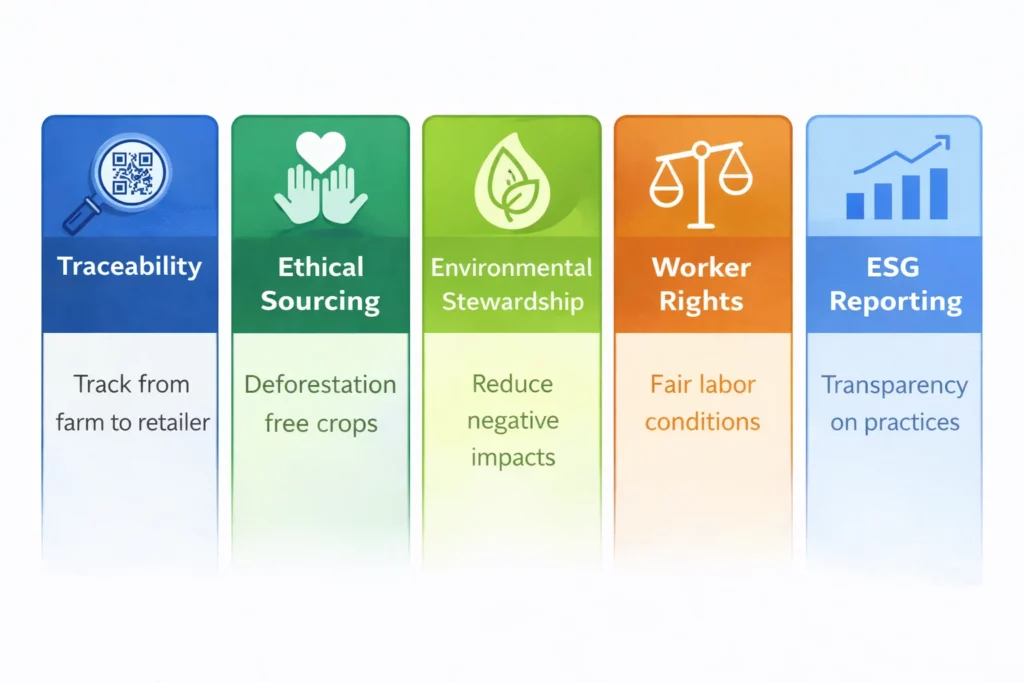
The 5 Pillars of a Responsible Supply Chain
Pillar 1: End-to-End Traceability
Traceability isn’t a feature it’s the foundation. Without knowing where your raw material came from, who grew it, on which plot of land, using which inputs, you can’t credibly claim any other responsible sourcing attribute.
Full-chain traceability requires digitising farmer and supplier data at the point of origin GPS-mapped plots, land tenure records, harvest volumes and linking it to batch-level production data, logistics records, and final product QR codes that consumers can scan.
Pillar 2: Ethical Sourcing & Fair Trade
Ethical sourcing means paying fair farmgate prices, enforcing a supplier code of conduct, and documenting procurement trails that prove no undisclosed intermediary markups or exploitative pricing. For certified products (Fairtrade, Rainforest Alliance, UEBT), it means maintaining the data continuity that certification auditors require.
Pillar 3: Environmental Stewardship
For commodity agriculture, environmental responsibility centres on three verifiable claims: deforestation-free land use (validated against satellite datasets), responsible input application (pesticide and fertilizer tracking), and carbon footprint measurement (Scope 3 from primary farm data, not estimates).
Pillar 4: Worker Rights & Human Dignity
No forced labor, no child labor, safe working conditions, right to organise, and grievance channels that actually function. Under EUDR, LkSG, HRDD and the EU Corporate Sustainability Due Diligence Directive, these aren’t aspirational goals they’re documented compliance obligations with defined monitoring requirements.
Pillar 5: Transparent ESG Reporting
The fifth pillar ties the others together. Responsible supply chain data must flow into investor-grade ESG reports aligned to CSRD, GRI, TNFD, or SBTi standards using primary supply chain data, not industry-average proxies. Greenwashing risk is highest when companies report sustainability metrics they can’t trace back to primary data sources.
Learn how to build transparency, accountability, and long-term resilience.
The Real Barriers Agri-Food Companies Face
Ask a Sustainability Director at a mid-sized agri-exporter what’s standing between them and a truly responsible supply chain. The answer won’t be lack of intention. It’ll be three structural barriers:
🌾 ESG Director — Head of Sustainability / ESG Director at a listed agri-food exporter
Pain: Fragmented supplier data, no single source of truth, greenwashing accusations from investors
“We need to prove our supply chain is deforestation-free our EU buyers are asking for it.”
📋 Compliance Lead — Compliance Manager / Trade Operations Lead at an agri-commodity trader
Pain: Manual DDS creation, geolocation gaps with smallholder farmers, ERP data silos
“We can’t manually collect GPS data from 2,000 farmers every season.”
🤝 Procurement VP — VP Procurement / Sourcing Manager at a large food brand with contract farming
Pain: No real-time farm visibility, inventory forecasting failures, quality inconsistencies
“We can’t see what’s happening at the farm level until it’s too late.”
The Smallholder Gap
Over 500 million smallholder farmers globally supply 70% of the world’s food calories Yet most supply chain compliance platforms were built for Tier-1 industrial suppliers in developed markets. They assume stable internet connectivity, digital literacy, and single-language operation. None of those assumptions hold in the sourcing regions that matter most: Karnataka, Assam, Oromia, Sulawesi, Mato Grosso.
“The tools built for compliance were built for a supplier in Hamburg, not a farmer in Coorg. We need something that works offline, in Kannada, on a feature phone.” — Procurement Lead, Indian spice exporter
The Data Fragmentation Problem
Even companies with mature compliance ambitions face a structural data problem: farmer records in spreadsheets, certifications in email threads, logistics data in an ERP, and sustainability metrics in a separate reporting tool. None of these systems talk to each other. The result is manual reconciliation, data quality issues, and audit failures at the worst possible moment just before a shipment.
A leading multi-state agribusiness operating across 120 collection centers faced challenges in managing farmer-level traceability and compliance due to reliance on fragmented spreadsheets and manual registersdespite using SAP S/4HANA for core operations like finance, inventory, and procurement.
With increasing buyer demands for traceability, sustainability reporting, and faster farmer payments, the company moved to integrate its ERP system with a digital traceability platform. This enabled a seamless flow of data from farm-level procurement to enterprise systems, eliminating manual processes and improving operational efficiency.
Bridge the gap between ERP systems and on-ground traceability.Discover how integrating digital traceability with enterprise platforms can streamline operations, improve compliance, and unlock real-time supply chain visibility.
Responsible Supply Chain Examples & Use Cases by Commodity
Use Case 1: Palm Oil: Deforestation-Free Verification, Indonesia
Challenge: Challenge: A European FMCG brand sourcing palm oil from a Sumatra-based processor needed to demonstrate deforestation-free status for 3,200 smallholder plots to satisfy EUDR requirements before a Q1 2026 shipment to Germany.
Solution: Solution: TraceX can deployed its GPS polygon mapping tool via offline-capable field apps. Satellite data from JRC and the Hansen Global Forest Change dataset can automatically be cross-referenced against each mapped plot. Due Diligence Statements can be auto-generated and submitted to EU TRACES within 4 weeks.
Outcome: Outcome: Zero shipment delays. EUDR DDS accepted on first submission. Buyer extended contract with a 9% price premium tied to verified sustainability credentials.
Use Case 2: Coffee: Fairtrade Alignment & Carbon Tracking, Ethiopia
Challenge: Challenge: A specialty coffee exporter in Yirgacheffe, Ethiopia, supplying a UK roaster needed to align with Fairtrade pricing requirements, track organic input usage, and begin Scope 3 carbon measurement for CSRD compliance reporting.
Solution: Solution: TraceX’s Sustainable Sourcing Platform can digitise farmgate transactions for smallholder farmers capturing input records, harvest weights, and pricing data. The Digital MRV module calculates Scope 3 emissions per kilogram of green coffee using primary data, replacing estimation-based figures.
Outcome: Outcome: Fairtrade audit passes without field visits. Carbon intensity per kg can be reduced by 14% through input optimisation insights surfaced by the platform.
Case Study Summary
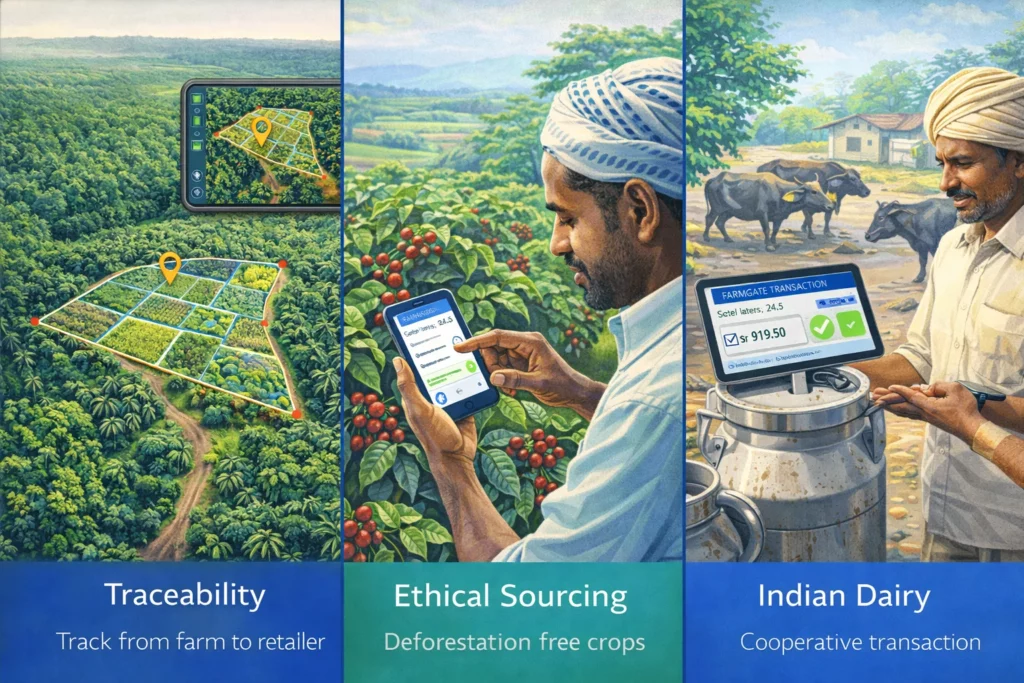
A rapidly growing dairy brand sourcing milk from 150+ smallholder farmers in Punjab and distributing products in Mumbai faced scalability challenges due to manual, fragmented systems. As consumer expectations shifted toward transparency, quality, and traceability, the company needed a more robust solution.
By partnering with TraceX, the company implemented a unified digital traceability platform that transformed its operations. This enabled:
End-to-end visibility from farm to finished product
Batch-wise traceability for improved quality control
Streamlined data capture across farmers, collection, and processing
Stronger brand trust through verifiable, clean dairy sourcing
The result: a fully digitized, efficient, and scalable dairy supply chain aligned with modern consumer and regulatory demands.
Ready to transform your supply chain into a transparent, traceable, and future-ready ecosystem?
How TraceX Enables Responsible Supply Chains at Scale
TraceX is purpose-built for the reality of emerging market supply chains where smallholder farmers, connectivity gaps, multilingual sourcing networks, and regulatory complexity converge. The platform delivers three integrated capabilities:
What makes TraceX different from generic supply chain SaaS tools:
Offline-first mobile apps: field agents capture data in remote, low-connectivity areas syncing when connected
Multilingual portals: supports onboarding in local languages across India, Africa, and SE Asia
Blockchain-backed immutability: data cannot be altered post-capture critical for audit defensibility
Agentic AI: automatically parses supplier documents, extracts KYC and certification data, and flags discrepancies
API-first ERP integration: plugs into existing procurement systems no rip-and-replace required
Is Your Supply Chain Actually Responsible Or Just Claimed?
TraceX works with agri-food exporters, F&B brands, and development organisations across 15+ commodities. If you’re managing supplier compliance manually, facing an EUDR deadline, or preparing for a CSRD audit a 30-minute platform walkthrough will show you the gap between where you are and where buyers need you to be.
Responsible vs. Conventional Supply Chain: A Side-by-Side
Dimension
Responsible Supply Chain
Conventional Supply Chain
Risk if Conventional
Supplier visibility
GPS-verified, real-time, tier 2–4 coverage
Tier-1 only, spreadsheet-based
EUDR non-compliance, shipment blocks
Traceability
Batch-level, forward & reverse, QR-linked
Partial or none
Food safety recall exposure
Deforestation proof
Satellite-validated polygon mapping
Self-declaration or none
EU market access risk
Labor monitoring
Documented, audited, grievance channels
No monitoring
LkSG / CSDDD violations
Farmgate pricing
Recorded, transparent, Fairtrade-aligned
Undisclosed margins
Certification loss, NGO scrutiny
ESG reporting
Primary Scope 3 data, CSRD-ready
Industry averages, data gaps
CSRD fines, investor downgrades
Smallholder inclusion
Offline onboarding, multilingual, GPS
Excluded from programs
Supply dropout, crop risk
Audit readiness
One-click export, blockchain-backed
Manual reconciliation, weeks to prepare
Audit failures, contract loss
Responsible Supply Chain Capability Gap — Agri-Food Exporters (2024)
Supplier code of conduct — enforced ————————————– 61%
Source: EcoVadis Sustainability Barometer 2024
The data tells a clear story: the most commercially and regulatorily critical capabilities tier-2+ visibility, GPS mapping, EUDR-ready systems have the lowest adoption rates. Companies with these capabilities in place hold a decisive competitive advantage.
Responsible Supply Chains Are Not Optional Anymore
Today, ‘responsible supply chain’ is not a sustainability aspiration it’s a baseline commercial and regulatory requirement. EUDR says: prove your commodity is deforestation-free, or it doesn’t enter Europe. CSRD says: report Scope 3 emissions from primary data, not estimates. LkSG says: monitor human rights across your full supply chain, not just Tier 1.
The companies that will thrive are the ones that have built the digital infrastructure to prove responsibility not just claim it. That means GPS-verified farm mapping, blockchain-backed traceability, AI-generated compliance documentation, and ESG reports built on real data from real farms.
TraceX exists specifically for this: bringing responsible supply chain infrastructure to agri-food exporters, F&B brands, and development organisations working with smallholder farmers across India, Africa, and SE Asia.
Build the Responsible Supply Chain Your Buyers Are Demanding
Whether you’re 60 days from an EUDR shipment, or onboarding 3,000 farmers in a new sourcing region TraceX gives you the traceability, compliance, and ESG reporting infrastructure to prove your supply chain is responsible.
Frequently Asked Questions (FAQ’s)
What is an example of a responsible supply chain?
A responsible supply chain example: an Indian coffee exporter GPS-maps 1,200 smallholder plots, tracks organic inputs, documents fair farmgate pricing, and auto-generates EUDR Due Diligence Statements via TraceX providing their German buyer with blockchain-verified, satellite-validated proof of deforestation-free, fair-trade sourcing within 24 hours of a shipment request.
What are the key elements of a responsible supply chain?
The five core elements are: (1) end-to-end traceability from farm to shelf, (2) ethical sourcing with documented fair pricing and a supplier code of conduct, (3) environmental stewardship including deforestation-free verification, (4) worker rights monitoring with grievance channels, and (5) transparent ESG reporting using primary supply chain data aligned to CSRD or GRI standards.
How does EUDR affect responsible supply chain requirements?
EUDR requires companies placing coffee, cocoa, palm oil, soy, beef, rubber, or timber on the EU market to prove the commodities weren’t produced on deforested land after December 31, 2020. This means GPS-polygon farm mapping, due diligence statement (DDS) generation, and satellite-validated deforestation risk assessment for every shipment, every operator, at every scale.
How do smallholder-heavy supply chains achieve responsible sourcing?
Smallholder-heavy supply chains require offline-first data collection tools, multilingual farmer onboarding, GPS plot capture without reliable internet, and automated data aggregation across thousands of farms. Platforms from TraceX are specifically designed for these conditions unlike enterprise compliance tools built for industrial Tier-1 suppliers.
What technology enables responsible supply chain management?
Key technologies include: blockchain for tamper-proof data immutability, GPS and satellite mapping for deforestation-free verification, AI for automated document parsing and compliance report generation, offline-capable mobile apps for last-mile data capture, and API integrations that connect supply chain data to ERP and ESG reporting systems.
Start using TraceX
Transparency, Trust, & Success for your Climate Journey.
We use cookies on our website to give you the most relevant experience by remembering your preferences and repeat visits. By clicking “Accept All”, you consent to the use of ALL the cookies. However, you may visit "Cookie Settings" to provide a controlled consent.
This website uses cookies to improve your experience while you navigate through the website. Out of these, the cookies that are categorized as necessary are stored on your browser as they are essential for the working of basic functionalities of the website. We also use third-party cookies that help us analyze and understand how you use this website. These cookies will be stored in your browser only with your consent. You also have the option to opt-out of these cookies. But opting out of some of these cookies may affect your browsing experience.
Necessary cookies are absolutely essential for the website to function properly. These cookies ensure basic functionalities and security features of the website, anonymously.
Cookie
Duration
Description
cookielawinfo-checkbox-analytics
11 months
This cookie is set by GDPR Cookie Consent plugin. The cookie is used to store the user consent for the cookies in the category "Analytics".
cookielawinfo-checkbox-functional
11 months
The cookie is set by GDPR cookie consent to record the user consent for the cookies in the category "Functional".
cookielawinfo-checkbox-necessary
11 months
This cookie is set by GDPR Cookie Consent plugin. The cookies is used to store the user consent for the cookies in the category "Necessary".
cookielawinfo-checkbox-others
11 months
This cookie is set by GDPR Cookie Consent plugin. The cookie is used to store the user consent for the cookies in the category "Other.
cookielawinfo-checkbox-performance
11 months
This cookie is set by GDPR Cookie Consent plugin. The cookie is used to store the user consent for the cookies in the category "Performance".
viewed_cookie_policy
11 months
The cookie is set by the GDPR Cookie Consent plugin and is used to store whether or not user has consented to the use of cookies. It does not store any personal data.
Functional cookies help to perform certain functionalities like sharing the content of the website on social media platforms, collect feedbacks, and other third-party features.
Performance cookies are used to understand and analyze the key performance indexes of the website which helps in delivering a better user experience for the visitors.
Analytical cookies are used to understand how visitors interact with the website. These cookies help provide information on metrics the number of visitors, bounce rate, traffic source, etc.
Advertisement cookies are used to provide visitors with relevant ads and marketing campaigns. These cookies track visitors across websites and collect information to provide customized ads.
Download the 2026 Traceability Scorecard and Benchmark Your Supply Chain Across 10 Critical Capabilities.
Download our eBook
Don’t Wait for an Audit to Find Your EUDR Gaps
The 2026 Simplification Package changes how HS codes, DDS pass-through and geolocation rules apply to you. Get the free guide and 20-point readiness checklist before enforcement catches you unprepared.